WEATHER ALERT

Ottawa’s share of health-care funding to be top concern at premiers’ meeting in B.C.

Advertisement

Advertise with us

A group representing emergency room doctors across the country has a message for Canada's premiers: come up with a co-ordinated plan to prevent their workplaces from being closed due to staffing shortages that are creating an unprecedented crisis in health care.

Read this article for free:


By clicking the button above, an account will be created and you will begin to receive some of our recommended newsletters. You may opt out of any newsletter by visiting your Email and Communication Preferences page or by clicking "unsubscribe" at the bottom of any email.

or

Already have an account? Log in here »

To continue reading, please subscribe:

Digital Subscription

One year of digital access for only $1.44 a week*

  • Enjoy unlimited reading on winnipegfreepress.com
  • Read the E-Edition, our digital replica newspaper
  • Access News Break, our award-winning app
  • Play interactive puzzles

*Billed as $5.77 plus GST every four weeks. After 52 weeks, price increases to the regular rate of $19.95 plus GST every four weeks. Offer available to new and qualified returning subscribers only. Cancel any time.

To continue reading, please subscribe:

Add Free Press access to your Brandon Sun subscription for only an additional

$1 for the first 4 weeks*

  • Enjoy unlimited reading on winnipegfreepress.com
  • Read the E-Edition, our digital replica newspaper
  • Access News Break, our award-winning app
  • Play interactive puzzles
Start now

*Your next Brandon Sun subscription payment will increase by $1.00 and you will be charged $17.95 plus GST for four weeks. After four weeks, your payment will increase to $24.95 plus GST every four weeks.

Hey there, time traveller!
This article was published 10/07/2022 (1575 days ago), so information in it may no longer be current.

A group representing emergency room doctors across the country has a message for Canada’s premiers: come up with a co-ordinated plan to prevent their workplaces from being closed due to staffing shortages that are creating an unprecedented crisis in health care.

Dr. Atul Kapur, a spokesman for the Canadian Association of Emergency Physicians, said premiers gathering at a meeting in Victoria on Monday and Tuesday need to prioritize the recruitment and retention of health-care professionals, and not just in the short-term.

“We’ve been sounding the alarm about shortages of physicians and nurses for quite some time,” Kapur said, adding the temporary closure of emergency rooms is particularly troubling in rural areas because the next closest ER is often far away.

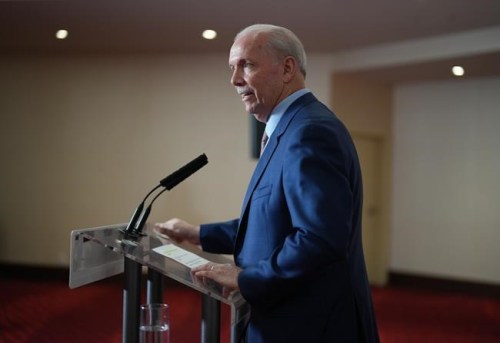
B.C. Premier John Horgan pauses after announcing he will not run in the next provincial election during a news conference in Vancouver, on Tuesday, June 28, 2022. A group representing emergency room doctors across the country has a message for Canada's premiers: come up with a co-ordinated plan to prevent their workplaces from being closed due to staffing shortages that are creating an unprecedented crisis in health care. THE CANADIAN PRESS/Darryl Dyck

One of the biggest gaps in the health-care system is the lack of nurses, said Kapur, an ER doctor in Ottawa.

“We recognize that our nursing colleagues are vital, that in (emergency) especially, the stresses on them are even more than they are on us because they bear more of the brunt of patient and family anger than we do.”

A lack of nurses on wards means patients who have been admitted to hospital languish in emergency departments, leaving fewer beds available for those stuck in waiting rooms, including people who don’t have a family doctor, Kapur said.

Data from the Canadian Institute for Health Information shows admitted patients across Canada waited 38.3 hours in emergency rooms in 2019-2020, up from 29.3 hours five years earlier. The total number of visits spiked to nearly 1.6 million during that time, up from just over 1.1 million.

The figures apply to 90 per cent of patients, and Kapur said 10 per cent waited even longer.

British Columbia Premier John Horgan, chair of the Council of the Federation made up of the country’s 13 premiers, has joined his colleagues to call on the federal government to increase its share of health-care spending from 22 to 35 per cent as they try to implement initiatives aimed at improving the system.

Horgan said he met with Justin Trudeau last November when the prime minister visited British Columbia following catastrophic floods. He said he told Trudeau about the premiers’ concerns regarding health costs, which will be discussed at their first in-person meeting in three years.

Trudeau committed to assembling a team to work on health funding, but that has not yet materialized, Horgan said in an interview.

“Eight months of what I thought was going to be a concerted effort has produced nothing other than a meeting in Victoria where all of us will gather to express our profound disappointment at the lack of leadership from Ottawa,” he said.

Trudeau has said the federal share of spending on health-care transfers would be negotiated after the COVID-19 pandemic winds down.

Horgan, who criticized April’s federal budget for not including health funding, said he and his colleagues are ready to address Ottawa’s expectations of any accountability measures that would come with more money.

But premiers first need to know what types of “strings” will be attached to it, he said, adding national solutions are needed to deal with problems plaguing provinces and territories.

But Horgan suggested he was not in favour of jurisdictions working together to nationally license health-care professionals, allowing them to work anywhere in the country, because that would amount to “poaching” people after their training has been paid for.

Ontario Premier Doug Ford said his province has an ambitious plan to rebuild its health-care system, and the federal government can help by paying its fair share of health funding.

“The premiers have been asking the federal government to come to the table and be a true funding partner,” he said in a written statement.

Alberta Premier Jason Kenney said that when universal health care was implemented in Canada, it was envisioned as a 50-per-cent split between the federal and provincial governments.

“COVID-19 showed the weaknesses in Canada’s health-care system, and we need to address those weaknesses for Canadians,” he said in a statement.

Dr. Katharine Smart, president of the Canadian Medical Association, said enabling health workers to be mobile would “alleviate pressure points” as part of one solution to increase resources where they’re needed.

“When a universal health system is not able to provide basic health care needs to Canadians, we must accept that it has failed and work together to fix it,” she said in a release. “This will take more than simply investing more money.”

Linda Silas, president of the Canadian Federation of Nurses Unions, said some emergency and intensive care departments that would have been staffed by 20 nurses now have half that number.

Legislation in Ontario restricting wages has meant many nurses are leaving to work for agencies so they have flexible hours and a choice of employers, or they’re quitting the profession because of poor working conditions, Silas said.

“So, the message I’m trying to give to premiers is: I have never, in 30 years of union work, seen nurses so angry. And they’re a tough bunch.”

Some premiers have indicated they will focus on other priorities at the meeting.

Saskatchewan Premier Scott Moe said during a recent news conference he wants to address issues with Canada’s energy supply.

“The No. 1 ask would be to have a very serious look at the policy positions that the government of Canada is taking that are preventing … production of some of the most sustainable energy in the world,” Moe said.

Kenney said the premiers will also be discussing internal trade and how they can address the tens of billions of dollars in economic activity lost every year due to barriers put up by provinces.

Canada’s “historic labour shortage” is also a concern for Ford. Manitoba Premier Heather Stefanson echoed the sentiment, saying lower immigration during the pandemic has contributed to the problem.

“We need the federal government to work with us to tackle the labour shortfall to help ensure our economy remains strong during these challenging times,” Ford said in a statement.

This report by The Canadian Press was first published July 10, 2022.

— With files from Steve Lambert in Winnipeg and Colette Derworiz in Edmonton

Report Error Submit a Tip

More Stories

Letters, Oct. 31

6 minute read Yesterday at 2:01 AM CDT

Civic election a missed opportunity

The outcome of the latest municipal election in Winnipeg is nothing short of baffling. The decline of what was once a proud, beautiful prairie hub is impossible to ignore.

Winnipeg is rapidly sliding into a state of structural and social dilapidation, yet voters have inexplicably chosen to hand incumbent Mayor Scott Gillingham a second term. The decision smells of complacency, and sadly, it represents a massive missed opportunity for real urban renewal.

Walking through downtown Winnipeg today is an exercise in heartbreak. A city centre that should be a bustling economic and cultural core has instead transformed into an absolute eyesore. Encampments and tents are permitted to dot the heart of the city. Streets that used to thrive are now dominated by the tragic, visible reality of severe addiction, with individuals wandering and staggering through public spaces without adequate intervention or care.

Premiers want more federal money for health care

Camille Bains, The Canadian Press 6 minute read Preview

Premiers want more federal money for health care

Camille Bains, The Canadian Press 6 minute read Sunday, Jul. 10, 2022

A group representing emergency room doctors across the country has a message for Canada's premiers: come up with a co-ordinated plan to prevent their workplaces from being closed due to staffing shortages that are creating an unprecedented crisis in health care.

Dr. Atul Kapur, a spokesman for the Canadian Association of Emergency Physicians, said premiers gathering at a meeting in Victoria on Monday and Tuesday need to prioritize the recruitment and retention of health-care professionals, and not just in the short-term.

"We've been sounding the alarm about shortages of physicians and nurses for quite some time," Kapur said, adding the temporary closure of emergency rooms is particularly troubling in rural areas because the next closest ER is often far away.

One of the biggest gaps in the health-care system is the lack of nurses, said Kapur, an ER doctor in Ottawa.

Read
Sunday, Jul. 10, 2022

The long and winding road

Editorial 4 minute read Preview

The long and winding road

Editorial 4 minute read Yesterday at 2:01 AM CDT

As theatre goes, it sent a strong message.

Manitoba Premier Wab Kinew, standing in front of microphones and television cameras, holding up his Indigenous status card and saying that he didn’t feel Canada should have “a race-based form of identification in this country, but that is a reality,” adding that it was time to abolish the Indian Act.

“I think it’s time to abolish the Indian Act, get rid of the Indian Act, move past the Indian Act, and it needs to be done with First Nations people and First Nations governments, of course. I think it’s long overdue that we have a relationship with Indigenous Peoples in Canada that reflects who we are as Canadians today,” he said.

The Indian Act — the name alone suggests how out-dated and out of place the law has become. Originally dating from 1876, the law was put in place to “amend and consolidate the laws respecting Indians” and gave the Minister of the Interior the responsibility to “control and management of the reserves, lands, moneys and property of Indians in Canada.”

Read
Yesterday at 2:01 AM CDT

Court ruling concludes Canadian Wheat Board saga

Laura Rance-Unger 4 minute read Preview

Court ruling concludes Canadian Wheat Board saga

Laura Rance-Unger 4 minute read Yesterday at 2:01 AM CDT

It remains to be seen whether the recent court ruling in a lawsuit filed after Canadian Wheat Board’s dissolution in 2012 puts the whole debate to rest, as some no doubt hope.

But either way, the dust has settled on the post-CWB world. The sun still rises and a new generation of farmers on the land only knows by name an institution that for generations influenced every aspect of Prairie grain farming.

The first Rural Revival column I wrote for this newspaper more than 30 years ago was about a thousand farmers from Western Canada demonstrating in support of the Wheat Board. It was in the aftermath of the Western Grain Marketing Panel report, one of several efforts that eventually included a plebiscite to help the federal government decide what to do about a vocal minority of farmers who wanted marketing “freedom.”

The polls at the time suggested about two-thirds of farmers were comfortable enough with the single-desk system for food wheat and barley to keep it around. It served as a counterbalance to canola, which they sold on the open market. They essentially had a dual market.

Read
Yesterday at 2:01 AM CDT

Canada tops Dominican Republic in pre-qualifier

Jason Hills, The Canadian Press 4 minute read Preview

Canada tops Dominican Republic in pre-qualifier

Jason Hills, The Canadian Press 4 minute read Sunday, Nov. 17, 2019

EDMONTON - Canada's women's basketball team put its depth on display Sunday in a dominant 110-60 victory over the Dominican Republic in the final game of the FIBA Olympic pre-qualifying tournament.

All 12 players hit the scoresheet, including six in double digits, to help the Canadians finish 3-0 at the tournament and advance to the next Olympic qualifier in February.

Sami Hill led the way with 16 points, three rebounds, two assists and three steals, while 20-year-old Shaina Pellington recorded 14 points. Bridget Carleton and Jamie Scott had 13 points each and Ruth Hamblin had 11 points and five rebounds.

"We got to roll our whole lineups through, and it was fun when we got going," said Canada's coach Lisa Thomaidis. "It was nice to see different lineup contributing and building chemistry.

Read
Sunday, Nov. 17, 2019

Brandon manufacturer says Canadian steel in demand, but high costs, long delivery times hit hard

Gabrielle Piché 6 minute read Preview

Brandon manufacturer says Canadian steel in demand, but high costs, long delivery times hit hard

Gabrielle Piché 6 minute read Yesterday at 2:01 AM CDT

Something’s different in a Brandon plant.

Building envelope panels — or shells for homes and commercial buildings — keep being produced at Greenstone Building Products.

But the galvanized steel used by workers has been arriving later and the price is constantly increasing, according to company leadership.

“It’s just a little bit nerve-wracking for us to hear the opposite narrative,” said Tilda Fortier, Greenstone Building Products’ business manager.

Read
Yesterday at 2:01 AM CDT