Horgan urges federal government to carry half the health-care load as premiers meet
Advertisement
Read this article for free:
or
Already have an account? Log in here »
To continue reading, please subscribe:
Digital Subscription
One year of digital access for only $1.44 a week*
- Enjoy unlimited reading on winnipegfreepress.com
- Read the E-Edition, our digital replica newspaper
- Access News Break, our award-winning app
- Play interactive puzzles
*Billed as $5.77 plus GST every four weeks. After 52 weeks, price increases to the regular rate of $19.95 plus GST every four weeks. Offer available to new and qualified returning subscribers only. Cancel any time.
To continue reading, please subscribe:
Add Free Press access to your Brandon Sun subscription for only an additional
$1 for the first 4 weeks*
- Enjoy unlimited reading on winnipegfreepress.com
- Read the E-Edition, our digital replica newspaper
- Access News Break, our award-winning app
- Play interactive puzzles
*Your next Brandon Sun subscription payment will increase by $1.00 and you will be charged $17.95 plus GST for four weeks. After four weeks, your payment will increase to $24.95 plus GST every four weeks.
Read unlimited articles for free today:
or
Already have an account? Log in here »
Hey there, time traveller!
This article was published 11/07/2022 (1576 days ago), so information in it may no longer be current.
VICTORIA – Canada’s provinces and territories need a partner that will share half the financial load on the health-care system, which is buckling without stable, predictable and long-term funding, British Columbia Premier John Horgan said Monday.
The country’s 13 premiers began two days of meetings in Victoria with the primary topic of health-care funding as Canada eases out of the COVID-19 pandemic with a severe shortage of doctors, nurses and other health workers.
“We need to reimagine public health care in Canada,” said Horgan, who chairs the premiers’ Council of the Federation.
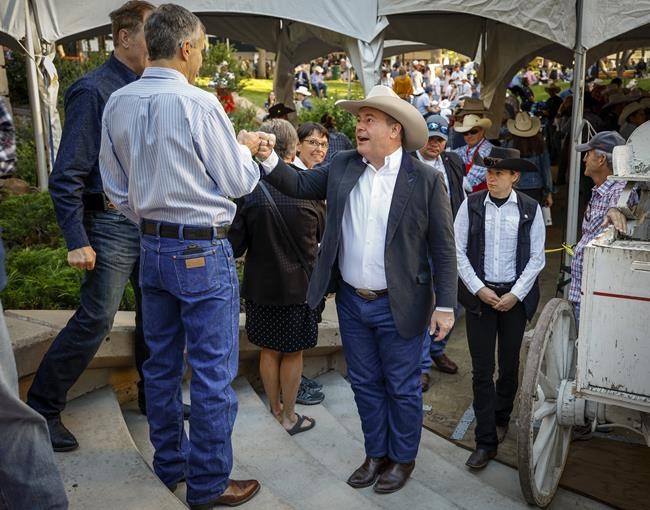
He said the premiers already sent the federal government a detailed funding proposal and they are waiting for a response.
Horgan received a text from Prime Minister Justin Trudeau on Monday saying Ottawa is aware of the funding situation and “they’ve been working on it,” he said.
“But we can’t determine what we’re going to do with money we don’t have,” he said.
“And we can go a lot further if we had a partner that was carrying half the load.”
Horgan told a news conference that the history of health-care funding in Canada was one of “dual responsibility” before cuts began in the 1990s.
“That has diminished over decades. This is not at the feet of the current Trudeau administration,” he added.
Successive federal governments have provided one-time funding to address immediate health-care needs, and that approach isn’t working, Horgan said, adding stable funding is needed.
“Once those temporary, part-time, once-only funding pots empty, we have a void, which then is inevitably filled by the jurisdictions that are providing the services,” Horgan said of the provinces and territories.
The premiers have called on Ottawa to increase health funding to 35 per cent, from what they have said currently amounts to 22 per cent.
Stable funding would allow provinces and territories to invest in a human resource strategy, so they aren’t “poaching” from each other as they train the next generation of health-care workers to take the burden off those who were celebrated in the early days of the pandemic, Horgan said.
“It’s just not good enough to show our gratitude. We need to now show we’re committed to those workers, those patients, and that’s what these discussions are about this afternoon and into tomorrow,” he said.
Canadian nursing leaders also met with premiers earlier Monday with a message that nurses are suffering through a “dire staffing crisis” that threatens the sustainability of public health care.
Referencing that meeting, Horgan said people working in the health-care system are “strained beyond belief.”
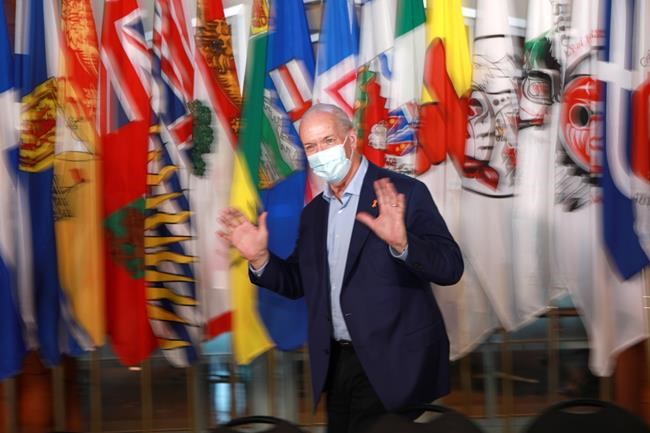
A statement from Linda Silas, president of the Canadian Federation of Nurses Unions, said the system is “on the brink of disaster.”
Silas said nurses have been “struggling through extreme staffing shortages, forced overtime and cancelled vacations, with no end in sight” to untenable conditions.
The federation said its proposals focus on retaining nurses, encouraging them to return to the profession and adding measures to recruit and train more of them.
Silas said provincial commitments to strengthen health care are welcome, but “no one province or territory can solve this on their own,” and federal funding will be key.

Premiers also met with leaders of the National Indigenous Organizations, made up of the Assembly of First Nations, Congress of Aboriginal Peoples, Inuit Tapiriit Kanatami, Métis National Council and the Native Women’s Association of Canada.
Horgan said they discussed issues including land claims, reconciliation, child welfare, missing and murdered Indigenous women and the “archaic” Indian Act, saying it was introduced when residential school policies were being implemented.
He said they also talked about the United Nations Declaration on the Rights of Indigenous Peoples, which the B.C. government is in the process of implementing. Ottawa has also pledged to implement the declaration, and Assembly of First Nations B.C. Regional Chief Terry Teegee called for a first ministers meeting within the next year to focus on how to adopt it across all levels of Canadian governments.
Horgan was also asked about how the premiers plan to manage rising inflation and said they will be discussing “best practices” from their jurisdictions to help reduce costs for the public and protect them from “seismic issues” affecting the global economy, including the pandemic and Vladimir Putin’s invasion of Ukraine.
This report by The Canadian Press was first published July 11, 2022.
Related Articles
Premiers want more federal money for health care

Advertisement Advertise With Us
Advertisement Advertise With Us