Faith

Faith

Growth in number of people with dementia challenges faith groups

John Longhurst 5 minute read Saturday, Jul. 11, 2026

There are over 770,000 people in Canada today living with dementia. By 2030, that number could be more than a million — a “tsunami” of dementia cases, according to Hope for Dementia, a Canadian advocacy organization.

“Current trends in growth of the number of people affected by dementia present an unsustainable trajectory,” the organization states, adding the cost of dementia care will rise from $12 billion in 2020 to $16.6 billion by 2031.

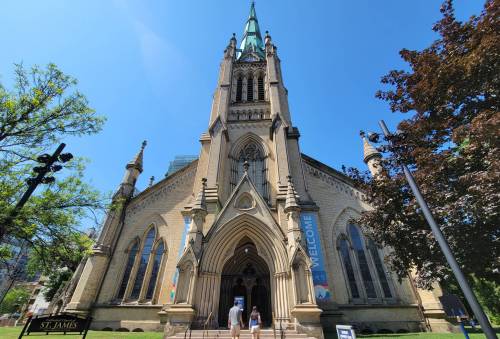
For Canadian society as a whole, it’s going to be a huge challenge. But it’s also challenging for faith groups — especially those Christian denominations that have large numbers of older members. They will be on the frontline of the increase in the numbers of people with cognitive impairment.

How can they respond? One organization that can help is the Alzheimer Society, through its Dementia Friendly Communities program.

Advertisement

Advertise With Us

Weather

Jul. 15, 12 PM: 20°c Cloudy Jul. 15, 6 PM: 19°c Cloudy

Winnipeg MB

21°C, Cloudy

Full Forecast

Faith

Medical student association formed in response to antisemitism

Sharon Chisvin 5 minute read Preview

Medical student association formed in response to antisemitism

Sharon Chisvin 5 minute read Saturday, Jul. 11, 2026

Eighty years ago, after months of intensive research, analysis and interviews, a group of Jewish students at the University of Manitoba proved what had been suspected for years — the university’s faculty of medicine had a quota system in place that was restricting entry to Jewish applicants.

Once publicly revealed and condemned, that quota system was quickly revoked, and in the ensuing decades hundreds of Jewish students have passed through the halls of the medical college , graduated as physicians, pursued careers in an array of medical fields, and contributed significantly to the practice of medicine in Manitoba.

Graduates of the college include Dr. Arnold Naimark, who later served as the dean of the faculty of medicine and as U of M president and vice-chancellor, and Dr. Max Rady, an early 20th-century graduate, for whom the Winnipeg medical school is now named.

Thirty-year-old Tim Rozovsky was just a first-year student at the Max Rady College of Medicine last fall, when he determined that it was time for Jewish medical students to organize once again. He was aware that there already existed several student groups associated with the faculty, including a Christian one and a Muslim one, but to his knowledge there hadn’t been a viable Jewish group since the days of the quota.

Read
Saturday, Jul. 11, 2026

Faith

Churches face challenges but hope remains, meeting hears

John Longhurst 5 minute read Preview

Churches face challenges but hope remains, meeting hears

John Longhurst 5 minute read Saturday, Jul. 4, 2026

What is the future of the Christian presence in Canada? That was the topic of discussion in May when representatives from various Canadian Protestant denominations met in Winnipeg.

The meeting, which brought together leaders from the United, Presbyterian, Lutheran, Salvation Army, Anglican, Christian Reformed and Disciples of Christ, was organized under the auspices of the Canadian Council of Churches.

The idea for the meeting came from the United Church of Canada, which has been researching the challenges facing its congregations across Canada.

Using its own statistics, along with information from other sources, the denomination identified a number of churches in rural Canada, especially in the west, that have no neighbouring United Church closer than 50 kilometres away. At the same time, they ascertained how many of those churches are struggling, which ones are thriving and those that could go either way — giving them a red, yellow or green score.

Read
Saturday, Jul. 4, 2026

Faith

Archdiocese of Winnipeg funding multiple projects in reconciliation efforts with Indigenous Peoples

Josiah Neufeld 4 minute read Preview

Archdiocese of Winnipeg funding multiple projects in reconciliation efforts with Indigenous Peoples

Josiah Neufeld 4 minute read Thursday, Jul. 2, 2026

About 100 kilometres north of Winnipeg, on the eastern shores of Lake Winnipeg, a village is being built where Indigenous girls, women and two-spirit people will be able to heal from the trauma of sexual exploitation within a supportive community guided by Indigenous matriarchs.

“Our philosophy is that you have to have long-term healing to deal with all the intergenerational trauma that got you to that point,” said Jamie Goulet, executive director of the Clan Mothers Healing Village and Knowledge Centre. “Our programming is quite different than any other model.”

That model is based on traditional knowledge and designed by Indigenous women who’ve been working with exploited Indigenous women, girls and two-spirit people for decades.

The workers constructing the village, which is expected to be finished in the fall, are women enrolled in the program and employed by a construction company the Healing Village, which operates as a social enterprise.

Read
Thursday, Jul. 2, 2026

Faith

Israel moves to formally recognize Armenian WWI deaths as a genocide

The Associated Press 3 minute read Sunday, Jun. 28, 2026

TEL AVIV, Israel (AP) — Israel’s Cabinet unanimously approved a proposal on Sunday to designate violence against Armenians by the Ottoman Empire during World War I as a genocide.

The step, which still needs approval in Parliament, reflects deteriorating ties between Israel and Turkey. Turkey has fiercely lobbied to prevent countries from officially recognizing the mass deaths of Armenians around 1915 as a genocide, even as Armenians have pushed for it.

Historians estimate that up to 1.5 million Armenians were killed by Ottoman Turks around the time of World War I, an event widely viewed by scholars as the first genocide of the 20th century. Turkey denies that the deaths constituted genocide, saying the toll has been inflated and that those killed were victims of civil war and unrest.

For years, Israel never officially broached the subject for fear of angering Turkey, but that relationship has soured over the past two decades, especially as the most recent wars in Gaza, Lebanon and Iran have dragged on.

Faith

What a time change could mean for religious practices

John Longhurst 5 minute read Saturday, Jun. 27, 2026

Manitobans are being asked if they want to end seasonal time changes by making either standard or daylight savings time permanent in the province.

So far, three-quarters of those who answered a survey by Winnipeg-based Prairie Research Associates support an end to seasonal time changes. Of those, 34 per cent prefer a move to permanent daylight time — which means the sun would rise and set later each day.

Eighteen per cent prefer standard time, while 21 per cent just want the province to choose one time or another.

Talk about time change got me thinking about how such a change could impact religious groups.

Faith

Rituals of ceremonies the cornerstone of Hindu weddings

Romona Goomansingh 8 minute read Preview

Rituals of ceremonies the cornerstone of Hindu weddings

Romona Goomansingh 8 minute read Saturday, Jun. 27, 2026

Taking place over three to five days, a Hindu wedding is steeped in timeless traditions and curated customs.

While the grandeur of Hindu weddings strikes stunning notes, the rituals of the ceremonies remain the cornerstone of the celebration. The rituals are sacred offerings to seek blessings from the Divine and family and friends for the bride and groom to have a healthy and happy life.

Deeply anchored to the wedding rituals, called shaadi ki rasmein, is the role of family members. In Indian culture, it is believed that a wedding is an alliance of two families, not only an alliance of two people. Dates for the wedding ceremonies are sought by a Hindu priest who reads the bride and groom’s horoscope, or kundali to determine the auspicious time, or muhurat for the celebrations. Parents of both sides are consulted in this special first step.

While some wedding rituals are common across different regions of India, others are unique to a particular region. Among Indo- Caribbeans of the Hindu faith, wedding rituals vary. One of these cherished rituals is the Maticoor, or Matkor ceremony, which symbolizes that by expressing gratitude to Mother Earth, the lives of the new couple will be happy and harmonious.

Read
Saturday, Jun. 27, 2026

Faith

Daycare, community hub answer to church’s prayers

Josiah Neufeld 4 minute read Preview

Daycare, community hub answer to church’s prayers

Josiah Neufeld 4 minute read Tuesday, Jun. 23, 2026

A dwindling congregation that owns a red brick church building in South Osborne has found a creative way to keep its doors open while meeting a vital need in the neighbourhood.

If all goes according to plan, the sanctuary of Churchill Park United Church will be echoing with the cries and laughter of children by next fall.

The $4.4-million construction project will transform the main floor of the church, at the corner of Beresford Avenue and Nassau Street, into a 112-space daycare centre, while the second floor will become a community hub with meeting space for congregants and other community groups.

A few years ago, the aging congregation — which averaged 30 or 40 people on a Sunday — came to the painful conclusion that they wouldn’t be able to keep managing their building much longer.

Read
Tuesday, Jun. 23, 2026

Faith

History of Doctrine of Discovery is complicated

John Longhurst 5 minute read Saturday, Jun. 20, 2026

Graydon Nicholas, a retired lawyer, judge and an elder from the Wolastoqey First Nation in New Brunswick, understands only too well the negative impact of colonization on Indigenous people in the Americas.

He also understands the role the Roman Catholic Church played in it through what became known as the Doctrine of Discovery — the idea that by “discovering” the Americas, colonizing countries like Spain and Portugal could claim Indigenous land as their own.

But Nicholas, who is Roman Catholic, also believes the story is more complicated than most people realize and also incomplete without noting opposition from those in the Church during that age of discovery and conquest.

That includes Dominican priests such as Antonio de Montesinos, who publicly condemned Spanish and Portuguese abuses against Indigenous people in the Americas during that time.

Faith

Conference focuses on addressing antisemitism

Sharon Chisvin 5 minute read Saturday, Jun. 20, 2026

Due to unprecedented levels of antisemitism in Canada in the last few years, most organizers of Jewish community events, in Winnipeg as elsewhere across the country, no longer publicly advertise the location of those events, choosing instead to share that information only with those who are registered in advance and, in some cases, only to those who provide proof of identification.

The fact that the organizers of a conference entitled Faith Not Fear still felt the need to follow that practice is less ironic than it is pragmatic. Not publicly identifying the conference’s location seemed to be the only way to ensure that its participants could safely meet to learn about protecting themselves, their community institutions and their freedom to walk through university campuses and city streets without being harassed because of their religion, culture or an international conflict in which they play no part.

Faith Not Fear: Building Jewish Leadership for a New Era in Canada took place in Vaughan, Ont., on the evening of Sunday, June 14. It was, as Simon Wolle, CEO of conference co-sponsor B’nai Brith Canada, explains, “a fresh initiative bringing together voices and organizations at a time when there is a national crisis of antisemitism.”

“The conference was inspired by the need to address Canada’s systemic failure to address threats to the Jewish community, the ongoing threat to Canadian values and its effect on the lived experience of Jewish Canadians in particular,” Wolle said.

Faith

Church archivists swamped with requests for docs

John Longhurst 5 minute read Saturday, Jun. 13, 2026

There’s a rule in nature that you can’t only do one thing. If you dam a river to make hydroelectricity, you will impede the fish trying to swim upriver to spawn. If you drain wetlands, flooding usually increases elsewhere. If you remove trees from steep slopes, erosion results.

In December, last year, Canada experienced the truth of that rule in another way. That’s when Parliament passed Bill C-3 to extend citizenship to those born outside of Canada.

The new rules retroactively restore Canadian citizenship to someone who was born outside of Canada before December 15, 2025 and who can prove that an ancestor, such as grandparent or great-grandparent, was a Canadian citizen on or after January 1, 1947.

Called the Act to Amend the Citizenship Act, the bill was designed to fix a problem that arose after an Ontario court ruled the “first-generation limit” on citizenship was unconstitutional.

Faith

Winkler hosts first LGBTTQ+ celebration Saturday

Josiah Neufeld 6 minute read Preview

Winkler hosts first LGBTTQ+ celebration Saturday

Josiah Neufeld 6 minute read Friday, Jun. 12, 2026

Sebastian Sanders is both excited and nervous about returning to Winkler to tell his story at his hometown’s first Pride event.

To get through his anxiety, he imagines a younger version of himself in the audience. “I’m just imagining that kid being like: ‘Oh, I can be happy and healthy and be myself and find community and be OK,’” he says.

Growing up attending church in Winkler, Sanders internalized a lot of homophobia and transphobia. “I was indoctrinated to believe I was a giant abomination,” he says. At times he thought about taking his own life.

Sanders was diagnosed with cancer when he was 19. The experience forced him to ask himself hard questions. When he finished chemotherapy, he told his family and friends he was queer. “I was ostracized by most of the people around me,” he says.

Read
Friday, Jun. 12, 2026

Faith

Bishop of the Arctic: Christopher Williams immersed himself in northern culture

Aastha Sethi 7 minute read Preview

Bishop of the Arctic: Christopher Williams immersed himself in northern culture

Aastha Sethi 7 minute read Saturday, Jun. 6, 2026

Born on May 22, 1936, in Sale, England, John Christopher Richard Williams arrived in Kugluktuk in 1960 at the age of 24.

His journey north began with what his son Drew described as a chance encounter in a student dormitory room, when he came across a handmade ceramic coin bank shaped like an igloo — a fundraising display for the Diocese of the Arctic.

Williams’ decision to ask what the coin bank was, Drew said, “ended up being either the stupidest or most significant question he would ever ask in his life.” That moment led to a deeper conversation about ministry in the North and the need for clergy in isolated communities.

Moving away from plans for a career in advertising, he instead immersed himself in northern culture, becoming fluent in Inuktitut and later working alongside colleagues to translate portions of the Old Testament, helping to make religious texts more accessible in the language.

Read
Saturday, Jun. 6, 2026

Faith

Kinew’s ‘Old Testament’ remark creates controversy

John Longhurst 5 minute read Saturday, Jun. 6, 2026

“As an observant Jew who was celebrating Shavuot, a holiday mentioned in the Hebrew Bible as a time of rejoicing, I was shocked to open my paper on Friday morning to see our premier indulging in an antisemitic Christian trope — apparently being tough on drug dealers is ‘Old Testament,’ and having love and compassion for drug users is ‘New Testament’?”

That’s what a writer of a letter to the editor of the Free Press said last week. He was writing in response to a remark made by premier Wab Kinew about his approach to drug dealers and drug users in the province.

At an event on May 21, Kinew said Manitoba’s stance would be “Old Testament for the drug dealers, New Testament for the drug users.”

By that he meant there will be “harm reduction and compassion and recovery” for users, but “law enforcement” for those who deal drugs.

Faith

Religion on census needs a rework, group says

John Longhurst 5 minute read Preview

Religion on census needs a rework, group says

John Longhurst 5 minute read Saturday, May. 30, 2026

Did you get the long form of the census? If you did, then you are among the 25 per cent of Canadians who had a chance to tell the government about your religious identity.

The federal government has been collecting information about religion in Canada since 1871; it’s one of the oldest efforts to track religion in the world.

Since that time, the religious landscape in Canada has changed a lot. Up until the 1960s, the country was mainly Christian, with small numbers of Jewish, Muslim, Hindu, Sikh and Buddhist Canadians.

The 2026 census lists over 200 religious groups, just over half of them Protestant and Catholic. The rest are from a wide variety of other religious traditions, including six streams of Buddhism, 10 different Jewish groups, seven kinds of Islam and five different forms of Indigenous spirituality. People can also choose from Wiccan, Satanist, Rastafarian and New Age groups, among others.

Read
Saturday, May. 30, 2026

Faith

CMU choir brings community together to raise voices for peace

Sharon Chisvin 4 minute read Saturday, May. 30, 2026

Decades have passed since We Shall Overcome was deemed the unofficial anthem of the American civil rights and anti-war movements, but the folk song — originally a gospel spiritual — remains as relevant today, and as frequently sung, as it was back in the 1960s. In the last few months alone, the song’s lyrics have loudly echoed through the crowds at non-violent rallies, protests and sit-ins around the world, and been performed onstage by renowned artists, social activists and community choirs.

One of those community choirs is the Canadian Mennonite University’s (CMU) Voices for Peace. Voices for Peace was launched in March 2026 as an extension of the Anabaptist university’s Singing Resistance program. That program had brought like-minded voices together earlier in the winter to sing in solidarity with those being affected by the ICE raids in Minneapolis.

“We started getting questions about how this work might extend to community protests,” says Anneli Loepp Thiessen, an assistant professor of music at the university and one of the choir co-ordinators. “So we began Voices for Peace as a mobile, rapid-response group that can share music for peace at protests or other community events.”

The mobile, rapid-response nature of the group means that it is not a traditional or typical choir.

LOAD MORE FAITH ARTICLES