‘A little bit scary for everybody’: Air passengers wary as new rules take effect

Advertisement

Advertise with us

MONTREAL - As Canada's two largest airlines move to end so-called seat distancing, travellers have mixed feelings about stepping on board an aircraft in the age of COVID-19.

Read this article for free:


or

Already have an account? Log in here »

To continue reading, please subscribe:

Subscribe and receive a limited-edition Free Press branded hat or tote.

Digital Subscription

One year of digital access for only $205*

  • Enjoy unlimited reading on winnipegfreepress.com
  • Read the E-Edition, our digital replica newspaper
  • Access News Break, our award-winning app
  • Play interactive puzzles

*First annual payment billed as $205.00 + GST for one year. This annual subscription will automatically renew at $233.00 + GST every 52 weeks (10% off the regular annual price of $259.35). Offer available to new and qualified returning subscribers only. Cancel any time.

To continue reading, please subscribe:

Add Free Press access to your Brandon Sun subscription for only an additional

$1 for the first 4 weeks*

  • Enjoy unlimited reading on winnipegfreepress.com
  • Read the E-Edition, our digital replica newspaper
  • Access News Break, our award-winning app
  • Play interactive puzzles
Start now

*Your next Brandon Sun subscription payment will increase by $1.00 and you will be charged $17.95 plus GST for four weeks. After four weeks, your payment will increase to $24.95 plus GST every four weeks.

Hey there, time traveller!
This article was published 30/06/2020 (2285 days ago), so information in it may no longer be current.

MONTREAL – As Canada’s two largest airlines move to end so-called seat distancing, travellers have mixed feelings about stepping on board an aircraft in the age of COVID-19.

Starting on Canada Day, Air Canada and WestJet will resume the sale of adjacent seats, which they had largely blocked to help prevent viral spread.

Canada’s public health officer has expressed reservations about the practice, though it is permitted under federal transportation rules.
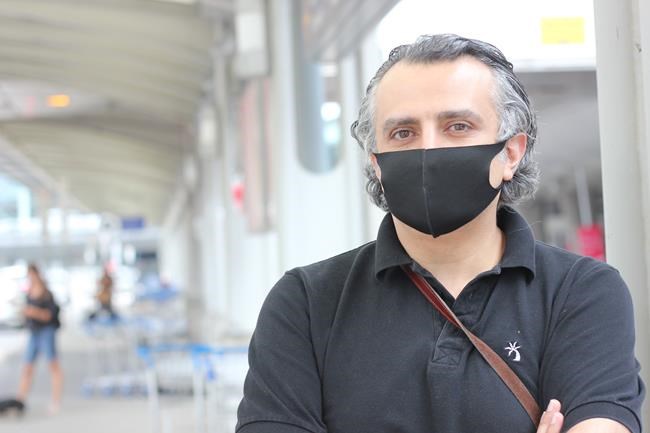
Air passenger Karen Kabiri is shown at Pierre Trudeau International Airport in Montreal, Monday, June 29, 2020. One day before Canada's two largest airlines end so-called seat distancing, travellers have mixed feelings about stepping on board an aircraft in the age of COVID-19. Starting on Canada Day, Air Canada and WestJet will resume the sale of adjacent seats, which they had largely blocked to help prevent viral spread. THE CANADIAN PRESS/Christopher Reynolds

“We really feel it is important to avoid the close physical contact as much as possible. And if not, wear the medical mask,” Dr. Theresa Tam said Monday.

Masks or face coverings have been mandatory on flights since April 20.

Even so, “there are some difficult decisions for travellers, for sure,” Tam added, saying individuals should assess their own risk levels and need to fly.

Karen Kabiri took his first plane trip in five years on Monday after learning his mother had died in Iran the day before — just 20 days after his father.

“It’s very, very hard for us. That’s why I’m going there right now, to help my sister,” said Kabiri, 44.

The piano teacher from Toronto, who stopped over in Montreal before continuing on to Tehran via Qatar to help with funeral arrangements, spent several hours outside the terminal at Trudeau airport with his other sister, who lives in the area but could not make the trip. Enduring a light drizzle, the siblings adhered to Transport Canada rules that prevent anyone but staff and passengers from entering airports.

Kabiri said he had concerns about stepping into a packed cabin, though he credited Air Canada for providing all passengers with a mask, gloves, disinfectant wipes and a water bottle.

“It’s a little bit scary for everybody. You can see many people are affected by COVID-19,” he said. “It’s very hard for everybody in these situations to travel. But sometimes an emergency is happening.”

Claire Parois and her five-year-old daughter climbed aboard a Monday flight bound for her home country of France to join her parents after receiving approval to continue telecommuting until late August.

“We decided to spend the rest of the summer at my parents’ house where I don’t have to do the full-time parenting and full-time working at the same time, which I’ve been doing in the past 15 or 16 weeks,” said Parois, who works for the United Nations in Montreal. “It’s been really, really, really challenging.

“My main concern would be to get infected and then infect my parents. Otherwise I’m not too worried,” she said.

With Canada’s border still closed to nearly all non-residents, international travel has barely budged since dropping by more than 95 per cent year over year in April. However, domestic travel is expected to edge up in the coming weeks and months as interprovincial restrictions loosen and the economy continues to reopen.

Anthony Morgan, who works on a Great Lakes bulk carrier, said he has a harder time with pandemic protocols on the water than in the sky. Until Monday, the 39-year-old wheelsman hadn’t stepped off the boat in three months.

“It’s like almost pulling your head off and bootin’ it over the side,” he said of being confined to the freighter.

“But flying home I definitely don’t feel like I got any concerns.”

Morgan took off Monday for St. John’s, Nfld. and plans to spend his month of downtime close to home in his outport community near the provincial capital. That includes two weeks of self-isolation after landing.

The sudden return of middle-seat sales is not unique to Canadian carriers.

Michelline Nesrallah said there was no distancing on her packed Qatar Airways flight back to Canada.

“There was no temperature screening when we got into the Qatari airport,” added the 39-year-old teacher who moved back to Ottawa this week after spending most of the past 14 years in the Gulf state.

“People aren’t really taking it as seriously as they should,” she said. “I was standing at the baggage counter and this woman was literally touching me with her arm. And I said, ‘Sister, you have to stand back.’

Transport Canada listed physical distancing among the “key points” in preventing the spread of the virus, part of a guide it issued to the aviation industry in April.

“Operators should develop guidance for spacing passengers aboard aircraft when possible to optimize social distancing,” the document states.

Some health experts have highlighted the risks of spreading COVID in crowded airports and sardine-tin cabins.

“Once it’s in the cabin, it’s difficult to stop air moving around,” Tim Sly, an epidemiologist and professor emeritus at Ryerson University’s School of Public Health, said in a recent interview.

However Joseph Allen, director of the Harvard public health school’s Healthy Buildings program, has said the HEPA air filters used on most planes effectively control airborne bacteria and viruses.

In line with federal directives, Air Canada and WestJet conduct pre-boarding temperature checks and require masks on board.

Both airlines also implemented enhanced aircraft cleaning and scaled back their in-flight service in late March, cutting out hot drinks, hot meals and fresh food.

This report by The Canadian Press was first published June 30, 2020.

Companies in this story: (TSX:AC)

Report Error Submit a Tip

More Stories

Health minister warns $1.2 billion in annual federal funding set to expire in March

Scott Billeck 4 minute read Preview

Health minister warns $1.2 billion in annual federal funding set to expire in March

Scott Billeck 4 minute read 6:58 PM CDT

Manitoba’s health minister is warning of possible cuts to health care with $1.2 billion in annual funding from Ottawa set to expire next year.

“We’re very concerned that what would be the largest cut to health care in a generation is right in front of us,” Health Minister Uzoma Asagwara said Thursday at the Manitoba legislature. “It means that services that Manitobans depend on will be in jeopardy and be at risk.

“Any reductions, any cuts from Canada, will have direct impacts on the health outcomes of Manitobans.”

Asagwara, who serves as the provincial and territorial health minister lead, chaired a meeting Monday with provincial and territorial health ministers to discuss federal funding for health care, mental health care and substance use services, which is scheduled to expire March 31, 2027.

Read
6:58 PM CDT

Pimicikamak FN locked down, police hunt for suspect after fatal shooting

By Zoe Pierce 3 minute read Preview

Pimicikamak FN locked down, police hunt for suspect after fatal shooting

By Zoe Pierce 3 minute read Saturday, Aug. 1, 2026

Pimicikamak Cree First Nation, also known as Cross Lake, remains under lockdown as RCMP Major Crime Services investigate a shooting that left a 42-year-old man dead.

RCMP said officers were notified by local First Nation Safety Officers at about 9:30 p.m. Friday about a seriously injured person on Main Road in the community. Officers found two males at the scene, including one with a gunshot wound.

The 42-year-old man was pronounced dead at the scene by EMS. The second male was not injured and did not require medical attention, police said.

Manitoba RCMP Major Crime Services, along with Cross Lake RCMP and Forensic Identification Services, are investigating. Police said the suspect is believed to be known to the person shot and may still be in the community.

Read
Saturday, Aug. 1, 2026

J’accuse!: Kinew uses French to fry interim Tory leader over alleged caucus subterfuge

Chris Kitching and Maggie Macintosh 4 minute read Preview

J’accuse!: Kinew uses French to fry interim Tory leader over alleged caucus subterfuge

Chris Kitching and Maggie Macintosh 4 minute read 5:55 PM CDT

NDP Premier Wab Kinew took a dig at the Progressive Conservatives’ leadership change while facing off with Obby Khan’s short-term replacement for the first time in question period Thursday.

It came after interim Tory leader Konrad Narth accused the New Democrats of failing to implement “stronger” bail reform and enforcement measures as promised.

“Now we see there is less crime in Manitoba than there was when the Progressive Conservatives were in government. What are they doing now? Well, they found knives and chased their old leader out,” Kinew said, speaking in French.

“We don’t even know who’s going to be the PC leader next month… next year? We don’t know. What we know is that we’re working on making communities safer.”

Read
5:55 PM CDT

Confidence vote was gamble for MLA, Tories: political expert

Alex Lambert 5 minute read Preview

Confidence vote was gamble for MLA, Tories: political expert

Alex Lambert 5 minute read 7:30 PM CDT

BRANDON — A Progressive Conservative MLA’s decision to put forward a confidence motion against the party’s former leader carries a lot of risk for her and the Tories, a political science expert says.

Obby Khan resigned as leader of the PCs on Monday after Jodie Byram (Agassiz) initiated a confidence vote against him the previous week.

The majority of the PC caucus voted in favour of Khan, but he resigned a few days later, citing continued efforts to undermine him by a minority of MLAs.

Brandon University political science Prof. Kelly Saunders said while she doesn’t know what Byram’s motivations were for triggering the vote, such a move carries a lot of risk.

Read
7:30 PM CDT

Robot study gives seniors say in era of AI

Conrad Sweatman 4 minute read Preview

Robot study gives seniors say in era of AI

Conrad Sweatman 4 minute read 8:15 PM CDT

It’s no longer the stuff of sci-fi: AI sidekicks that simulate emotional support and guide routines.

Robot companions are increasingly becoming part of everyday life for seniors, with certain U.S. states even subsidizing such devices for personal use through public health-care programs.

Among the many ethical questions this raises: what’s to be done with these robots, and all the secrets and personal data they carry, after the owner dies?

“We don’t know the answers. That’s why I’m running a study. It’s a participatory study with seniors,” said Clara Xie, a PhD student in computer science at the University of Calgary, who is conducting research at the University of Manitoba.

Read
8:15 PM CDT

Retirement has been a rocky road for Osmond

Lori Ewing, The Canadian Press 5 minute read Preview

Retirement has been a rocky road for Osmond

Lori Ewing, The Canadian Press 5 minute read Wednesday, Jan. 8, 2020

TORONTO - For the better part of two decades, Kaetlyn Osmond knew exactly what she'd be doing every day. Her world and her schedule revolved around figure skating.

The 24-year-old announced her retirement last May, and hasn't competed since winning gold at the 2018 world championships. And while she's completely at peace with her decision to walk away when she did, the months since haven't been all smooth sailing.

"It was a big change," Osmond said Wednesday. "Not having the rink to go to every day — the rink was a safe spot for me — skating was my job, it was my hobby, it was all my friends, it was just a great place for me to be. And I knew exactly what my purpose was every single day.

"Losing that was a lot harder than I was expecting it to be. I didn't have a team of 15 people telling me where to be and what to do, I had to figure that out on my own. And it felt like I had to grow up really quickly."

Read
Wednesday, Jan. 8, 2020