How risky is flying during the coronavirus pandemic?

Advertisement

Advertise with us

How risky is flying during the coronavirus pandemic?

Read this article for free:


or

Already have an account? Log in here »

To continue reading, please subscribe:

Subscribe and receive a limited-edition Free Press branded hat or tote.

Digital Subscription

One year of digital access for only $205*

  • Enjoy unlimited reading on winnipegfreepress.com
  • Read the E-Edition, our digital replica newspaper
  • Access News Break, our award-winning app
  • Play interactive puzzles

*First annual payment billed as $205.00 + GST for one year. This annual subscription will automatically renew at $233.00 + GST every 52 weeks (10% off the regular annual price of $259.35). Offer available to new and qualified returning subscribers only. Cancel any time.

To continue reading, please subscribe:

Add Free Press access to your Brandon Sun subscription for only an additional

$1 for the first 4 weeks*

  • Enjoy unlimited reading on winnipegfreepress.com
  • Read the E-Edition, our digital replica newspaper
  • Access News Break, our award-winning app
  • Play interactive puzzles
Start now

*Your next Brandon Sun subscription payment will increase by $1.00 and you will be charged $17.95 plus GST for four weeks. After four weeks, your payment will increase to $24.95 plus GST every four weeks.

Hey there, time traveller!
This article was published 30/06/2020 (2258 days ago), so information in it may no longer be current.

How risky is flying during the coronavirus pandemic?

Flying can increase your risk of exposure to infection, but airlines are taking some precautions and you can too.

Air travel means spending time in security lines and airport terminals, which puts you into close contact with other people. As travel slowly recovers, planes are becoming more crowded, which means you will likely sit close to other people, often for hours, which raises your risk.
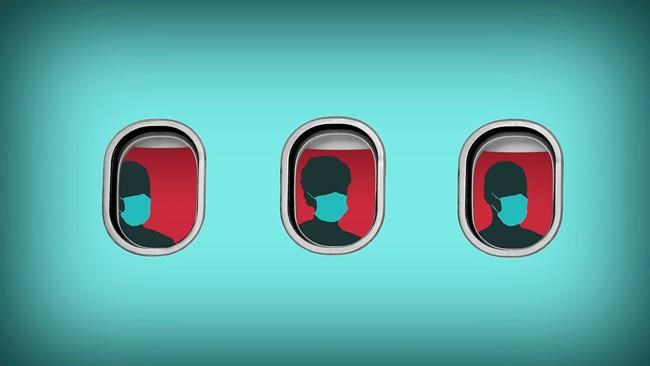
Illustration by Peter Hamlin.;

Once on a plane, most viruses and other germs don’t spread easily because of the way air circulates, according to the U.S. Centers for Disease Control and Prevention. Airlines also say they are focusing on sanitizing the hard surfaces that passengers commonly touch.

Some airlines like Alaska, Delta, JetBlue and Southwest are blocking middle seats or limiting capacity. But even if every middle seat is empty you will likely be closer than the recommended distance of 6 feet to another passenger now that planes are getting fuller.

American, United and Spirit are now booking flights to full capacity when they can. All leading U.S. airlines require passengers to wear masks. Lauren Ancel Meyers, an expert in disease outbreaks at the University of Texas, says that can help limit risk.

For air travel, and all other types of transportation, the CDC recommends washing your hands, maintaining social distancing and wearing face coverings.

Several airlines announced Monday that they will ask passengers about possible COVID-19 symptoms and whether they have been in contact with someone who tested positive for the virus in the previous two weeks.

Still, Meyers said you still might consider whether you need to be on that plane. “We should all be in the mindset of ‘only if necessary’ and always taking the most precautions we can to protect ourselves and others,” she said.

___

The AP is answering your questions about the coronavirus in this series. Submit them at: FactCheck@AP.org.

Read previous Viral Questions:

Who would be the first to get a COVID-19 vaccine?

Is it safe to form a COVID-19 “support bubble” with friends?

Is it safe to stay in hotels as reopenings get underway?

Report Error Submit a Tip

More Stories

Not a Donut takes the circular confection in an entirely different direction

Eva Wasney 4 minute read Preview

Not a Donut takes the circular confection in an entirely different direction

Eva Wasney 4 minute read Tuesday, Nov. 2, 2021

Let’s get one thing straight: Not A Donut does indeed serve doughnuts, just not the kind most North American fried dough connoisseurs are familiar with. The small shop on Langside Street specializes in mochi doughnuts, cute flower-shaped rings with a soft, chewy texture thanks to the addition of glutinous rice flour.

It’s a nostalgic dessert for owner Echo Shen.

“I tried it when I was back in Shanghai when I was little,” says Shen, who moved to Canada from China for school. “I had it for the first time and couldn’t forget it — it’s so good, it’s not like the regular doughnuts.”

Mochi doughnuts were popularized in Japan by the Mister Donuts chain, which calls them “pon de ring,” and have recently gained a following elsewhere. Shen and her boyfriend Mumu Ma, who co-owns the business, saw an opportunity with the growing trend.

Read
Tuesday, Nov. 2, 2021

Billboard evangelism may look outdated but group says it’s effective

John Longhurst 5 minute read Preview

Billboard evangelism may look outdated but group says it’s effective

John Longhurst 5 minute read 2:02 AM CDT

Maybe you’ve seen them in Winnipeg — billboards that say things like: “Jesus is alive!” “Are you prepared to meet Jesus?” “After you die, you will meet God.” They include a phone number to call: 844-FIND-TRUTH.

There are two billboards in Winnipeg. One is on Henderson Highway in Elmwood. The other is on Balmoral Street, by Cumberland.

Have you ever wondered who is behind them, and why they do it?

You might be surprised to learn they are created and sponsored by an Amish/Mennonite organization called Christian Aid Ministries (CAM). Based in rural Ontario, the group is funded by Amish and some conservative Mennonite denominations and individuals.

Read
2:02 AM CDT

Kittie Wong

2 minute read Preview

Kittie Wong

2 minute read Sunday, Aug. 14, 2022

Kittie Wong wears three different hats for the Winnipeg Free Press editorial department: page designer, picture editor and web editor.

Read
Sunday, Aug. 14, 2022

No end in sight to Ottawa’s pandemic spending

Temur Durrani 8 minute read Preview

No end in sight to Ottawa’s pandemic spending

Temur Durrani 8 minute read Monday, Nov. 30, 2020

A crucial caveat expected in Monday's fiscal statement from Ottawa failed to manifest: there is no end in sight to federal spending amidst the COVID-19 pandemic.

As Canada stares down a nearly $400-billion, record-high deficit for 2020, the Liberal government plans to spend up to $100 billion over the next three years, along with a further $25.1 billion in immediate measures to support workers and businesses affected by the novel coronavirus.

That's not all.

In a long-awaited speech from the House of Commons, Finance Minister Chrystia Freeland did not provide a spending cap to draw any red lines around the limit to which the feds will continue funnelling toward an economic recovery she acknowledged is still well-off the horizon.

Read
Monday, Nov. 30, 2020

Paper trail

Allison Gillmor closer look 4 minute read Preview

Paper trail

Allison Gillmor closer look 4 minute read 2:02 AM CDT

WHAT IT IS: Copy Paperis a 2014 textile-based piece by Ontario-born, Winnipeg-based artist Kristin Nelson, currently on view at WAG-Qaumajuq as part of the exhibition Terra Cognita/Incognita.

Of the 125 works in the show — which uses historical and contemporary pieces from WAG-Qaumajuq’s permanent collection to explore how artists have represented the landscape over time and across cultures —probably the most attention-getting are the beautiful paintings of Canada’s lakes, plains, forests and mountains.

So, how does this seemingly modest, somewhat enigmatic work connect to Terra Cognita/Incognita’s larger themes?

WHAT IT’S ABOUT: In the middle of the exhibition, an antique desk holds several objects of beauty and utility, and this is where Copy Paper sneaks in, as something both “cognita and incognita,” known and unknown.

Read
2:02 AM CDT

While the politicians talk, Bank of Canada aims to tame house prices with a dose of psychology

Star Editorial Board - , Toronto Star 4 minute read Preview

While the politicians talk, Bank of Canada aims to tame house prices with a dose of psychology

Star Editorial Board - , Toronto Star 4 minute read Thursday, Apr. 14, 2022

‘Any hope for bringing prices back to earth lies with those rising rates, rather than the flurry of words and actions we’ve seen in recent weeks from politicians at all levels.’

Read
Thursday, Apr. 14, 2022