Bibeau says Canada has enough food but COVID-19 will still bring challenges

Advertisement

Advertise with us

OTTAWA - Higher prices and less variety on store shelves is a possibility as the agriculture industry confronts a wide range of challenges created by COVID-19, the federal agriculture minister said Wednesday.

Read this article for free:


By clicking the button above, an account will be created and you will begin to receive some of our recommended newsletters. You may opt out of any newsletter by visiting your Email and Communication Preferences page or by clicking "unsubscribe" at the bottom of any email.

or

Already have an account? Log in here »

To continue reading, please subscribe:

Digital Subscription

One year of digital access for only $1.44 a week*

  • Enjoy unlimited reading on winnipegfreepress.com
  • Read the E-Edition, our digital replica newspaper
  • Access News Break, our award-winning app
  • Play interactive puzzles

*Billed as $5.77 plus GST every four weeks. After 52 weeks, price increases to the regular rate of $19.95 plus GST every four weeks. Offer available to new and qualified returning subscribers only. Cancel any time.

To continue reading, please subscribe:

Add Free Press access to your Brandon Sun subscription for only an additional

$1 for the first 4 weeks*

  • Enjoy unlimited reading on winnipegfreepress.com
  • Read the E-Edition, our digital replica newspaper
  • Access News Break, our award-winning app
  • Play interactive puzzles
Start now

*Your next Brandon Sun subscription payment will increase by $1.00 and you will be charged $17.95 plus GST for four weeks. After four weeks, your payment will increase to $24.95 plus GST every four weeks.

Hey there, time traveller!
This article was published 15/04/2020 (2391 days ago), so information in it may no longer be current.

OTTAWA – Higher prices and less variety on store shelves is a possibility as the agriculture industry confronts a wide range of challenges created by COVID-19, the federal agriculture minister said Wednesday.

Agriculture Minister Marie-Claude Bibeau said she’s confident the country has enough food and stopped short of suggesting Canadians start growing war-era “victory gardens” to supplement their own supplies.

But everything from a potential labour shortage on farms to COVID-19 outbreaks among workers at food processing plants will have an impact, she said.
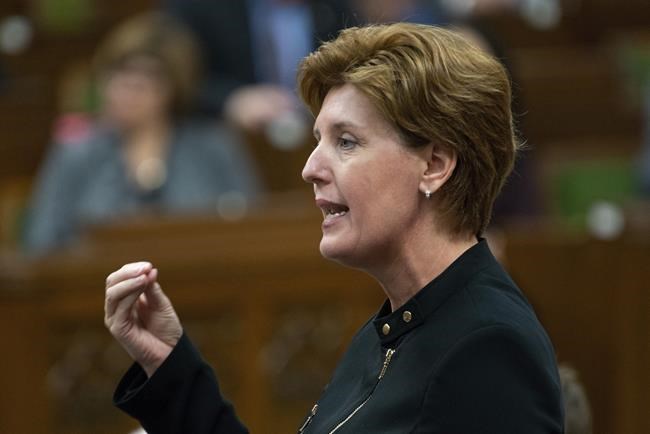
Agriculture Minister Marie-Claude Bibeau responds to a question during Question Period in the House of Commons, Monday April 29, 2019 in Ottawa. Bibeau is not worried about food shortages overall but acknowledging really challenges in the industry. THE CANADIAN PRESS/Adrian Wyld

“I think our system is strong enough and resilient enough that it will adapt, but these days it is particularly challenging,” Bibeau said during a video news conference Wednesday, where she fielded questions from her home in Sherbrooke, Que.

“I do not worry that we will not have enough food,” she added.

“But we might see some differences in the variety and, hopefully not, but maybe in the prices as well.”

The federal government has announced millions in new spending for farmers this week alone, including $20 million for the Canadian Food Inspection Agency so it can have enough inspectors on hand to carry out its work.

The funds are partially designed to guard against the potential for CFIA inspectors to be stricken with the virus and be unable to work, further slowing down an already struggling supply chain.

The other labour issue facing the industry is a farm worker shortage. Some 60,000 temporary foreign workers come to Canada annually to work on farms and in plants but border closures mean fewer are expected this year.

They are also required to quarantine for two weeks upon arrival, and this week, the federal government announced $1,500 per worker to help employers cover salary payments or revamp living quarters to ensure workers can abide by distancing protocols.

Checks on those measures will be carried out by local, provincial and federal authorities, Bibeau said.

Workers’ rights group Justicia for Migrant Workers has raised concerns the onus is actually being placed on workers — not their employers — to comply.

They cite a video being produced by the Ontario Provincial Police telling workers in Spanish what their obligations are, and say there are already efforts by communities to “name and shame” migrant labourers.

“We find it disconcerting that local community members are so concerned about migrant workers’ social distancing while in public, yet do not share the same concerns regarding the lack of protections and accommodations provided by the employer to ensure that migrant farm workers are able to socially distance in their workplace and home,” they said in a statement Wednesday.

The arrival of temporary foreign workers is being stymied by global travel restrictions, and what’s ordinarily an annual shortage of several thousand workers is likely to be made worse, Bibeau said.

The government is examining efforts to get unemployed or under-employed Canadians into jobs on farms, she said.

That’s despite the fact that the very reason the temporary foreign worker program exists is due to Canadians not wanting those jobs — and farmers don’t necessarily want to hire them either, as the work can require extensive training. Many workers return to the same area every year because they’ve developed a specific skill set.

“It’s a challenge, but we have to do even more to encourage them to join the industry,” Bibeau said of the workers the government hopes to recruit.

Another issue facing the sector is outbreaks in processing plants. An Olymel pork processing plant northeast of Montreal reopened this week after the spread of illness among its workers forced a two-week shutdown.

The Cargill Meat Solutions plant south of Calgary, which represents more than one-third of Canada’s beef-processing capacity, announced this week it is idling its second shift of workers.

The union representing those staff said there have been 38 cases of COVID-19 at the plant in High River, Alta.

Bibeau said she is reviewing a pitch by the cattle industry to help weather the crisis. The Canadian Cattlemen’s Association wants a federally co-ordinated “set-aside” program that would enable producers to keep their animals longer.

The program would slow down the supply chain because there’s not enough processing capacity, the group has said.

The Conservatives called Wednesday for Bibeau to immediately implement that program and be far more transparent about what else the government is examining.

“Farmers, producers and processors work hard day and night to ensure that Canadians have the food they need while they stay home,” three Conservative MPs who work on agriculture issues — John Barlow, Richard Lehoux and Lianne Rood — wrote in a letter to Bibeau.

“These hard-working Canadians need to know that their jobs will be safe during this pandemic and that they can continue to produce world class products.”

This report by The Canadian Press was first published April 15, 2020.

Report Error Submit a Tip

More Stories

B.C. declares state of emergency over wildfires

Amy Smart, The Canadian Press 5 minute read Preview

B.C. declares state of emergency over wildfires

Amy Smart, The Canadian Press 5 minute read Wednesday, Jul. 21, 2021

VANCOUVER - British Columbia's public safety minister has declared a provincial state of emergency over the growing wildfire threat to prepare for potential mass evacuations and help secure accommodation that might be needed by evacuees.

Mike Farnworth said he made the decision based on information from officials that weather conditions will lead to more severe fire behaviour and the potential for more evacuations.

"In a briefing last night, I received word that we'll be facing a few days of very difficult weather in the Interior," Farnworth said in a statement.

The state of emergency goes into effect on Wednesday and gives government agencies, the fire commissioner and the RCMP the authority to take whatever action they deem is necessary to fight the wildfires and protect people and communities.

Read
Wednesday, Jul. 21, 2021

RRC Polytech program cuts take bite out of hospitality, tourism sector

Maggie Macintosh 4 minute read Preview

RRC Polytech program cuts take bite out of hospitality, tourism sector

Maggie Macintosh 4 minute read Saturday, May. 2, 2026

Manitoba’s tourism industry is bracing for the disappearance of hospitality training programs — once-popular courses among international students.

Citing budgetary challenges related to a shift in federal immigration policy, Red River College Polytechnic is scrapping 11 programs and scaling back three others in 2026-27. Its hospitality business management diploma is one of seven permanent casualties.

The announcement, while unsurprising, is but the latest blow to a sector trying to “build back the workforce” in the wake of the COVID-19 pandemic, said Michael Juce, president of the Manitoba Hotel Association.

“Are people going to go outside of Manitoba for training? And if they leave, are they going to come back?” Juce said, adding that rural hotels in particular are already grappling with staffing shortages.

Read
Saturday, May. 2, 2026

Sharpton decries 'stench of racism' in Daunte Wright's death

Aaron Morrison, Tim Sullivan And Tammy Webber, The Associated Press 5 minute read Friday, Apr. 23, 2021

MINNEAPOLIS - Daunte Wright, the young Black man shot by an officer during a traffic stop in suburban Minneapolis, was not “just some kid with an air freshener,” but a “prince” whose life ended too soon at the hands of police, the Rev. Al Sharpton said Thursday during an emotional funeral.

Hundreds of people wearing COVID-19 masks packed into Shiloh Temple International Ministries to remember Wright, a 20-year-old father of one who was shot by a white police officer on April 11 in the small city of Brooklyn Center. The funeral was held just two days after former Minneapolis police Officer Derek Chauvin was convicted in the death of George Floyd and amid a national reckoning on racism and policing.

“The absence of justice is the absence of peace,” Sharpton said. “You can’t tell us to shut up and suffer. We must speak up when there is an injustice.”

The civil rights leader's thundering eulogy included a stinging rebuke of the possibility that Wright was pulled over for having air fresheners dangling from his mirror. Wright’s mother has said her son called her after he was stopped and told her that was the reason. Police said it was for expired registration.

The long and winding road

Editorial 4 minute read Preview

The long and winding road

Editorial 4 minute read Yesterday at 2:01 AM CDT

As theatre goes, it sent a strong message.

Manitoba Premier Wab Kinew, standing in front of microphones and television cameras, holding up his Indigenous status card and saying that he didn’t feel Canada should have “a race-based form of identification in this country, but that is a reality,” adding that it was time to abolish the Indian Act.

“I think it’s time to abolish the Indian Act, get rid of the Indian Act, move past the Indian Act, and it needs to be done with First Nations people and First Nations governments, of course. I think it’s long overdue that we have a relationship with Indigenous Peoples in Canada that reflects who we are as Canadians today,” he said.

The Indian Act — the name alone suggests how out-dated and out of place the law has become. Originally dating from 1876, the law was put in place to “amend and consolidate the laws respecting Indians” and gave the Minister of the Interior the responsibility to “control and management of the reserves, lands, moneys and property of Indians in Canada.”

Read
Yesterday at 2:01 AM CDT

Canada tops Dominican Republic in pre-qualifier

Jason Hills, The Canadian Press 4 minute read Preview

Canada tops Dominican Republic in pre-qualifier

Jason Hills, The Canadian Press 4 minute read Sunday, Nov. 17, 2019

EDMONTON - Canada's women's basketball team put its depth on display Sunday in a dominant 110-60 victory over the Dominican Republic in the final game of the FIBA Olympic pre-qualifying tournament.

All 12 players hit the scoresheet, including six in double digits, to help the Canadians finish 3-0 at the tournament and advance to the next Olympic qualifier in February.

Sami Hill led the way with 16 points, three rebounds, two assists and three steals, while 20-year-old Shaina Pellington recorded 14 points. Bridget Carleton and Jamie Scott had 13 points each and Ruth Hamblin had 11 points and five rebounds.

"We got to roll our whole lineups through, and it was fun when we got going," said Canada's coach Lisa Thomaidis. "It was nice to see different lineup contributing and building chemistry.

Read
Sunday, Nov. 17, 2019

Brandon manufacturer says Canadian steel in demand, but high costs, long delivery times hit hard

Gabrielle Piché 6 minute read Preview

Brandon manufacturer says Canadian steel in demand, but high costs, long delivery times hit hard

Gabrielle Piché 6 minute read Yesterday at 2:01 AM CDT

Something’s different in a Brandon plant.

Building envelope panels — or shells for homes and commercial buildings — keep being produced at Greenstone Building Products.

But the galvanized steel used by workers has been arriving later and the price is constantly increasing, according to company leadership.

“It’s just a little bit nerve-wracking for us to hear the opposite narrative,” said Tilda Fortier, Greenstone Building Products’ business manager.

Read
Yesterday at 2:01 AM CDT