Liberals ease access to emergency benefit as economy shrinks fast
Advertisement
Read this article for free:
or
Already have an account? Log in here »
To continue reading, please subscribe:
Digital Subscription
One year of digital access for only $1.44 a week*
- Enjoy unlimited reading on winnipegfreepress.com
- Read the E-Edition, our digital replica newspaper
- Access News Break, our award-winning app
- Play interactive puzzles
*Billed as $5.77 plus GST every four weeks. After 52 weeks, price increases to the regular rate of $19.95 plus GST every four weeks. Offer available to new and qualified returning subscribers only. Cancel any time.
To continue reading, please subscribe:
Add Free Press access to your Brandon Sun subscription for only an additional
$1 for the first 4 weeks*
- Enjoy unlimited reading on winnipegfreepress.com
- Read the E-Edition, our digital replica newspaper
- Access News Break, our award-winning app
- Play interactive puzzles
*Your next Brandon Sun subscription payment will increase by $1.00 and you will be charged $17.95 plus GST for four weeks. After four weeks, your payment will increase to $24.95 plus GST every four weeks.
Read unlimited articles for free today:
or
Already have an account? Log in here »
Hey there, time traveller!
This article was published 15/04/2020 (2390 days ago), so information in it may no longer be current.
OTTAWA – The federal government will expand its main relief program for people losing work because of COVID-19, Prime Minister Justin Trudeau announced Wednesday, just after Statistics Canada delivered a preliminary report that the economy contracted nine per cent in March alone.
The estimate, which is to be refined over time, would be the sharpest decline in the nearly 60 years the agency has kept such data.
What the economy will look like at the end of this quarter is uncertain, the Bank of Canada warned in a separate report, which shunned the central bank’s usual forecasts for growth, saying it would “false precision” to give one.
So Trudeau promised more government money for suffering workers, pledging to send benefits to seasonal workers without jobs, those who were jobless before the crisis and can’t find work because of it, and those whose hours have been drastically cut but who still have some income.
Those changes begin to address key concerns about who qualifies for the $2,000-a-month Canada Emergency Response Benefit, which was quickly put in place earlier this month to deal with the pandemic’s swift and harsh economic effects.
Some six million people have applied for the help since the middle of March, including over two million who were previously approved for employment insurance benefits. The remainder wouldn’t have qualified for EI under the terms of the program, so the Liberals launched the CERB.
The changes will also allow people who are making up to $1,000 a month to qualify for the benefit, as well as those whose EI benefits have run out since the start of the calendar year and who still can’t find work because of the pandemic. Seasonal workers whose EI is running out and have seen their job offers yanked will also qualify.
Conservative employment critic Dan Albas warned the changes are likely to require parliamentary approval, meaning a small group of MPs and senators would have to come to Ottawa to vote on the measure.
Employment Minister Carla Qualtrough said it was too early to say how many people will apply or how much it will add to the cost of the $24-billion program. She said much will rest on how many companies use an upcoming $73-billion wage-subsidy program, which will cover up to 75 per cent of employee salaries for companies that have seen sharp revenue declines.
The government is expecting companies to take advantage of the program to keep workers tied to an employer, meaning fewer of them would get the CERB.
“The expansion of the CERB to include those continuing to work in low-income, precarious jobs is an important step,” said Hassan Yussuff, president of the Canadian Labour Congress.
“This move will be a relief to many workers who have been struggling and were left out of previous supports.”
For those doing jobs deemed essential and making less than $2,500 a month, Trudeau said the federal government will top up their pay to encourage them to keep going into work during the health and economic crisis. The government didn’t detail the value of the federal top-up.

Trudeau said the government is still weeks away from seriously considering loosening public health restrictions to reopen the domestic economy, something that will be done in phases with some regions and industries starting sooner than others.
In a best-case scenario, the restrictions could begin lifting by the end of May or early June if current measures are effective at quickly bringing the pandemic under control, Canada’s top central banker said Wednesday.
If conditions improve quickly, the Bank of Canada said the economic shock is likely to be “abrupt and deep, but relatively short-lived” and will be followed by a strong rebound for most, but not all, sectors of the economy.
A more severe scenario where restrictions remain in place through the summer would likely see a “significant number” of businesses closing for good and longer spells of unemployment as workers look for new jobs.
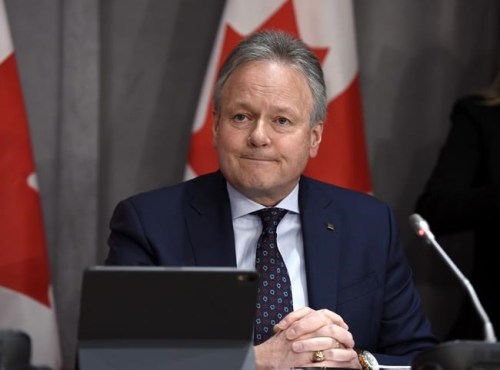
A longer downturn would also mean households, businesses and governments could have higher debt by the time the recovery takes hold — all reasons why governor Stephen Poloz emphasized keeping rates low, rapidly expanding buying programs for provincial bonds, and doing what was necessary to help ease costs whenever the recovery takes hold.
The bank kept its key interest rate at 0.25 per cent, saying that it is effectively as low as it can go to combat the economic impacts of COVID-19 and needed to help banks pass on the savings in the form of lower mortgage and loan rates.
But it also announced plans to start buying both provincial and corporate bonds on the secondary market, from investors that have previously bought them from the issuers, to reduce the risk that those markets will lock up. Between them, those measures are to inject up to $60 billion into the economy and will last, tentatively, for a year.
The bank is also increasing the quantity of federal treasury bills it’s willing to buy, effectively making more low-interest loans to the federal government.
No matter the scenario, all the possibilities suggest “the near-term downturn will be the sharpest on record,” the central bank said in its anticipated economic outlook.

“There may not be a traditional forecast here, but the bank’s messaging is clearly ‘buckle your seatbelts,'” wrote TD senior economist Brian DePratto in a note.

“The economy is facing an intense shock, and the Bank of Canada clearly intends to do all it can to not only soften the blow, but also speed up the recovery.”
In his opening remarks, Poloz noted that “substantial monetary stimulus needed to be in place to lay the foundation” for the anticipated recovery.
“Now what we’re making sure is that what they have to look forward to is the lowest interest rates that we’ve seen in a very, very long time,” Poloz said of the bank’s actions.
“We therefore have a lot of pieces in place for that recovery to be robust.”
This report by The Canadian Press was first published April 15, 2020.