Lemieux’s sportsmanship story from 1988 Seoul Games featured in new Olympic book
Advertisement
Read this article for free:
or
Already have an account? Log in here »
To continue reading, please subscribe:
Digital Subscription
One year of digital access for only $1.44 a week*
- Enjoy unlimited reading on winnipegfreepress.com
- Read the E-Edition, our digital replica newspaper
- Access News Break, our award-winning app
- Play interactive puzzles
*Billed as $5.77 plus GST every four weeks. After 52 weeks, price increases to the regular rate of $19.95 plus GST every four weeks. Offer available to new and qualified returning subscribers only. Cancel any time.
To continue reading, please subscribe:
Add Free Press access to your Brandon Sun subscription for only an additional
$1 for the first 4 weeks*
- Enjoy unlimited reading on winnipegfreepress.com
- Read the E-Edition, our digital replica newspaper
- Access News Break, our award-winning app
- Play interactive puzzles
*Your next Brandon Sun subscription payment will increase by $1.00 and you will be charged $17.95 plus GST for four weeks. After four weeks, your payment will increase to $24.95 plus GST every four weeks.
Read unlimited articles for free today:
or
Already have an account? Log in here »
Hey there, time traveller!
This article was published 21/07/2021 (1928 days ago), so information in it may no longer be current.
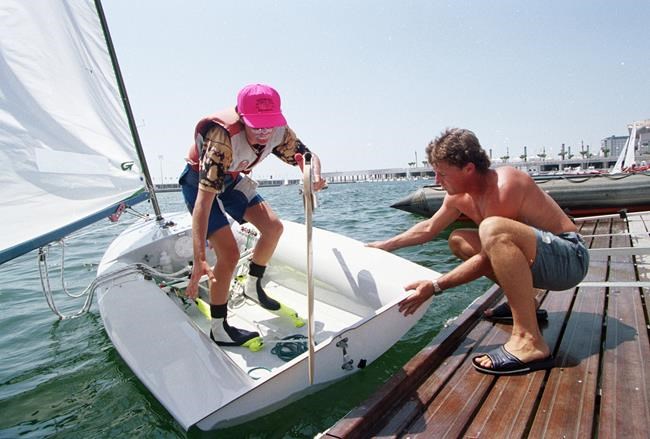
Somewhat lost in the shuffle of the 1988 Seoul Olympics — a Games forever remembered for the Ben Johnson saga — was a competition that featured sportsmanship of the highest order.
Canadian sailor Lawrence Lemieux stopped racing to save a sailor who was struggling in the water after his boat capsized. While he missed the podium, Lemieux was awarded the prestigious Pierre de Coubertin medal for exhibiting true sportsmanship in an Olympic event.
The saga of “The Gentlemanly Olympian” is one of many interesting anecdotes featured in the book “Total Olympics: Every Obscure, Hilarious, Dramatic and Inspiring Tale Worth Knowing,” by sports writer Jeremy Fuchs.
Johnson generated worldwide headlines by edging archrival Carl Lewis in the men’s 100-metre final but later failing a drug test. The sordid doping tale was contrasted by Lemieux’s actions on a windy September day near the port city of Busan.
Lemieux competed in the one-man Finn class event on a course that was shared with two other races. Halfway through his heat, he spotted two Singapore sailors who were struggling in rough waters.
One sailor made it back to the dinghy’s hull, but the other athlete was bobbing in waves while fighting the current. Lemieux manoeuvered his boat to the sailor and pulled him in before waiting for a patrol boat to arrive.
Lemieux was in second place in his heat at the time. He rejoined the race but would settle for 22nd place, eventually finishing 11th in the overall standings.
“He didn’t win a medal — gold, silver or bronze — but he got something else that I think was just as valuable,” Fuchs said. “And he arguably saved this guy’s life.”
Lemieux’s story is one of many intriguing anecdotes packed into the 322-page volume. Fuchs delved back into the late 1800s with his research, digging into old newspapers, files and scholarly reports on the Games.
The craziest story on his list dates back to 1912, he said: Japan’s Shizo Kanakuri was in a field of 68 marathoners, half of whom were suffering from extreme overheating (hyperthermia) during the race.
Kanakuri decided to stop racing after noticing some people enjoying some juice by a garden in a village outside Stockholm. The parched runner ended up mingling with them for about an hour, Fuchs writes, before leaving Sweden the next day on the first boat back to Japan.
Officials in his home country were embarrassed by his failure to finish the race. Communication, much like athletic event organization in those early Olympic days, was lacking.
The Swedes didn’t know where Kanakuri was and placed him on the missing persons list. He remained there for 50 years, despite competing at the next two Summer Games.
The Swedish Olympic Committee eventually tracked him down in 1967. Kanakuri accepted an invite to return to Sweden for an anniversary celebration of the Stockholm Games and even finished the race as part of a fundraising effort.
That gave him a time of 54 years, eight months, six days, five hours, 32 minutes and 20.3 seconds.
“Everything from the biggest stars to people who finished in last place in the most embarrassing ways, it’s all there,” Fuchs said of the book. “Obviously you can’t do the entire Olympics, there’s just too much.
“So I just tried to focus on some of the coolest and most interesting (stories) and the sort of things that make you go, ‘Huh? I didn’t know that happened.'”
The did-you-know factor is prominent throughout.
For example, winners at the ancient Olympics were awarded money instead of medals. The famous Olympic rings made their debut at the 1920 Games in Antwerp.
A traditional podium was used for the first time at the 1932 Lake Placid Games after then-IOC president Henri de Baillet-Latour liked its use at the 1930 British Empire Games in Hamilton, Ont.
Discontinued sports — a trivia lover’s delight — also get some love, with details on club swinging (1904, ’32), tandem bicycle (1908, ’20-72), pigeon shooting (1900) and tug of war (1900-20).
Remember the Canadian Bruce-Li badminton team from the 2012 London Olympics?
Michelle Li and Alex Bruce made an unlikely run to the medal round after eight players from China, South Korea and Indonesia were expelled for dropping their matches on purpose to get a more favourable opponent in the knockout round.
“The Olympics are supposed to be about fair play, sportsmanship and these higher ideals,” Fuchs said. “This was pretty much the complete opposite of that. A black mark on a sport that is not the most popular and it’s just a weird way for it to get more attention.”
The financial overruns that plagued the Montreal Games in 1976 also made the cut in the “Wild and Strange” chapter. Fuchs notes the city set an Olympic record at the time by going a whopping 720 per cent over budget.
“Olympics cost a lot, they go over-budget, things go wrong,” Fuchs said in a recent interview. “But this one was just so in a different stratosphere.”

Olympic icons like Michael Phelps, Ian Thorpe, Usain Bolt and Jesse Owens are featured along with memorable games like the infamous “Blood in the Water” Soviet Union-Hungary water polo match in 1956.
“This is about as complete as you can get without making it into an encyclopedia,” Fuchs said.
“Total Olympics: Every Obscure, Hilarious, Dramatic, and Inspiring Tale Worth Knowing,” by Workman Publishing is available now at a retail price of US$22.95.
This report by The Canadian Press was first published July 21, 2021.
Follow @GregoryStrongCP on Twitter.
Related Articles
Biles: Mental health advocacy part of post-Olympic tour






Advertisement Advertise With Us
Advertisement Advertise With Us