Olympic flag arrives in Paris ahead of 2024 Games

Advertisement

Advertise with us

PARIS (AP) — Paris Mayor Anne Hidalgo brandished the Olympic flag on Monday in Paris upon her return from Tokyo, as the French capital will organize the Games in 2024.

Read this article for free:


By clicking the button above, an account will be created and you will begin to receive some of our recommended newsletters. You may opt out of any newsletter by visiting your Email and Communication Preferences page or by clicking "unsubscribe" at the bottom of any email.

or

Already have an account? Log in here »

To continue reading, please subscribe:

Digital Subscription

One year of digital access for only $1.44 a week*

  • Enjoy unlimited reading on winnipegfreepress.com
  • Read the E-Edition, our digital replica newspaper
  • Access News Break, our award-winning app
  • Play interactive puzzles

*Billed as $5.77 plus GST every four weeks. After 52 weeks, price increases to the regular rate of $19.95 plus GST every four weeks. Offer available to new and qualified returning subscribers only. Cancel any time.

To continue reading, please subscribe:

Add Free Press access to your Brandon Sun subscription for only an additional

$1 for the first 4 weeks*

  • Enjoy unlimited reading on winnipegfreepress.com
  • Read the E-Edition, our digital replica newspaper
  • Access News Break, our award-winning app
  • Play interactive puzzles
Start now

*Your next Brandon Sun subscription payment will increase by $1.00 and you will be charged $17.95 plus GST for four weeks. After four weeks, your payment will increase to $24.95 plus GST every four weeks.

Hey there, time traveller!
This article was published 09/08/2021 (1910 days ago), so information in it may no longer be current.

PARIS (AP) — Paris Mayor Anne Hidalgo brandished the Olympic flag on Monday in Paris upon her return from Tokyo, as the French capital will organize the Games in 2024.

After leaving the plane at Charles de Gaulle airport, surrounded by many of France’s Olympic medalists, Hidalgo spoke of her “great emotion.”

She formally received the flag Sunday during the Tokyo closing ceremony from International Olympic Committee president Thomas Bach.
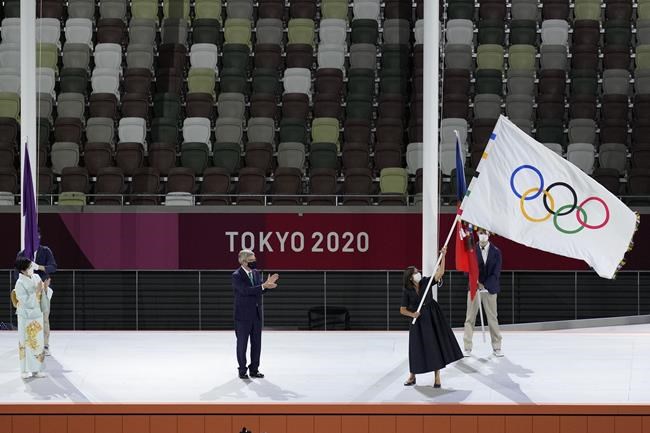
Paris mayor Anne Hidalgo, right, holds the Olympic flag next International Olympic Committee's President Thomas Bach, center, and Tokyo Gov. Yuriko Koike, left, during the closing ceremony in the Olympic Stadium at the 2020 Summer Olympics, Sunday, Aug. 8, 2021, in Tokyo, Japan. (AP Photo/Lee Jin-man)

The flag “is the symbol that now, really, the Paris Games are coming and it will go very fast,” Hidalgo told reporters, saying they will be “very positive for our country.”

She said the Tokyo Games were “organized in very difficult conditions” because of the COVID-19 pandemic.

French organizers will stay in touch with Japanese counterparts to prepare for the Paris Games, including on security issues, Hidalgo added.

The Olympic flag will be raised at Paris City Hall later Monday. A celebration event will then take place at the Trocadero square, near the Eiffel Tower, so that the public can welcome French medalists home.

Report Error Submit a Tip

More Stories

The new normal in Canadian politics

David McLaughlin 5 minute read Preview

The new normal in Canadian politics

David McLaughlin 5 minute read Yesterday at 2:01 AM CDT

“Nothing happening, all at once.”

Welcome to the new normal of Canadian politics, where normality is the new normal. Routine and stable are in; disruptive and excessive are out. Exhibits A and B are the Alberta referendum and the British Columbia election. Voters opted for stability over volatility.

The opposite of being normal is being different from the norm. In politics that means different from where we’ve been and what we’ve come to expect. Two competing trends have dominated our politics for the past decade and a half — progressivism and populism. Think Justin Trudeau and liberal, progressive identity politics in Canada, and Donald Trump and conservative, populist MAGA politics in America. We are now experiencing a swing away from both those trends.

Representing this “new normal” are Prime Minister Mark Carney, for one, and newly elected British Columbia premier, Lorne Doerksen, for another. Both are considered normal because they talk and act like adults in a childish political world. Their political flair is to not have any political flair. They stand out for not standing out.

Read
Yesterday at 2:01 AM CDT

RRC Polytech program cuts take bite out of hospitality, tourism sector

Maggie Macintosh 4 minute read Preview

RRC Polytech program cuts take bite out of hospitality, tourism sector

Maggie Macintosh 4 minute read Saturday, May. 2, 2026

Manitoba’s tourism industry is bracing for the disappearance of hospitality training programs — once-popular courses among international students.

Citing budgetary challenges related to a shift in federal immigration policy, Red River College Polytechnic is scrapping 11 programs and scaling back three others in 2026-27. Its hospitality business management diploma is one of seven permanent casualties.

The announcement, while unsurprising, is but the latest blow to a sector trying to “build back the workforce” in the wake of the COVID-19 pandemic, said Michael Juce, president of the Manitoba Hotel Association.

“Are people going to go outside of Manitoba for training? And if they leave, are they going to come back?” Juce said, adding that rural hotels in particular are already grappling with staffing shortages.

Read
Saturday, May. 2, 2026

Letters, Oct. 31

6 minute read Yesterday at 2:01 AM CDT

Civic election a missed opportunity

The outcome of the latest municipal election in Winnipeg is nothing short of baffling. The decline of what was once a proud, beautiful prairie hub is impossible to ignore.

Winnipeg is rapidly sliding into a state of structural and social dilapidation, yet voters have inexplicably chosen to hand incumbent Mayor Scott Gillingham a second term. The decision smells of complacency, and sadly, it represents a massive missed opportunity for real urban renewal.

Walking through downtown Winnipeg today is an exercise in heartbreak. A city centre that should be a bustling economic and cultural core has instead transformed into an absolute eyesore. Encampments and tents are permitted to dot the heart of the city. Streets that used to thrive are now dominated by the tragic, visible reality of severe addiction, with individuals wandering and staggering through public spaces without adequate intervention or care.

SNC planned U.S. move if no deal: documents

Jordan Press and Christopher Reynolds, The Canadian Press 5 minute read Preview

SNC planned U.S. move if no deal: documents

Jordan Press and Christopher Reynolds, The Canadian Press 5 minute read Thursday, Mar. 28, 2019

OTTAWA - SNC-Lavalin warned federal prosecutors last fall about a possible plan to split the company in two, move its offices to the United States and eliminate its Canadian workforce if it didn't get a deal to avoid criminal prosecution, newly obtained documents show.

The documents, part of a PowerPoint presentation obtained by The Canadian Press, describe something called "Plan B" — what Montreal-based SNC might have to do if it can't convince the government to grant a so-called remediation agreement to avoid criminal proceedings in a fraud and corruption case related to projects in Libya.

Under that plan, SNC would move its Montreal headquarters and corporate offices in Ontario and Quebec to the U.S. within a year, cutting its workforce to just 3,500 from 8,717, before eventually winding up its Canadian operations.

“The government of Canada needs to weigh the public interest impact of the prosecution of SNC-Lavalin," the presentation reads.

Read
Thursday, Mar. 28, 2019

Canada tops Dominican Republic in pre-qualifier

Jason Hills, The Canadian Press 4 minute read Preview

Canada tops Dominican Republic in pre-qualifier

Jason Hills, The Canadian Press 4 minute read Sunday, Nov. 17, 2019

EDMONTON - Canada's women's basketball team put its depth on display Sunday in a dominant 110-60 victory over the Dominican Republic in the final game of the FIBA Olympic pre-qualifying tournament.

All 12 players hit the scoresheet, including six in double digits, to help the Canadians finish 3-0 at the tournament and advance to the next Olympic qualifier in February.

Sami Hill led the way with 16 points, three rebounds, two assists and three steals, while 20-year-old Shaina Pellington recorded 14 points. Bridget Carleton and Jamie Scott had 13 points each and Ruth Hamblin had 11 points and five rebounds.

"We got to roll our whole lineups through, and it was fun when we got going," said Canada's coach Lisa Thomaidis. "It was nice to see different lineup contributing and building chemistry.

Read
Sunday, Nov. 17, 2019

Imperialist crusades: 21st-century style

John R. Wiens 5 minute read Preview

Imperialist crusades: 21st-century style

John R. Wiens 5 minute read Wednesday, Jul. 8, 2026

In the 11th century and lasting into the 13th, the papacy launched a series of at least eight military campaigns we now refer to as the Crusades, or Holy Wars. They were an imperialistic call to arms for Christians to retake Jerusalem, which was at the time under Muslim rule.

Spiritual rewards for participation were implied, and other incentives offered, to dull the extra taxation demanded to fund the campaigns. Over time, the “crusades” morphed to become massacres of not only Muslims but also Jews and Christian dissidents — in other words, any enemies of the papacy. If today’s news sounds like déjà vu all over again, it probably should.

The stories keep repeating themselves in many forms. We now know that two 20th century world wars, global in scope, were caused by imperialistic ambitions, changes in the balance of international powers and corresponding arms races. The first was attributed to the assassination of the heir to the Austro-Hungarian throne by a Bosnian Serb, a kind of “regime change” initiative. The second resulted from rising tensions between Allied and Axis powers, triggered by the rise of European fascism and Japanese militarism. The human toll of both was unimaginable.

In the First World War, 15 to 22 million people, including soldiers and civilians, were killed and another 23 million were wounded. These numbers do not account for those otherwise affected — victims of chemical warfare whose compromised health shortened their lives; of the subsequent Spanish flu epidemic amplified by the displacement of peoples; others who died from other diseases caused by war conditions; and those who were malnourished or starved. Nor do they account for the ongoing trauma and resentments passed on intergenerationally to this day.

Read
Wednesday, Jul. 8, 2026