From battlefield to Tokyo: Combat vets vie at Paralympics
Advertisement
Read this article for free:
or
Already have an account? Log in here »
To continue reading, please subscribe:

Digital Subscription
One year of digital access for only $205*
- Enjoy unlimited reading on winnipegfreepress.com
- Read the E-Edition, our digital replica newspaper
- Access News Break, our award-winning app
- Play interactive puzzles
*First annual payment billed as $205.00 + GST for one year. This annual subscription will automatically renew at $233.00 + GST every 52 weeks (10% off the regular annual price of $259.35). Offer available to new and qualified returning subscribers only. Cancel any time.
To continue reading, please subscribe:
Add Free Press access to your Brandon Sun subscription for only an additional
$1 for the first 4 weeks*
- Enjoy unlimited reading on winnipegfreepress.com
- Read the E-Edition, our digital replica newspaper
- Access News Break, our award-winning app
- Play interactive puzzles
*Your next Brandon Sun subscription payment will increase by $1.00 and you will be charged $17.95 plus GST for four weeks. After four weeks, your payment will increase to $24.95 plus GST every four weeks.
Read unlimited articles for free today:
or
Already have an account? Log in here »
Hey there, time traveller!
This article was published 07/09/2021 (1855 days ago), so information in it may no longer be current.
FREMONT, Ind. (AP) — The bald, broad-shouldered cyclist has spent years remembering a nighttime road in a faraway city. He can still describe the city’s narrow streets and crushing heat. He talks about the dead end that forced his convoy turn around.
And the explosion.
“It’ll always be a part of me,” said Tom Davis, sitting outside his family home in rural Indiana. Cicadas are screeching. “I can do all things through Christ who strengthens me,” says a tattoo on an immense forearm.
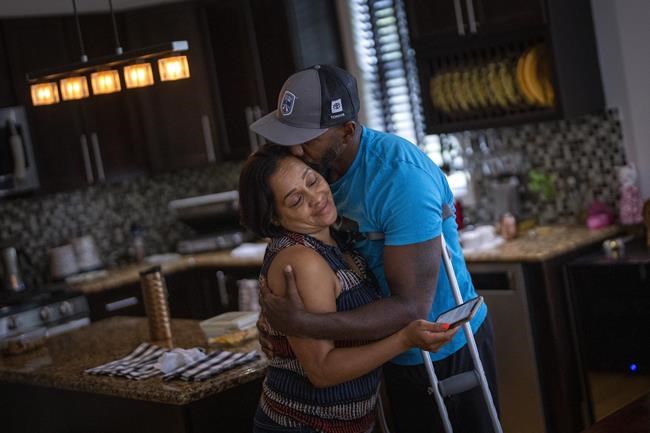
“But I can’t continue to be that guy that got blown up in Ramadi,” the city outside Baghdad where a hidden bomb threw his armored vehicle high into the air, costing the soldier much of his left leg.
Davis is no longer that guy. Tens of thousands of miles of training helped make him into someone else — one of the fastest men alive.
Twenty years after the attacks of Sept. 11, and just days after the Taliban took control of Kabul, Davis is one of the small group of American combat veterans competing in the Tokyo Paralympics — a corps of elite athletes who have triumphed over catastrophic injuries they suffered in Iraq and Afghanistan.
There’s the triathlete who lost a leg when her convoy was ambushed on the bomb-cratered road to Baghdad’s airport. The swimmer who went blind after stepping on a land mine in rural Afghanistan. The sprinter who lost both legs in another Baghdad convoy.
There’s the cyclist who remembers clutching his dismembered leg in the moments after an attack in Afghanistan, holding it to his chest as if it was a baby.
They are a disparate group. Some are relentlessly optimistic. Others spent years wrestling emotional demons. Some insist they emerged from their personal battlefields without emotional scarring. Others insist that’s impossible. Their stories are tangles of adversity and redemption, loss and achievement.
What unites them is a fierce competitiveness and an ability to push past disabilities that can look insurmountable to an outsider. And, at times, a quiet anger at people who dismiss them.
“Sometimes, people look at us and they don’t see real athletes,” said Freddie De Los Santos, a hand-cyclist and Army veteran.
Those people are wrong.
___
De Los Santos is open about his own struggles.
There were the basement suicide attempts, when he’d take handfuls of painkillers and wash them down with liquor. There were the nightmares that sometimes awakened him, and still do. There was the time he was locked into a psychiatric ward after attacking a pharmacist, and the countless times he screamed at his wife and two kids.
He scoffs at disabled combat vets who say they’re fine.
“It’s not possible,” he said. “There’s always some kind of trauma there.”
De Los Santos, 51, who grew up in a rough New York City neighborhood at the height of the crack cocaine epidemic, has created an idyllic small-town life north of the city. His family lives in a neighborhood of quiet streets and American flags, where young mothers push strollers and rockers sit on front porches. He loves the neighborhood’s strict rules: Grass must be cut weekly; houses can only be painted in approved colors; Christmas decorations must come down after Jan. 1.
De Los Santos, who is Black, was furious when a neighbor put up a Black pride flag.
“That’s about division,” he grumbled, driving past the flag. “We have rules because we don’t want things like that here.”
A fierce cyclist, he was introduced to the sport by physical therapists at Walter Reed National Military Medical Center, the hospital outside of Washington where tens of thousands of injured American soldiers were treated after Sept. 11.
Now, he trains on twisting, hilly roads that go past centuries-old farmhouses. He regularly breaks speed limits.
His life changed in 2009, when a rocket-propelled grenade ripped into his vehicle in an Afghan village. He remembers his beard burning, and grabbing his leg after it was ripped off by the blast.
But by then he’d already seen plenty of firefights in Afghanistan, and in an earlier combat tour in Iraq. He’d seen friends die, and children cut down. The scars on his psyche were deep before that ambush, he says.
Even after he began training as a Paralympian, he sometimes hid for days in his basement. It took him years to feel stable, and he says he’s still recovering.
“I function pretty well right now, but it hasn’t been easy,” he said.
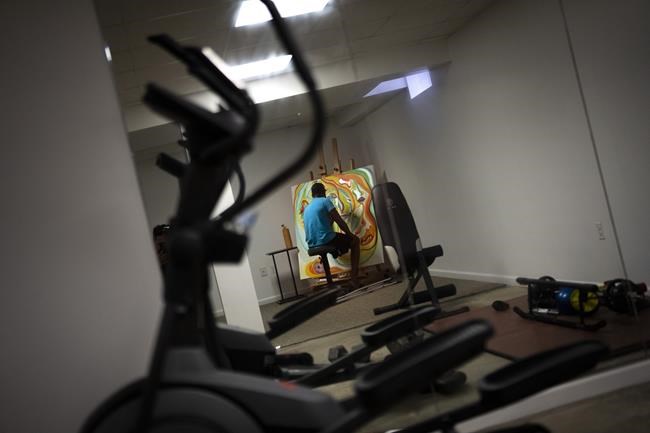
He credits psychotherapy, along with a deep Christian faith, a very patient family, and a love for painting — his art expresses his pain.
And he credits cycling.
Combat, he said, taught him to thrive on pain, making him a relentless competitor.
“You enjoy the pain,” he said. “Sometimes, that pain is your best enemy. When I’m racing and I start to feel the pain, I say ‘How are you doing?’”
Combat also taught him to advance relentlessly.
It’s easy to hear echoes of that today.
“I have days where you see me moving and laughing, but I’m not functioning very well,” he said.
“But I’m still pushing forward.”
___
Walking through his New Jersey neighborhood, Brad Snyder looks like just another guy with his dog. In his bright, spotless kitchen, he moves effortlessly, a man with no eyes navigating with a few quick touches on the marble countertop.
Losing his sight, he says, seems to matter more to other people.
If anything ties these combat veterans together, it’s how casually many can dismiss their injuries.
“Everyone is really distraught about this blindness thing,” said Snyder, who is 37.
“Society has this bizarre reaction to me when they realize I’m blind,” he said a couple weeks before leaving for Tokyo. “Almost every person will say ‘I’m sorry.’”
“Well, I’m not sorry,” he continues. “It’s who I am. I’m used to it. I have an awesome life, an awesome wife, a cool life here in Princeton. Don’t pity me. Don’t feel sorry for me.”
Sports, he says, lets the rest of the world see that.
“The Paralympics turns that pity upside down.”
A Navy explosives expert, Snyder stepped on hidden mine in Afghanistan in 2011 as he moved to help a group of Afghan commandos badly injured by another blast. In moments he went from thinking he was dead, to relief that he was alive, to confusion as he stood up with blood pouring from his face.
“How bad is it?” he asked a friend.
The answer wasn’t very reassuring: “Well, your face is f—— up but you can walk.”
And, it turned out, he could swim.
A top swimmer at the U.S. Naval Academy, Snyder won his first two Paralympic gold medals in London barely a year after losing his sight. He won three more in Rio De Janeiro in 2016, then switched to the triathlon.
Snyder, who discovered a love for the classroom after teaching ethics a few years ago at the Naval Academy, started a Ph.D. at Princeton last year. He’s focusing on relationships between militaries and the people they serve.
He lives near campus with his wife, Sara; they met a few years ago through a friend.
She is, he says, the most beautiful woman in the world.
He has never seen her.
___
Luis Puertas says he’s not lonely, though on most nights, dinner means one place-setting at the big kitchen table. He likes being alone. He says that repeatedly.
His training keeps him busy, along with occasional visits from old Army buddies, and relentless worrying over his blades, the curved carbon prosthetics he uses for sprinting. He has dozens of them. He can tinker with them for hours.
But his world is small: a quiet house on a quiet street in Orlando, Florida.
His 7-year-old daughter, who he loves so much it almost hurts, only lives with him part-time. His relationship with her mother turned bad long ago. Much of his family lives far away.
Puertas, 34, lost both his legs in September 2006 as he patrolled a crowded Baghdad neighborhood. His legs were severed when a massive IED blasted through his armored vehicle.
He’s matter of fact about his injuries — “In the Paralympics everybody has a story. There’s always some guy whose story is worse.” But the first years were rough.
There was the time he destroyed a computer at Walter Reed. Then he destroyed another. There were rivers of vodka and rum.
But even as he struggled emotionally, he began working out. First it was 10-mile runs to get himself in shape. Later it was sprinting.
He stopped for a few years — a time he doesn’t want to talk about — but came back to the sport a few years ago.
“It became a part of me. The training and the running. The ritual. Waking up. Going to the track,” he said.
You can hear his joy as he talks about his daughter, Emilia. She’s the fastest runner in her grade, he’ll tell you. She beats the boys, he says.
Beyond her, he said, little else counts. Not the blast. Not the years of anger. Nothing.
“The other stuff is just coincidence,” he said. “It’s just what I did in my life.”
___
Melissa Stockwell knows how she can come across.
She’s the triathlete with the big smile, the beautiful family and the prosthetic leg decorated like an American flag.
“I’ve always been an optimistic person,” she said — cheerfully — in a phone interview from Colorado Springs, where she lives and trains. “Probably annoyingly optimistic to lots of people.”
There’s a good chance you’ve seen Stockwell at some point.
Maybe it was in the TV commercial for Ritz Crackers, where she inspires a girl who has lost a leg. Maybe it was in the Modelo beer commercial, or the one for Chobani yoghurt.
Maybe it was recent the Toyota ad, with the announcer proclaiming: “Right now, you can win during our ‘Driven To Be The Best Event!’”
She’s a public figure who has done countless interviews and a sought-after speaker who knows to avoid controversy. Ask her about America’s pullouts from Iraq and Afghanistan and she effortlessly shifts the conversation to patriotism and her family.
Stockwell, 41, said she’s the target of occasional gentle teasing from fellow athletes for her success with sponsors (“I’m happy to take it”) but her optimism is also at the core of her success. She’s won a small mountain of medals over more than a decade of competing.
“I’m not saying it’s all unicorns and rainbows every day all day,” she said. But “I accepted the loss of my leg early on, and that acceptance propelled me.”
It propels her still.
Just eight weeks before the games in Tokyo, Stockwell was training on a bike when she swerved to miss a fallen branch and slammed into a tree. She broke her back in three places. The pain was excruciating.
“If this would have happened to a non-athlete they’d have you do nothing for eight weeks,” she said. “But that was not an option.”
Two weeks after the accident she was back in the pool. Soon after she was training on a bicycle. But just days before leaving for Tokyo, her running was still limited to low-impact aqua-jogging in a pool.
The Paralympic triathlon includes a half-mile (750 meter) swim, a 12.4-mile (20-kilometer) bike ride and a 3.1-mile (5-kilometer) run.
The run was the real worry.
“I need 3.1 miles — that’s it,” she said. “I’m hoping for 3.1 fast miles.”
___
By age 27, Tom Davis had been through a string of jobs, too many hangovers and a couple of DUI arrests. He was unemployed and living with his parents.
“‘Something’s gotta change,’” he told himself. “‘If I stay here, I’m either going to be dead or in jail or in prison in 10 years.’”
An Army Ranger competition on TV grabbed his attention: He enlisted the next day.
A few weeks into his second Iraq tour, in 2006, Davis was in a patrol convoy in the city of Ramadi when they hit a dead end. Just after turning around, a bomb blew his armored Humvee high into the air. Militants opened fire. He regained consciousness upside down inside in the vehicle, his left leg badly mangled, gunfire blasting around him.
He was eventually transferred to Walter Reed, where a therapist pushed him to try a hand-cycle. For a former high school runner who had once dreamed of the Olympics, it was a gift.
“As soon as I got on that bike, just feeling that speed again of being a runner,” he said, the pleasure evident so many years later. “I loved it.”
Davis, 44, has emerged as one of the world’s fastest hand-cyclists, going into the Tokyo competitions with three world championship silver medals and more marathon victories than he can easily count.
He struggled for a time, like so many other soldiers. He wrestled with PTSD. He’d explode at his family.
But he also had a strong, patient wife who wouldn’t give up.
They grew up just 20 miles apart, but he and Jamie met online during his first tour of Iraq. They soon married.
First she got him to tone down his drinking. After he lost his leg, she dragged him to church.
That combination — the bike, a growing family and a newfound, intense Christianity — gave him discipline and purpose.
The ambush, he says, made him a better man.
If he hadn’t lost his leg, “I would never have grown into the person I am now,” he said. “Not even just racing a bike or whatever, but as a human being and as a husband and as a dad.”
“I wouldn’t give all that back,” he said. “Just to walk?”
___
They had seen some of the worst places on Earth. They had suffered terribly. Some had killed. Many had buried friends.
But Tokyo wasn’t about combat. Battlefield experience doesn’t get you to the Paralympics. And in the end, the years of work and tens of thousands of miles of training often came down to a few seconds.
A few days after leaving New Jersey, Snyder — tethered to another triathlete who guided him through the course — took gold in his first Paralympic triathlon.

One by one, they competed. De Los Santos took home a bronze from a relay. Puertas pushed hard in his sprint but missed a medal and took fourth place. Davis, who had vowed not to focus solely on gold, silver and bronze, finished fifth in both his races.
And then there was Melissa Stockwell, who until her race had still been unable to do any serious running.
Still, she ran.
Early one Saturday morning, she jogged toward the finish, pumping her arms in the air, a huge smile on her face.
She came in fifth.
Related Articles
‘Looking ugly’: Why skiing might ditch its combined event Ski World Cup to add cross-border Swiss-Italian downhills





Advertisement Advertise With Us
Advertisement Advertise With Us