‘WeThe15’ stresses rights of 1.2 billion with disabilities

Advertisement

Advertise with us

TOKYO (AP) — The opening next week of the Paralympic Games in Tokyo is being used as a stage to launch a human-rights movement aimed at the world’s 1.2 billion people with disabilities.

Read this article for free:


or

Already have an account? Log in here »

To continue reading, please subscribe:

Subscribe and receive a limited-edition Free Press branded hat or tote.

Digital Subscription

One year of digital access for only $205*

  • Enjoy unlimited reading on winnipegfreepress.com
  • Read the E-Edition, our digital replica newspaper
  • Access News Break, our award-winning app
  • Play interactive puzzles

*First annual payment billed as $205.00 + GST for one year. This annual subscription will automatically renew at $233.00 + GST every 52 weeks (10% off the regular annual price of $259.35). Offer available to new and qualified returning subscribers only. Cancel any time.

To continue reading, please subscribe:

Add Free Press access to your Brandon Sun subscription for only an additional

$1 for the first 4 weeks*

  • Enjoy unlimited reading on winnipegfreepress.com
  • Read the E-Edition, our digital replica newspaper
  • Access News Break, our award-winning app
  • Play interactive puzzles
Start now

*Your next Brandon Sun subscription payment will increase by $1.00 and you will be charged $17.95 plus GST for four weeks. After four weeks, your payment will increase to $24.95 plus GST every four weeks.

Hey there, time traveller!
This article was published 18/08/2021 (1875 days ago), so information in it may no longer be current.

TOKYO (AP) — The opening next week of the Paralympic Games in Tokyo is being used as a stage to launch a human-rights movement aimed at the world’s 1.2 billion people with disabilities.

The campaign is called “WeThe15”and gets its name from World Health Organization estimates that persons with disabilities represent 15% of the global population. The campaign is being spearheaded by the International Paralympic Committee, UN Human Rights, the International Disability Alliance, and others.

The IPC is also hooking up in the campaign with other sports bodies including the Special Olympics, the Invictus Games Foundation, and the International Committee of Sports for the Deaf.
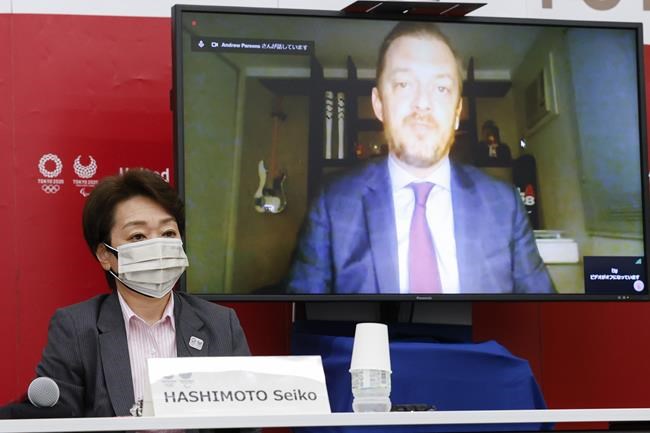
FILE - In this June 21, 2021, file photo, Tokyo 2020 President Seiko Hashimoto listens to International Paralympic Committee (IPC) President Andrew Parson, on a screen, during a five-party online meeting at Harumi Island Triton Square Tower Y in Tokyo. The opening next week of the Paralympic Games in Tokyo is being used as a stage to launch a human rights movement aimed at the world’s 1.2 billion people with disabilities.(Rodrigo Reyes Marin/Pool Photo via AP, File)

Andrew Parsons, president of the IPC, told The Associated Press that “WeThe15” aims to put persons with disabilities on the inclusion agenda along with “ethnicity, gender, and sexual orientation.”

“We have seen other movements like LBGTQ, Black Lives Matter, the Me Too movement, and we need a similar movement for persons with a disability,” Parsons said.

“These movements have organized themselves in a way that they could advance their agenda, and we believe that so far — even though the Paralympics has brought some change — we need to bring together these other international organizations to make this change more effective. Not only every four years.”

The launch Thursday features a 90-second campaign film that organizers say will be shown on television channels in 60 countries.

“It’s understanding that 1.2 billion people — 15% of the global population — cannot be ignored,” Parsons said. “They must be included in the society. That’s the message we want to bring and highlight to the world.”

The WHO estimates that of the 15% of the world’s population living with some form of disability, between 110 million and 190 million adults have significant difficulties in functioning.

Organizers will accent the launch by lighting up more than 125 worldwide landmarks in the color purple. Advocates say purple is long associated with the disability community. Included in the lighting will be New York’s Empire State Building, Tokyo’s Skytree and Rainbow Bridge, Rome’s Colosseum, the London Eye, and Niagara Falls spanning Canada and the United States.

“With WeThe15, I hope we unite people through creating understanding,” said Heinrich Popow, a two-time Paralympic gold-medal winner at 100 meters and the long jump. Heinrich piled up seven medals overall in four Paralympics — from 2004 in Athens through 2016 in Rio de Janeiro.

“We want to motivate through WeThe15 with stories,” Popow added. “And create the understanding that we also love life.”

The launch of WeThe15 comes a year after a documentary film on Paralympic athletes was released in almost 200 countries.

The film “Rising Phoenix” weaves the history of the Paralympic Games around athletes’ lives and the financial ups and downs of the movement. It also includes segments about Dr. Ludwig Guttmann, a refugee from Nazi Germany who put together an athletic competition for the disabled in Britain in 1948 as way to help treat World War II veterans with spinal cord injuries.

The Tokyo Paralympics open on Aug. 24 in a ceremony at Tokyo’s National Stadium. They will feature about 4,400 athletes, a much smaller contingent that the just-completed Olympics, which featured 11,000 athletes.

The Paralympics close on Sept. 5.

The Paralympics will be held without any fans, even fewer than the Olympics, which allowed some fans in outlying venues. The Paralympics come as new infections have accelerated in Tokyo, which may expose an athlete population that is more vulnerable to COVID-19.

New infections in Tokyo tripled during the 17 days of the Olympics, although medical experts said the surge was not directly linked the Tokyo Games. Rather, experts suggested an indirect effect as the public was distracted and lulled into a false sense of security that staging the Games offered.

___

More AP Olympics: https://apnews.com/hub/2020-tokyo-olympics and https://twitter.com/AP_Sports

Report Error Submit a Tip

More Stories

Essential workers ruling raises questions

Editorial 4 minute read Preview

Essential workers ruling raises questions

Editorial 4 minute read 2:00 AM CDT

Ever been to a Dynacare clinic? Most of us have been. It’s an amazing demographic and ethnic slice of the city we’ve become. Old patients. Young patients. New arrivals. Long-time Canadians. People who know the ropes — others who are startled by the crowds and the noise and the lockstep forward motion of professionals doing what they have been trained to do. It seems, all at the same time, both chaotic and diagnostic, as names of patients are steadily called out and thousands of tests are performed.

But Dynacare is at the centre of a new kind of test and this time, we’re all in the test tube together.

It’s the first real test for new labour law put in place by the government of Premier Wab Kinew in 2024 — a law that redefined what essential services are for provincially-regulated workplaces. Under this law, companies and their employee and unions must have an agreement of which employees are essential — which ones must stay on the job during a legal strike for the protection of the health and safety of the public.

Dynacare had that kind of essential employee agreement with its staff and union — the company and the union had agreed the employees were not essential.

Read
2:00 AM CDT

With a bang, B.C. applauds health-care workers

Amy Smart, The Canadian Press 4 minute read Preview

With a bang, B.C. applauds health-care workers

Amy Smart, The Canadian Press 4 minute read Wednesday, Mar. 25, 2020

VANCOUVER - At the same time each night, Rev. Gary Paterson and about half a dozen other neighbours have begun gathering at least two metres apart on the rooftop patio of their building in Vancouver's west end.

They don't know who will signal the beginning, and everyone's clocks are slightly different, but just before 7 p.m., they hear clapping in the distance.

"It's usually at about two minutes to seven, like people can't restrain their enthusiasm, and then it starts to move like a wave," he said on Wednesday.

The applause is for health-care workers and other essential service providers on the frontlines of the COVID-19 pandemic.

Read
Wednesday, Mar. 25, 2020

Seven Wilsons, one regional spirit

Hersh Seth 5 minute read Preview

Seven Wilsons, one regional spirit

Hersh Seth 5 minute read 2:00 AM CDT

In Dryden, Ont., a 34-metre suspension bridge crosses the Wabigoon River rapids. It is named after a man who paid for a quarter of the bridge himself. A plaque recognizes Roy Wilson’s “many contributions to City Revitalization” and mentions his 40 years in the Rotary Club, whose motto is “service above self”.

My father sold business machines from the 1970s through the ’90s, during the shift from carbon copy machines and typewriters to photocopiers, fax machines, and early office computers and printers. His sales territory — which he covered mostly by car but also by propeller plane — was Saskatchewan, the Northwest Territories, Manitoba, and northwestern Ontario, though much of it really belonged to the Wilsons.

In business machines, selling the machine was only half the job — the other half was ensuring a technician would fix it in January. Wilson’s set the standard for dealers across most of my dad’s regions. My father worked with Roy’s son Greg (who would later go on to become mayor of Dryden) but really respected Roy for teaching Greg to run the company with the towns they served as the priority.

Wilson’s service routes went beyond where roads stopped. Even if customers lived north of the highway system, Wilson’s still found a way to help, using three company planes based at the Dryden airport. As a result, a stationery shop from a paper mill town served all of northwestern Ontario and later northern Manitoba. Imagine a photocopier strapped into a small plane, a technician beside it, and a gravel runway waiting at the other end.

Read
2:00 AM CDT

City emergency crews to administer drug that stops opioid withdrawal symptoms

Joyanne Pursaga 5 minute read Preview

City emergency crews to administer drug that stops opioid withdrawal symptoms

Joyanne Pursaga 5 minute read Monday, Aug. 10, 2026

Winnipeg Fire Paramedic Service crews will soon give out a medication that stops withdrawal symptoms after someone is treated for an opioid overdose.

Emergency workers will be administering a drug called buprenorphine, after Health Canada granted WFPS permission to use the controlled substance.

“Buprenorphine is a medication that offers people who are in active addiction — so those people who have received naloxone as a result of an overdose and those that are experiencing significant and, at times, dangerous withdrawal symptoms — just a bit of a reprieve … (It) reduces cravings and prevents those immediate withdrawal symptoms, which allows more time to connect those patients to further care,” said Michelle Long, WFPS assistant chief of paramedic operations.

The treatment option is in response to a persistently high number of WFPS opioid calls.

Read
Monday, Aug. 10, 2026

Band keeps plight of MMIWG close to heart on new track

Ben Waldman 6 minute read Preview

Band keeps plight of MMIWG close to heart on new track

Ben Waldman 6 minute read 2:00 AM CDT

Gabrielle Fontaine won’t stop talking about them and neither will her bandmates.

As a teenager, the Winnipeg songwriter — whose late father Vince was the passionate leader of musical projects including Eagle & Hawk — would volunteer at Wiping Away the Tears, an annual gathering hosted by Ka Ni Kanichihk that offers space for healing, ceremony and support for relatives of missing and murdered Indigenous women, girls and two-spirit people.

Though Indigenous people make up less than five per cent of the Canadian population, Indigenous women make up 16 per cent of all female homicide victims and 11 per cent of missing women, according to the Assembly of First Nations.

Seeking a way to help in the community, Fontaine regularly volunteered as a child-minder during memorial events, an experience she says shaped her outlook as a musical storyteller.

Read
2:00 AM CDT

Biographer delves deep into the comedy and the tragedy of Robin Williams' troubled life

Reviewed by GC Cabana-Coldwell 6 minute read Preview

Biographer delves deep into the comedy and the tragedy of Robin Williams' troubled life

Reviewed by GC Cabana-Coldwell 6 minute read Saturday, Jun. 16, 2018

Whenever I’m asked with whom I’d love to dine, entertainer Robin Williams always tops my short list of three. Still.

It’s immaterial that we didn’t move in the same social circles. Or that our career paths never crossed, even though one of his many movies, The Big White, was partially shot in Winnipeg in 2005. Something about him — that hairy persona, those kind blue eyes, the “aw shucks” grin — had intrigued me since watching the debut of his Mork & Mindy TV sitcom in 1978. His off-the-wall goofiness simply sealed the deal.

Comedian Williams became movie-star Williams, and I bought every flick — the good, the not-so-good and the real stinkers. His raunchy standup recordings, often released between his movies, were just an added, adult-only bonus.

So I, like many, was gutted when, at age 63, Williams took his own life in 2014. I didn’t “get” it: how could an award-winning, funny guy, admired by so many for so long, get so beaten up inside that he’d off himself?

Read
Saturday, Jun. 16, 2018