EXPLAINER: What’s the history of the Olympics protest rule?

Advertisement

Advertise with us

TOKYO (AP) — The simple act of taking a knee felt like something more monumental when it happened on Olympic soccer pitches in Japan on the opening night of action.

Read this article for free:


or

Already have an account? Log in here »

To continue reading, please subscribe:

Subscribe and receive a limited-edition Free Press branded hat or tote.

Digital Subscription

One year of digital access for only $205*

  • Enjoy unlimited reading on winnipegfreepress.com
  • Read the E-Edition, our digital replica newspaper
  • Access News Break, our award-winning app
  • Play interactive puzzles

*First annual payment billed as $205.00 + GST for one year. This annual subscription will automatically renew at $233.00 + GST every 52 weeks (10% off the regular annual price of $259.35). Offer available to new and qualified returning subscribers only. Cancel any time.

To continue reading, please subscribe:

Add Free Press access to your Brandon Sun subscription for only an additional

$1 for the first 4 weeks*

  • Enjoy unlimited reading on winnipegfreepress.com
  • Read the E-Edition, our digital replica newspaper
  • Access News Break, our award-winning app
  • Play interactive puzzles
Start now

*Your next Brandon Sun subscription payment will increase by $1.00 and you will be charged $17.95 plus GST for four weeks. After four weeks, your payment will increase to $24.95 plus GST every four weeks.

Hey there, time traveller!
This article was published 22/07/2021 (1896 days ago), so information in it may no longer be current.

TOKYO (AP) — The simple act of taking a knee felt like something more monumental when it happened on Olympic soccer pitches in Japan on the opening night of action.

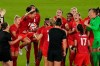
Players from the United States, Sweden, Chile, Britain and New Zealand women’s teams went to a knee before their games Wednesday night, anti-racism gestures the likes of which had not been seen before on the Olympic stage. They figured to be the first of many of these sort of demonstrations over the three-week stay in Tokyo.

The Olympic rule banning such demonstrations at the Games has been hotly debated and contested for decades, and those issues reached a flashpoint over the past two years. What resulted were changes in the rules, and the willingness of some sports organizations to enforce them.
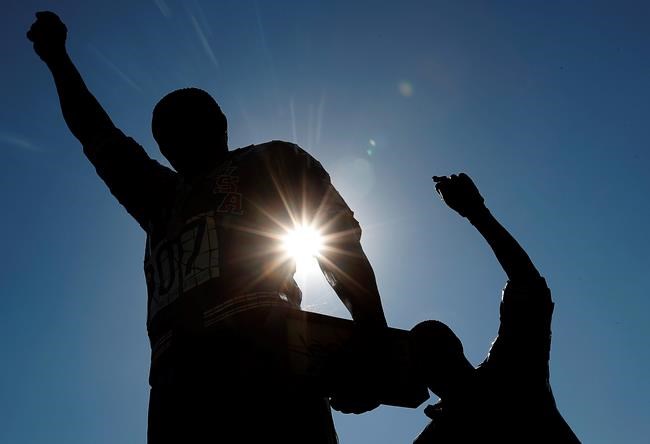
FILE - In this Oct. 17, 2018, file photo, a statue in honor of former Olympians Tommie Smith, left, and John Carlos is seen on the campus of San Jose State University in San Jose, Calif. Smith and Carlos raised their black-gloved fists while their national anthem played during the 200-meters medals ceremony at the Mexico City Olympics in 1968. Rule 50 of the IOC charter states: “No kind of demonstration or political, religious or racial propaganda is permitted in any Olympic sites, venues or other areas.” (AP Photo/Tony Avelar, File)

How have protests and demonstrations at the Games evolved over the years? Here’s a brief rundown.

WHAT: The Olympics have always billed themselves as a nonpolitical entity designed to bring countries together to celebrate sports and international unity. One of the best-recognized symbols of that nonpolitical ideal is a prohibition of “propaganda” at the Games. Rule 50 of the IOC charter states: “No kind of demonstration or political, religious or racial propaganda is permitted in any Olympic sites, venues or other areas.”

WHO: The ideals of the rule were most notably put to the test before it was officially enshrined in the Olympic charter. American sprinters Tommie Smith and John Carlos raised their black-gloved fists while their national anthem played during the 200-meters medals ceremony at the Mexico City Olympics in 1968. They would not only eventually be sent home for disregarding the ban on demonstrations, but ended up being ostracized from the Olympic movement for nearly a half century. Not until 2016 did the U.S. Olympic Committee bring them to an official event. Not until 2019 did it enshrine them in its hall of fame.

WHEN: The basic structure of Rule 50 was written into the Olympic charter in 1975. At that time, it was actually part of Rule 55 and it stated: “Every kind of demonstration or propaganda, whether political, religious or racial, in the Olympic areas is forbidden.” It would be refined and rewritten over the years. Only a few months ago, in the face of mounting pressure to do away with the rule, the IOC made its latest tweak, saying it would allow some demonstrations but only “prior to the start of competitions” and not on the medals podium. The IOC has also given discretion to the international agencies that run the individual sports on how — and whether — to enforce the bans.

WHERE: The rule became a sticking point two summers ago, a half a world away from Tokyo, in Lima, Peru. It was on the medals stands at the Pan-American Games that U.S. hammer thrower Gwen Berry raised her fist and U.S. fencer Race Imboden took a knee. They both received letters from the U.S. Olympic and Paralympic Committee that put them on a yearlong probation and, with the Tokyo Games scheduled for the following year, sent a message to other American athletes who were thinking of doing anything similar. The coronavirus pandemic pushed the Games back by 12 months, and the killing of George Floyd in the United States — and the activism that followed — prompted a thorough rethinking of the rule. The USOPC decided it would no longer sanction athletes who violated Rule 50, thus placing pressure on the IOC, which often depends on the national committees to enforce its rules at the Games.

WHY: While the USOPC was undergoing its review, the IOC also tasked its athletes commission to rethink the rule. The commission sent out a worldwide survey that found broad support for the rule as it was written. Following that lead, the IOC chose to keep the rule largely intact. It set up the possibility for tension throughout the Games in Tokyo, where, in addition to the soccer teams, Berry and U.S. sprinter Noah Lyles had telegraphed themselves as among the athletes to watch. Lyles wore a black glove and raised his fist at the starting line at Olympic trials, while Berry turned away from the flag during a playing of the national anthem.
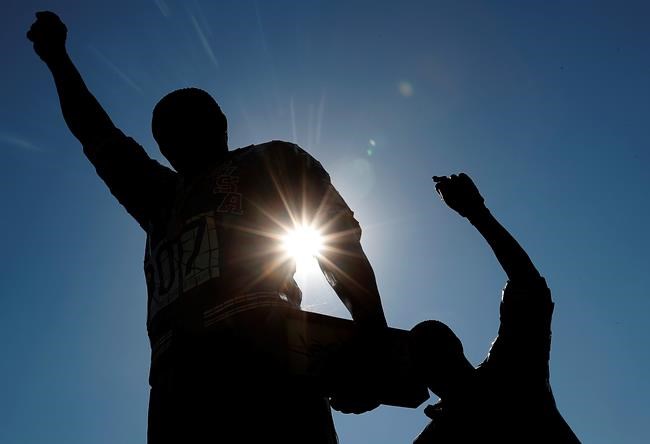
FILE - In this Oct. 17, 2018, file photo, a statue in honor of former Olympians Tommie Smith, left, and John Carlos is seen on the campus of San Jose State University in San Jose, Calif. Smith and Carlos raised their black-gloved fists while their national anthem played during the 200-meters medals ceremony at the Mexico City Olympics in 1968. Rule 50 of the IOC charter states: “No kind of demonstration or political, religious or racial propaganda is permitted in any Olympic sites, venues or other areas.” (AP Photo/Tony Avelar, File)

___

More AP Olympics: https://apnews.com/hub/2020-tokyo-olympics and https://twitter.com/AP_Sports

Report Error Submit a Tip

More Stories

EXPLAINER: What's the history of the Olympics protest rule?

Eddie Pells, The Associated Press 5 minute read Preview

EXPLAINER: What's the history of the Olympics protest rule?

Eddie Pells, The Associated Press 5 minute read Thursday, Jul. 22, 2021

TOKYO (AP) — The simple act of taking a knee felt like something more monumental when it happened on Olympic soccer pitches in Japan on the opening night of action.

Players from the United States, Sweden, Chile, Britain and New Zealand women's teams went to a knee before their games Wednesday night, anti-racism gestures the likes of which had not been seen before on the Olympic stage. They figured to be the first of many of these sort of demonstrations over the three-week stay in Tokyo.

The Olympic rule banning such demonstrations at the Games has been hotly debated and contested for decades, and those issues reached a flashpoint over the past two years. What resulted were changes in the rules, and the willingness of some sports organizations to enforce them.

How have protests and demonstrations at the Games evolved over the years? Here's a brief rundown.

Read
Thursday, Jul. 22, 2021

No museum can tell the whole story

Stuart Williams 5 minute read Wednesday, Jul. 29, 2026

The continuing debate over the Canadian Museum for Human Rights’ Uprooted: Nakba Past and Present exhibit has focused significantly on what the exhibit leaves out.

Some critics argue that the exhibit should have explained the United Nations Partition Plan, the Arab rejection of that plan, the 1948 invasion by neighbouring Arab states, the displacement of Jews from Arab countries, Hamas, October 7, the hostages and the reasons for Israeli security measures.

Others argue with equal conviction that it should also have addressed the Deir Yassin massacre, the expansion of Israeli settlements, decades of occupation, the Right of Return, changing demographic realities and the experiences of Palestinian refugees throughout the Middle East.

All of those subjects matter. Many remain the subject of legitimate scholarly debate. But the controversy points to a broader question that extends well beyond this particular exhibit.

Roughing it (less)

AV Kitching 6 minute read Preview

Roughing it (less)

AV Kitching 6 minute read Monday, Jul. 6, 2026

I hate camping.

I loathe the very idea of leaving the comfort and safety of home to sleep in a random field, where not only will I be exposed to the elements, but will also be at the mercy of all manner of creatures, from ursine to canine to insectan.

I do not want to hike up a hill just to share one outdoor tap with 12 others, standing alongside them as I brush my teeth.

I do not want to queue for 15 minutes, then part with a $2 coin to wedge myself into a shower stall just to stand under a piddly stream of lukewarm water while trying my best to swiftly soap up and sponge off lest I irk the rapidly growing line of campers outside.

Read
Monday, Jul. 6, 2026

What does the PC stand for in party’s name? Seems to be Pretty Confused

Tom Brodbeck 5 minute read Preview

What does the PC stand for in party’s name? Seems to be Pretty Confused

Tom Brodbeck 5 minute read Yesterday at 1:11 PM CDT

It should have been obvious from the beginning that the Manitoba Progressive Conservative party was going to have trouble holding itself together under Obby Khan.

The warning came in April 2025, when the now-former PC party leader narrowly won the leadership over far-right populist candidate Wally Daudrich.

Technically, Khan won. Politically, however, it was a more complicated result.

Daudrich received more votes than Khan, but Khan prevailed because the party used a constituency-weighted points system that gave him just enough of an advantage to put him over the top.

Read
Yesterday at 1:11 PM CDT

Northern style

AV Kitching 8 minute read Preview

Northern style

AV Kitching 8 minute read Tuesday, Sep. 15, 2026

North of North is partnering with the Winnipeg Art Gallery-Qaumajuq to celebrate the way it has propelled authentic northern fashion into the global spotlight at the gallery’s special edition of Crafted on the Catwalk tonight, featuring fashion and design from Manitoba, Nunavut, the Northwest Territories, Nunatsiavut and Nunavik.

Arnaquq-Baril and series stars Anna Lambe and Zorga Qaunaq spoke to the Free Press ahead of tonight’s catwalk show.

Read
Tuesday, Sep. 15, 2026

No dog? No problem Local program offers offices pup for a day

AV Kitching 5 minute read Preview

No dog? No problem Local program offers offices pup for a day

AV Kitching 5 minute read Saturday, Nov. 1, 2025

Brandt and Paisley are raring to start their new jobs.

They’ve passed their assessment tests, aced their personality evaluations, received all the relevant vaccinations and are getting ready to greet their colleagues at their respective places of employment.

But instead of hellos and handshakes, they’ll most likely be giving their co-workers tail wags and face licks. Not that anyone in the office will mind.

The doggie duo are part of Business Buddies, a new program from the city’s Animal Services Agency which sees canines in the facility spending the afternoon with local businesses.

Read
Saturday, Nov. 1, 2025