Edmonton’s public school board asks province to allow mask mandates during outbreaks

Advertisement

Advertise with us

EDMONTON - Alberta's second-largest school district is asking the provincial government for clarity on whether it can require masks when a school has a respiratory illness outbreak.

Read this article for free:


By clicking the button above, an account will be created and you will begin to receive some of our recommended newsletters. You may opt out of any newsletter by visiting your Email and Communication Preferences page or by clicking "unsubscribe" at the bottom of any email.

or

Already have an account? Log in here »

To continue reading, please subscribe:

Digital Subscription

One year of digital access for only $1.44 a week*

  • Enjoy unlimited reading on winnipegfreepress.com
  • Read the E-Edition, our digital replica newspaper
  • Access News Break, our award-winning app
  • Play interactive puzzles

*Billed as $5.77 plus GST every four weeks. After 52 weeks, price increases to the regular rate of $19.95 plus GST every four weeks. Offer available to new and qualified returning subscribers only. Cancel any time.

To continue reading, please subscribe:

Add Free Press access to your Brandon Sun subscription for only an additional

$1 for the first 4 weeks*

  • Enjoy unlimited reading on winnipegfreepress.com
  • Read the E-Edition, our digital replica newspaper
  • Access News Break, our award-winning app
  • Play interactive puzzles
Start now

*Your next Brandon Sun subscription payment will increase by $1.00 and you will be charged $17.95 plus GST for four weeks. After four weeks, your payment will increase to $24.95 plus GST every four weeks.

Hey there, time traveller!
This article was published 15/11/2022 (1445 days ago), so information in it may no longer be current.

EDMONTON – Alberta’s second-largest school district is asking the provincial government for clarity on whether it can require masks when a school has a respiratory illness outbreak.

Edmonton Public Schools held a special board meeting Tuesday to discuss a wave of viral illnesses that is sending thousands of students home sick. The board decided to ask for a meeting with the chief medical officer of health, as well as the ministers of health and education, to seek medical advice.

“We are not health officials,” said Trisha Estabrooks, chairwoman of the school board. “We rely on the advice of health officials.
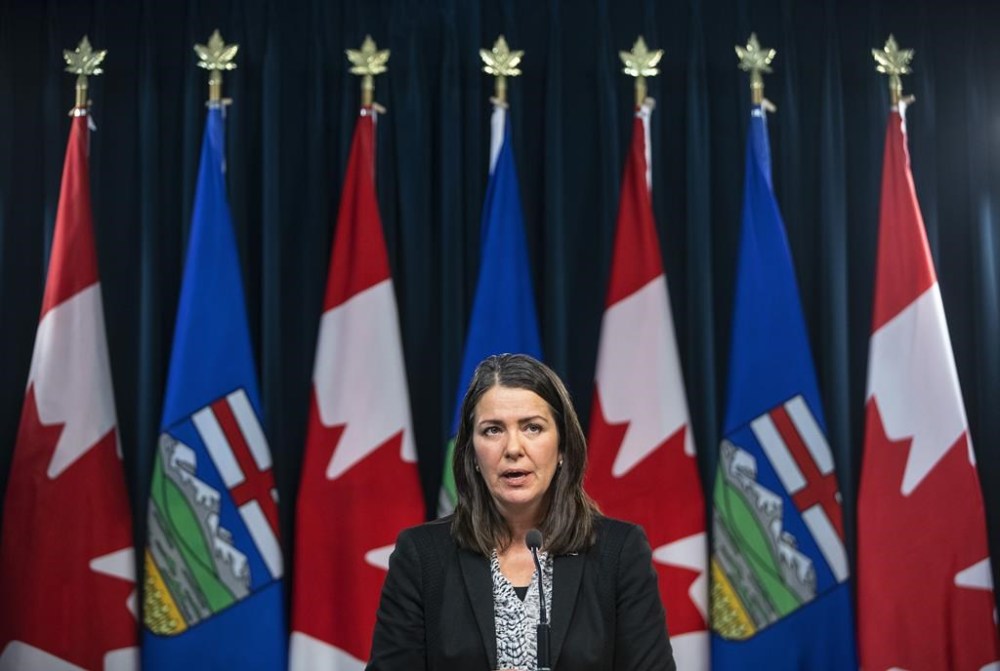
Alberta Premier Danielle Smith holds her first press conference in Edmonton on October 11, 2022. THE CANADIAN PRESS/Jason Franson

“We need to have some clear answers about what happens, what are thresholds in terms of when might we see a mask mandate?”

No one from Alberta Health responded to a request for comment.

Alberta Education said in an email that it would review the request and act appropriately with advice from the chief medical officer of health, but will not mandate masks for students.

School officials told the Edmonton public board that more than 150 of the 213 schools in the district have met or exceeded a 10 per cent threshold for outbreak status by Alberta Health Services.

AHS, the province’s health-care provider, has declined to provide outbreak information but schools across the province have reported spikes in absenteeism due to a wave of illnesses, including COVID-19, the flu and respiratory syncytial virus, or RSV.

The Calgary Board of Education said it had an average student absentee rate across the district of nearly 12 per cent last week due to illness and more than 15 of its 250 schools have had outbreaks declared.

Both Alberta Children’s Hospital in Calgary and the Stollery Children’s Hospital in Edmonton are dealing with a crush of patients, some seriously ill.

Health officials said this week that in-patient units at both hospitals are at or over 100 per cent of their normal beds.

Dr. Carina Majaesic, medical director of Stollery Children’s Hospital, said there are more patients and longer waits.

“We’re full,” she said, “but we also add extra space when we are full.”

Health officials have said the Alberta Children’s Hospital emergency department has seen more than 300 visits a day recently, compared to between about 180 and 220 before the latest surge.

“We have had a very challenging several days,” said Margaret Fullerton, senior operating officer with Alberta Children’s Hospital.

Fullerton said the Calgary pediatric facility is also full, but health-care workers are making it work.

Health officials in Calgary and Edmonton said teams are working closely with schools to deal with outbreaks.

Dr. Christopher Sikora, medical officer of health in Edmonton, said there is a lot of school absenteeism across Alberta due to the three respiratory illnesses.

“It’s reassuring to see that parents are keeping their kids home,” he said. “Staying home until you’re better is one of those big things you can do to help keep others from getting sick.”

Calgary’s medical officer of health, Dr. Karla Gustafson, said there are other ways to reduce the risk.

“It’s really important that children are vaccinated against COVID and influenza to help reduce that burden of illness,” she said.

Masks, they said, are also proven to be effective to prevent the spread of respiratory illnesses.

“It’s encouraged for people who do feel comfortable doing it,” said Gustafson.

Premier Danielle Smith has been critical of mask rules in schools, saying they adversely affected the mental health, development and education of students during the pandemic.

“We’re not going to be mandating masks,” Smith said Monday. “We’ve heard loud and clear from parents that they want a normal school environment for their kids and we’re going to let kids be kids.”

Estabrooks said that’s short-sighted.

“If we’ve learned anything in this pandemic, it’s the need to be nimble and flexible and respond to the situation,” she said Tuesday following the board meeting.

“This is unprecedented, to see this level of illness and these numbers, these high rates of illness among our staff and students.”

Estabrooks said she and other school trustees have heard from many concerned parents.

“The situation is critical that we are seeing in our schools,” she said.

“We are doing all we can as a division to make sure that message is communicated to decision-makers. And when I say decision-makers, I mean health officials. Health officials need to be making health decisions.”

This report by The Canadian Press was first published Nov. 15, 2022.

— By Colette Derworiz in Calgary

Report Error Submit a Tip

More Stories

Science-art collaboration injects dose of emotion into cold, hard truths

Sarah Lawrynuik 5 minute read Preview

Science-art collaboration injects dose of emotion into cold, hard truths

Sarah Lawrynuik 5 minute read Wednesday, Apr. 28, 2021

Looking at spreadsheets and map plots of trees is far beyond Rhian Brynjolson’s typical day as a visual artist, but she became entranced and inspired by data collected by Canadian scientists for a new art project.

Her hope is to try and bring the numbers, map dots and statistics to life in a new way to help the public better connect to climate science.

Falcon Lake’s Brynjolson is one of 12 Canadian artists who participated in an art-science collaboration exhibit, co-ordinated by the Global Water Futures program out of the University of Saskatchewan. The project saw the artists paired with researchers and scientists across the country who then engaged in conversations to try to inspire a new angle to their art.

“The whole idea behind it is: water is life,” says Louise Arnal, the project lead, and a post-doctoral fellow at the Centre for Hydrology and Coldwater Laboratory.

Read
Wednesday, Apr. 28, 2021

Building healthier Canadians

Jason M. Sutherland 4 minute read 2:00 AM CDT

Ottawa is betting that billions of taxpayer dollars spent on steel, asphalt and concrete will secure Canada’s economic future and prosperity. Through the $51 billion Build Communities Strong fund, the federal government is paying for roads, bridges, water systems and transit to boost productivity and attract capital from Europe and Asia.

As the shovels hit the ground from Halifax to Vancouver, Canadians should be asking themselves: What good does it do to build a stronger country if we are not building healthier Canadians?

The fund’s $5 billion allocation for health infrastructure is welcome news, as many of our hospitals and long-term care homes across the country are showing severe signs of aging, and modern care centres are much needed. But pouring concrete for new facilities is not the same as building a healthy population.

A ribbon-cutting at a modern hospital does not guarantee you see a family doctor when you need one, keep a rural emergency department open overnight, or shorten the wait for a knee replacement keeping someone off the job or robbing a retiree of independence.

Health officials ponder next steps as COVID cases surge in Southern Health region

Katie May 5 minute read Preview

Health officials ponder next steps as COVID cases surge in Southern Health region

Katie May 5 minute read Wednesday, Nov. 3, 2021

Public-health officials say they're trying to avoid ordering another lockdown in southern Manitoba, where COVID-19 infection rates are surging.

Deputy chief provincial public health officer Dr. Jazz Atwal told a news conference Wednesday he doesn't anticipate more lockdowns and suggested he will prioritize keeping schools open when considering future restrictions.

But he couldn't say what the next step will be in an area of the province where hospitalizations among unvaccinated residents are on the rise.

Average daily case counts in the southern part of the province are higher now than they were before lockdown measures went into effect last November, and officials are still figuring out what to do.

Read
Wednesday, Nov. 3, 2021

The volatile U.S. midterms

Allan Levine 5 minute read Preview

The volatile U.S. midterms

Allan Levine 5 minute read 2:00 AM CDT

The last time the Democratic Party had 218 or more seats — the number required to control the U.S. House of Representatives — was from 2021 to 2023, following the election of Democrat Joe Biden as president. During that same period, the Democrats also had the edge in the Senate. Despite a 50-50 split with the Republicans, Democrats were able to control the Senate with the help of Vice-President Kamala Harris, who cast the key vote in a tie. From 2023 to 2025, the Democrats had a slim 51 to 49 Senate majority.

If history repeats itself and the latest polls are fairly accurate, on Tuesday, Nov. 3, the Democratic Party will take back the House and (probably) the Senate from the Republicans, who have controlled both legislative bodies since the 2024 election. In the House, the Democrats have to gain at least three more seats. In the Senate, they have to win four more, which is entirely doable, though they almost certainly have to win a seat in Texas, Ohio, Kansas or Alaska, each of which currently has two Republican senators.

The prospect of a Democratic victory has President Donald Trump in a tizzy. For the past two years, he has abused his executive power to impose illegal tariffs on Canada and other countries; started a war with Iran; cozied up to Russian president Vladimir Putin and turned his back on Ukrainian president Volodymyr Zelenskyy; and increased the national debt through questionable tax cuts — to list only a few of his more egregious actions. He has been able to get away with this mainly because Republicans in the Senate and the House refuse to even question his decisions.

With the Democrats in charge, Trump’s brazen actions won’t be completely halted, but he will face significant legislative challenges and obstacles not easily dismissed. His controversial appointees, such as Attorney General Todd Blanche, who perceives himself as Trump’s private lawyer rather than the legal representative of the people, won’t get a free pass in committee hearings.

Read
2:00 AM CDT

A timeline of the WE Charity controversy

The Canadian Press 9 minute read Wednesday, Aug. 19, 2020

OTTAWA - A timeline of events regarding the Canada Student Service Grant program, based on public documents, events and statements from cabinet ministers, government officials, and WE Charity:

March 6, 2020: WE Charity staff prepare a concept paper on service learning for public servants at Employment and Social Development Canada.

April 5: Finance Minister Bill Morneau and Prime Minister Justin Trudeau talk over the phone about how to help students whose summer job and volunteer opportunities were vanishing due to the COVID-19 pandemic. Finance Department officials are tasked with considering options the next morning.

April 7: Small Business Minister Mary Ng and WE co-founder Craig Kielburger have an introductory phone call in which Ng asks WE to send what it calls a ``pre-established proposal'' to help young people launch businesses.

Manitoba family adopts Ukrainian children just before Russian invasion

Chris Kitching 7 minute read Preview

Manitoba family adopts Ukrainian children just before Russian invasion

Chris Kitching 7 minute read Wednesday, Mar. 30, 2022

When Trish Braun sees horrific images of Russia’s attack on Ukraine, the Manitoba mother is thankful she had enough time to flee from the country with her three adopted children.

Other Canadian families weren’t as fortunate, as Ukraine halted intercountry adoptions due to the Kremlin’s unprovoked invasion and war.

“I’m so thankful we were able to get out, but lots (of Ukrainians) don’t have the option of getting to leave,” said Braun, who lives in Grunthal, about 50 kilometres southeast of Winnipeg. “It’s hard to adjust to life here while our hearts are over there.”

Just days before Russia began its assault, Braun was staying in the Odesa region with the three Ukrainian children — siblings Daniel, 16, Lewis, 10, and Paige, 6 — that she and her husband, Mike, 43, had adopted from an orphanage.

Read
Wednesday, Mar. 30, 2022