Shocking development
EVs and partial EVs dominate stage at Canadian Car and Utility Vehicle of the Year

Advertisement
Read this article for free:
or
Already have an account? Log in here »
To continue reading, please subscribe:
Digital Subscription
One year of digital access for only $1.44 a week*
- Enjoy unlimited reading on winnipegfreepress.com
- Read the E-Edition, our digital replica newspaper
- Access News Break, our award-winning app
- Play interactive puzzles
*Billed as $5.77 plus GST every four weeks. After 52 weeks, price increases to the regular rate of $19.95 plus GST every four weeks. Offer available to new and qualified returning subscribers only. Cancel any time.
To continue reading, please subscribe:
Add Free Press access to your Brandon Sun subscription for only an additional
$1 for the first 4 weeks*
- Enjoy unlimited reading on winnipegfreepress.com
- Read the E-Edition, our digital replica newspaper
- Access News Break, our award-winning app
- Play interactive puzzles
*Your next Brandon Sun subscription payment will increase by $1.00 and you will be charged $17.95 plus GST for four weeks. After four weeks, your payment will increase to $24.95 plus GST every four weeks.
Read unlimited articles for free today:
or
Already have an account? Log in here »
HOCKLEY VALLEY, Ont. — It’s not too often you get into a new vehicle, look at the interior, and say to yourself, “Wow, this is different… in a good way.”
Automakers tend to stick pretty close to defined norms, and when they differ, it’s not always successful. I’m looking at you, Toyota Yaris and Nissan X-Trail.
So, stepping into the 2027 BMW iX3 was refreshing. A bright parallelogram of a main touchscreen is closer to the driver than most, aided in no small part by pushing the instrument cluster to a narrow band just under the windscreen.
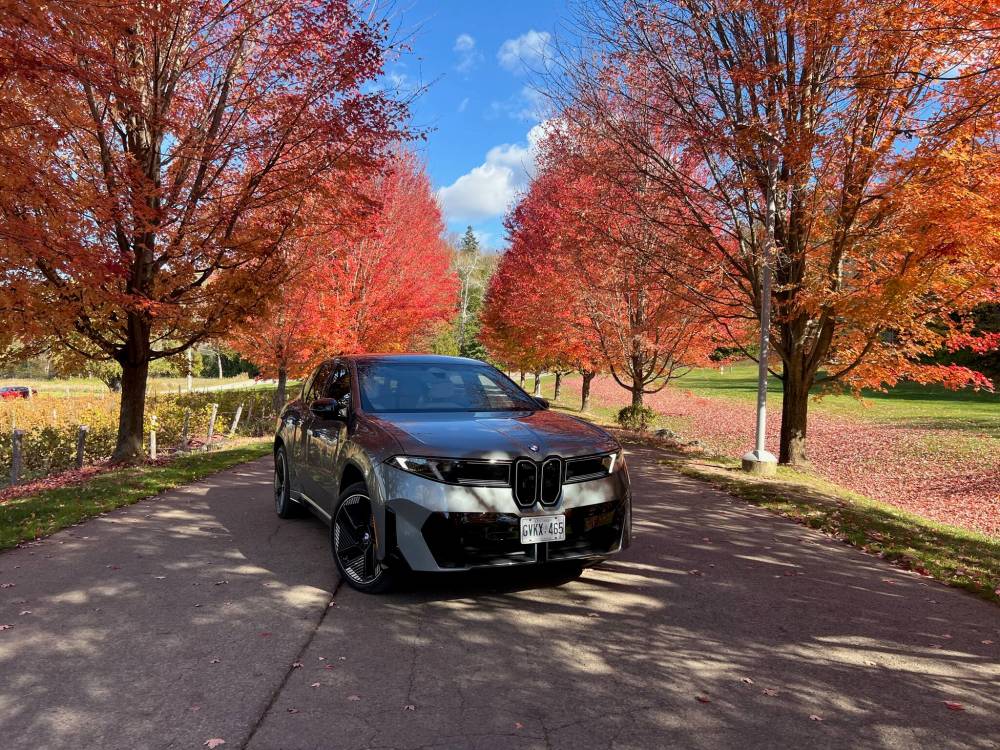
Kelly Taylor / Free Press
The BMW iX3 impressed with a flashy, unique approach to its interior, while on the road it was fast and nimble.
The effect is to clean up the look of the dash but without moving to a centre-mount instrument panel like the Yaris and X-Trail. The most valuable information (speed, battery charge, range) is right in front of the driver, visible above the top rim of the steering wheel.
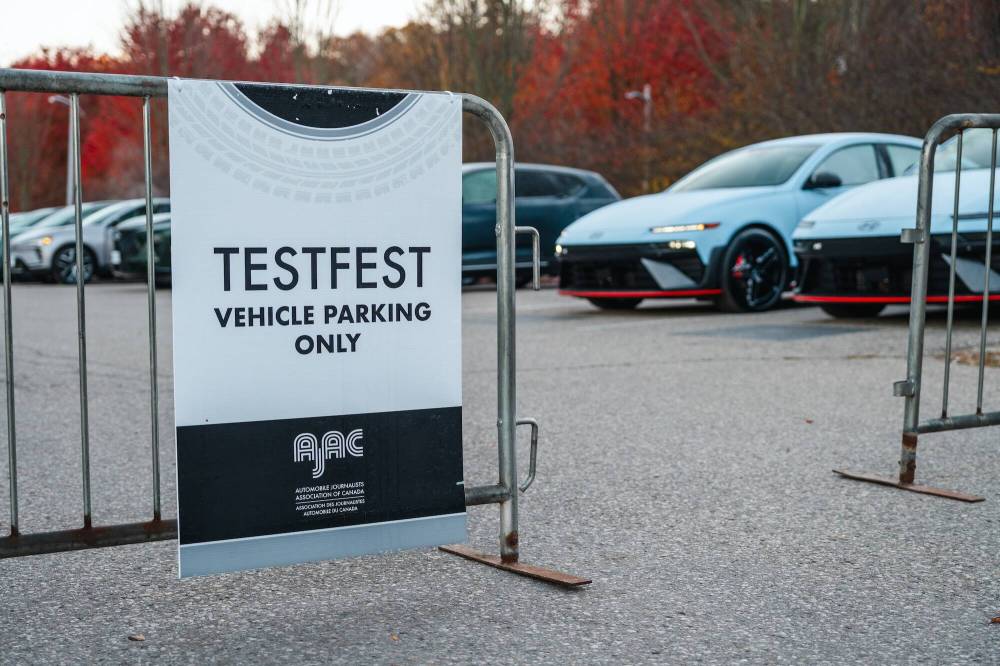
The iX3 was just one of many surprises at TestFest, the annual event where the Automobile Journalists Association of Canada helps judge the Canadian Car and Utility Vehicle of the Year awards. Not the least of those surprises was the heavy predominance of electrified vehicles.
In years past, there was an EV here, a hybrid there and perhaps a plug-in hybrid over there, but the dominant fuel source was petrol. This year, the script flipped: only a handful of vehicles on hand were solely powered by gasoline.
Some background is in order: every vehicle sold in Canada for 2027 is eligible for an award. In the past, carmakers had to be members of AJAC to enter vehicles. The change means every vehicle is eligible but it doesn’t mean every vehicle shows up at TestFest.
Of the 46 vehicles at the event, only eight were purely internal combustion. The range of electrified vehicles ran from the BMW iX3 (pure EV) to the Volvo EX60 (also a pure EV). In between were EVs such as the Genesis GV60 Magma, Mercedes-Benz CLA 250+, Toyota bZ Woodland and hybrids such as the Mazda CX-70 plug-in hybrid and Subaru Crosstrek.
The Porsche 911 Carrera was listed as internal combustion, but even it uses an electric motor to provide low-end boost for acceleration while reducing demands on the fuel tank.
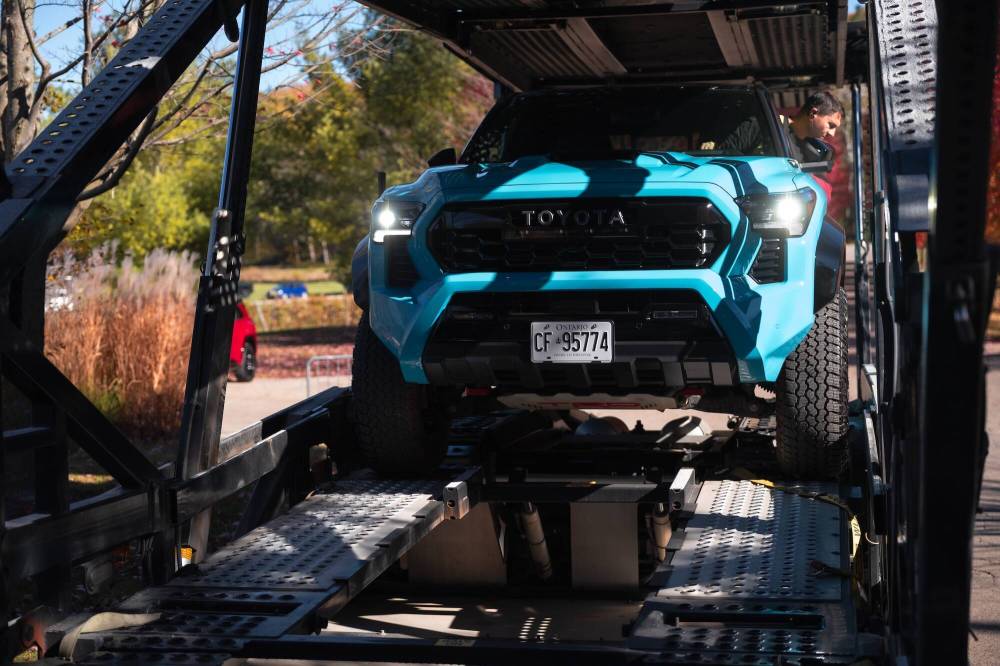
Aux Media
The Toyota Tacoma TRD Pro is every bit as butch as a pickup driver wants. Don’t forget your flannel plaid shirt.
If the terms of electrification are new to you, here’s a quick rundown: EV — pure battery power; PHEV — plug-in hybrid, is charged when not in use and runs primarily on battery power until it gets low then uses a mix of a gas engine and electric propulsion; HEV — hybrid electric, has no charging port and may have limited EV-only capability but primarily always mixes gas and electric propulsion.
The pros of each: EV — zero emissions, costs a few bucks to get to a full battery; PHEV — the EV range of most PHEVs means many Canadians’ commutes would be entirely electric, but the gas motor is on hand for longer trips; HEV — lower cost of entry, zero learning curve (you simply drive it like any other car, albeit while spending less on fuel).
Back to the BMW iX3: this was, perhaps, my favourite EV at TestFest, however, that may be due to the $75,900 price tag. It had the interior, the handling, the acceleration and the mix of luxury and minimalism to expect from BMW.
The iX3 is all-wheel drive, powered by a 463 horsepower, 476 pound-feet of torque electric motor running on an 800-volt architecture. It supports 400 kW DC charging, has maximum 698 km of range and supports bi-directional power through its NACS charging port. Which means it can charge at a Tesla Supercharger and can power your home in an emergency with the right equipment in your home.
The EV that caught my eye as well was the Mercedes CLA 250+. As driven, this $49,900 EV came in at $54,700, or tens of thousands of dollars less than I expected. Its 85 kWh battery delivers 602 km of range, 268 horsepower and 247 pound-feet of torque. It’s rear-drive, largely because that’s where the motor is, as well. Mercedes says it will clear 0-100 in 6.6 seconds.
It’s not as fast as the Bimmer, but nearly as luxurious, and a major advance of the CLA nameplate, since the first CLA looked and felt like a budget-friendly Benz and this one doesn’t.
Aux Media
Manufacturers provided 46 vehicles for journalists to drive. Kid in a candy store time.
My guilty pleasure at TestFest had to be the 2027 Toyota Tacoma TRD Pro. It is butch, to the point that if you’re driving it not wearing a flannel plaid shirt and faded blue jeans, you’ll feel out of place. I know I did.
Even the Tacoma doesn’t escape electrification. It’s powered by a 2.4-litre turbo four-cylinder that, thanks to the hybrid electric motor, doesn’t feel like a four-banger. It looks, and drives, as though it could conquer any offroad scenario you could throw at it. The TRD Pro package ($14,867) adds Fox shocks, an LED light bar, recovery hooks front and rear and four auxiliary switches you can customize for your own accessories, among other toys. The all-in price was $82,260.92, including $1,930 destination fee.
I’d be happy with the base Tacoma at $65,315. It is arguably an elbows-up choice, as well, as it’s built in Mexico, unlike its U.S.-built big brother.

The car that performed the best in the slalom was, unsurprisingly, the 911 Carrera. It too horribly inconveniences millions of electrons for its performance. It uses what the manufacturer calls a 3.6-litre eTurbo Boxer6, or a horizontally opposed six-cylinder motor with electric turbocharger tied to a 110 pound-foot electric motor for boost.
With a base price of $188,300 and an as-tested of $221,980, including $2,950 destination fee… it better be nice. And it is.
My predictions: Car of the Year: Honda Prelude (hybrid power, luxe treatment). Utility Vehicle of the Year: Toyota bZ Woodland (electric, fast, fun-to-drive). Luxury Car of the Year: Mercedes-Benz CLA 250+ (for a luxury EV at less than $55,000, it seems hard to beat). Luxury Utility of the Year: Lexus NX (fun-to-drive, fast, luxurious, Toyota quality).

Aux Media
A frosty start to the day and the perfect landing spot for a maple leaf, on the Nissan Leaf.
Finalists will be announced at the Montreal Auto Show (Jan. 15-24) and winners at the Canadian International Auto Show in Toronto (Feb 12-21).
kelly.taylor@winnipegfreepress.com
Our newsroom depends on a growing audience of readers to power our journalism. If you are not a paid reader, please consider becoming a subscriber.
Our newsroom depends on its audience of readers to power our journalism. Thank you for your support.
Our newsroom depends on a growing audience of readers to power our journalism. If you are not a paid reader, please consider becoming a subscriber.
Our newsroom depends on its audience of readers to power our journalism. Thank you for your support.
Advertisement Advertise With Us
Advertisement Advertise With Us