Pandemic fatigue, divisive politics pose likely hurdles to return to masking: experts

Advertisement

Advertise with us

TORONTO - A plea by health officials to resume masking in Ontario and Quebec is a tall order that is unlikely to take hold without a significant culture shift, say observers who point to pandemic fatigue, mixed messages and divisive politics as likely hurdles.

Read this article for free:


By clicking the button above, an account will be created and you will begin to receive some of our recommended newsletters. You may opt out of any newsletter by visiting your Email and Communication Preferences page or by clicking "unsubscribe" at the bottom of any email.

or

Already have an account? Log in here »

To continue reading, please subscribe:

Digital Subscription

One year of digital access for only $1.44 a week*

  • Enjoy unlimited reading on winnipegfreepress.com
  • Read the E-Edition, our digital replica newspaper
  • Access News Break, our award-winning app
  • Play interactive puzzles

*Billed as $5.77 plus GST every four weeks. After 52 weeks, price increases to the regular rate of $19.95 plus GST every four weeks. Offer available to new and qualified returning subscribers only. Cancel any time.

To continue reading, please subscribe:

Add Free Press access to your Brandon Sun subscription for only an additional

$1 for the first 4 weeks*

  • Enjoy unlimited reading on winnipegfreepress.com
  • Read the E-Edition, our digital replica newspaper
  • Access News Break, our award-winning app
  • Play interactive puzzles
Start now

*Your next Brandon Sun subscription payment will increase by $1.00 and you will be charged $17.95 plus GST for four weeks. After four weeks, your payment will increase to $24.95 plus GST every four weeks.

Hey there, time traveller!
This article was published 15/11/2022 (1445 days ago), so information in it may no longer be current.

TORONTO – A plea by health officials to resume masking in Ontario and Quebec is a tall order that is unlikely to take hold without a significant culture shift, say observers who point to pandemic fatigue, mixed messages and divisive politics as likely hurdles.

The fact that a renewed push for personal protective measures remains voluntary means many people will consider it optional, and possibly even unnecessary, says behaviour expert and York University associate professor Rebecca Bassett-Gunter.

She notes that many people abandoned masks altogether after most pandemic precautions were lifted earlier this year.
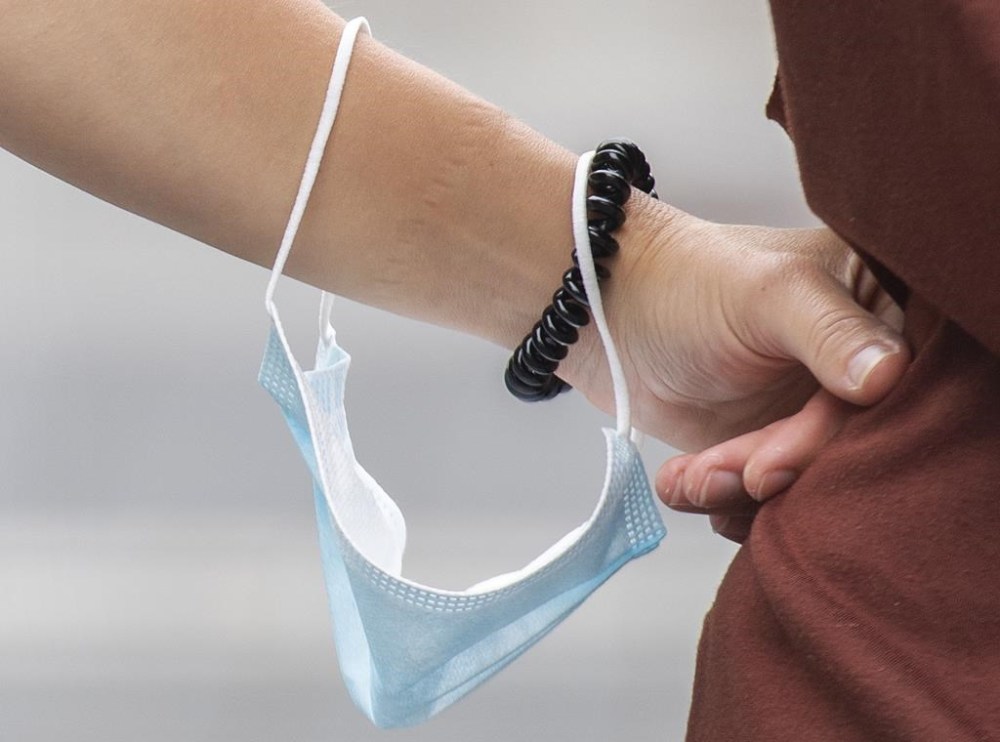
A disposable face mask is shown attached to a woman's arm in Old Montreal on July 18 2021. A plea by health officials to resume masking in Ontario and Quebec is a tall order that is unlikely to take hold without a significant culture shift, say observers who point to pandemic fatigue, mixed messages and divisive politics as likely hurdles. THE CANADIAN PRESS/Graham Hughes

It’s not clear that weeks of warnings from overwhelmed hospital staff over the “triple threat” of viral infections is enough to get those same people to put their masks back on.

“Without mandating it, I think people are hearing a message that it must not be as bad as it was,” says Bassett-Gunter, whose research at the school of kinesiology and health science has included a look at how to get people to comply with COVID-19 precautions.

“That’s a really hard implicit message to override, unfortunately.”

Add in pandemic fatigue and a yearning for festive holiday gatherings to return after two seasons of restraint, and public health officials face a tough psychological wall to break through, adds Dr. Eddy Lang, professor and department head for emergency medicine at the Cumming School of Medicine at the University of Calgary.

While his province isn’t seeing a surge in respiratory syncytial virus and influenza cases to the same degree as Ontario and Quebec, he noted cases are expected to increase as cold and flu season progresses.

“When we look at the wastewater analysis, RSV is still on the rise, which suggests that the worst of it may still be yet to come,” Lang said.

Already, a wave of viral illnesses among young students has pushed hospital capacity to dangerous levels. But given Alberta Premier Danielle Smith’s stated opposition to a school mask mandate, Lang doubts a masking plea is imminent or that there is much public support for more precautions.

“People are just so tired of public health directives,” says Lang.

“Until we really see a cultural shift … I don’t think this is going to work particularly well or give us much of an impact against hospitalizations.”

Health authorities in Canada’s two most populous provinces issued strong recommendations on Monday for people to mask up indoors to mitigate the spread of respiratory viruses that have overwhelmed hospitals and pediatric centres.

Ontario’s chief medical officer of health, Dr. Kieran Moore, stressed the vulnerability of babies and children younger than five to unseasonably high rates of RSV and rising rates of influenza. At the same time, he warned of emerging COVID-19 variants.

Quebec’s college of physicians made a similar appeal that the public don masks on a “voluntary and preventive basis” in public places, crowded private spaces and on public transit.

Last week, Canada’s top doctor stressed the need for “stepped-up precautions” while warning that COVID-19, RSV and the flu were challenging the health system in several parts of the country.

Turney McKee of the Montreal-based consultancy group Decision Lab was skeptical that “a mere recommendation” would be enough to drive the adoption needed to mitigate public health risks.

“Sure, our attitudes or values may align with one course of action, but then when actually put in the situation to either comply or not to comply, I think it’s very likely that we see a disconnect,” says McKee.

He sees politics as less a driver than fatigue, convenience and social pressure.

“When the mandate is no longer there, if it is no longer convenient, we’re probably going to stop,” says McKee, whose firm uses applied behavioural science to guide advice for organizations and government clients.

“And when we see everyone else around us starting to stop, the social influence can be very potent.”

However, that’s not to say this public health plea is completely powerless.

It sends a clear signal that stronger measures could follow and that the public should brace for a potential mandate, says McKee.

“It primes people to expect that maybe some more heavy-handed measures are around the corner,” he says.

Moore said a mask mandate could be possible if Ontario’s health-care system continues to see an increase in pressure due to respiratory illnesses, though he said that would be “the furthest we’d have to go.”

This report by The Canadian Press was first published Nov. 15, 2022.

Report Error Submit a Tip

More Stories

Health officials ponder next steps as COVID cases surge in Southern Health region

Katie May 5 minute read Preview

Health officials ponder next steps as COVID cases surge in Southern Health region

Katie May 5 minute read Wednesday, Nov. 3, 2021

Public-health officials say they're trying to avoid ordering another lockdown in southern Manitoba, where COVID-19 infection rates are surging.

Deputy chief provincial public health officer Dr. Jazz Atwal told a news conference Wednesday he doesn't anticipate more lockdowns and suggested he will prioritize keeping schools open when considering future restrictions.

But he couldn't say what the next step will be in an area of the province where hospitalizations among unvaccinated residents are on the rise.

Average daily case counts in the southern part of the province are higher now than they were before lockdown measures went into effect last November, and officials are still figuring out what to do.

Read
Wednesday, Nov. 3, 2021

Science-art collaboration injects dose of emotion into cold, hard truths

Sarah Lawrynuik 5 minute read Preview

Science-art collaboration injects dose of emotion into cold, hard truths

Sarah Lawrynuik 5 minute read Wednesday, Apr. 28, 2021

Looking at spreadsheets and map plots of trees is far beyond Rhian Brynjolson’s typical day as a visual artist, but she became entranced and inspired by data collected by Canadian scientists for a new art project.

Her hope is to try and bring the numbers, map dots and statistics to life in a new way to help the public better connect to climate science.

Falcon Lake’s Brynjolson is one of 12 Canadian artists who participated in an art-science collaboration exhibit, co-ordinated by the Global Water Futures program out of the University of Saskatchewan. The project saw the artists paired with researchers and scientists across the country who then engaged in conversations to try to inspire a new angle to their art.

“The whole idea behind it is: water is life,” says Louise Arnal, the project lead, and a post-doctoral fellow at the Centre for Hydrology and Coldwater Laboratory.

Read
Wednesday, Apr. 28, 2021

Notable quotes from 2020 Tokyo Olympics

The Canadian Press 4 minute read Sunday, Jul. 25, 2021

Correctional Services Canada is reopening prison farms. But in B.C., where it has no such programs, a wife and her late husband, who killed a man in a botched holdup, started Emma’s Acres, a unique prison farm she hopes to see expanded.

State of Manchester United goes beyond ‘favourite soap opera’ status

Jerrad Peters 7 minute read Preview

State of Manchester United goes beyond ‘favourite soap opera’ status

Jerrad Peters 7 minute read 1:17 PM CDT

Last Sunday, during Manchester United’s embarrassing 3-0 loss at home to Bournemouth, supporters in the Stretford End of Old Trafford unveiled a giant banner in protest of their club’s decline.

Beneath depictions of three iconic captains — Eric Cantona, Roy Keane and Bryan Robson — it presented a single word: “STANDARDS.” It wasn’t lost on anyone, as the Red Devils slumped to their meek defeat, that the banner represented the only “standards” in the stadium that afternoon.

The players were booed off the field, and the rest of the week was spent rehashing the inquiry of what, this time, might be wrong with England’s biggest club — an ongoing conversation the BBC has described as “one of the nation’s favourite soap operas.”

Inevitably, the public looked to the trio of greats whose likenesses looked down on the Bournemouth debacle to help make sense of the performance, of the ever-lowering bar of expectations and of the club’s more deep-rooted problems.

Read
1:17 PM CDT

Waiting for Cormier verdict the ‘calm before the storm’

Katie May 6 minute read Preview

Waiting for Cormier verdict the ‘calm before the storm’

Katie May 6 minute read Thursday, Feb. 22, 2018

As the jury room door closed behind the seven women and four men who are now deliberating on the evidence against Tina Fontaine’s accused killer, Thelma Favel rose from the chair she’s occupied for most of Raymond Cormier’s second-degree murder trial.

Almost every day over the past three weeks, Favel, the woman who raised 15-year-old Tina, has sat right up front, directly across from the jury box, listening, sobbing and soaking in disturbing details of the teen’s last days that have come to light over the course of Cormier’s second-degree murder trial.

On Wednesday afternoon, after Court of Queen’s Bench Chief Justice Glenn Joyal instructed the jury and sent them off to be sequestered until they decide whether 56-year-old Raymond Cormier is guilty of killing Tina, Favel got up and hugged Crown prosecutor Breta Passler. It was one of many moments, this one shielded from jurors, that have long since proven the emotional impact of the case and the lasting power of Tina’s legacy.

Tina’s death sparked a public outcry that renewed calls for a national inquiry into disproportionately high rates of missing and murdered Indigenous women and girls across Canada, and the criminal trial for the man accused of killing her hasn’t happened in a vacuum.

Read
Thursday, Feb. 22, 2018

Wife’s witchy wonderment won’t spell trouble

Maureen Scurfield 6 minute read 2:00 AM CDT

DEAR MISS LONELYHEARTS: My wife believes in magic potions, which used to make me laugh. But since Halloween season started this year, she’s been acting in a way that frightens me. She seems to think she’s a modern-day “witch.” Give me a break!

Now she has three friends who think they are really casting spells when they get together! And this year on Halloween night she’s being formally accepted into their little witchy group meeting at one of their homes, and is getting a new sorceress name. It’s creepy! How do I cope? I’ve had enough of this.

— Seriously Upset, South St. Vital

Dear Upset: Don’t buy into the hocus pocus by being afraid of it and expressing any trepidation to your wife. She needs you to be strong, so she knows she has a solid anchor and can drop out of this witchy group if it becomes too scary or silly for her.