Open U.S. land border could drain tourists southward, Canadian operators worry

Advertisement

Advertise with us

MONTREAL - Tourism operators are of two minds about the opening of the U.S. land border Monday.

Read this article for free:


or

Already have an account? Log in here »

To continue reading, please subscribe:

Subscribe and receive a limited-edition Free Press branded hat or tote.

Digital Subscription

One year of digital access for only $205*

  • Enjoy unlimited reading on winnipegfreepress.com
  • Read the E-Edition, our digital replica newspaper
  • Access News Break, our award-winning app
  • Play interactive puzzles

*First annual payment billed as $205.00 + GST for one year. This annual subscription will automatically renew at $233.00 + GST every 52 weeks (10% off the regular annual price of $259.35). Offer available to new and qualified returning subscribers only. Cancel any time.

To continue reading, please subscribe:

Add Free Press access to your Brandon Sun subscription for only an additional

$1 for the first 4 weeks*

  • Enjoy unlimited reading on winnipegfreepress.com
  • Read the E-Edition, our digital replica newspaper
  • Access News Break, our award-winning app
  • Play interactive puzzles
Start now

*Your next Brandon Sun subscription payment will increase by $1.00 and you will be charged $17.95 plus GST for four weeks. After four weeks, your payment will increase to $24.95 plus GST every four weeks.

Hey there, time traveller!
This article was published 08/11/2021 (1792 days ago), so information in it may no longer be current.

MONTREAL – Tourism operators are of two minds about the opening of the U.S. land border Monday.

An end to the 20-month closure of the world’s longest undefended frontier marks a sign that restrictions are loosening and more international leisure travel may be on the horizon.

Then again, if Canadians start to stream south for vacations and shopping sprees, they aren’t spending their money on destinations here.
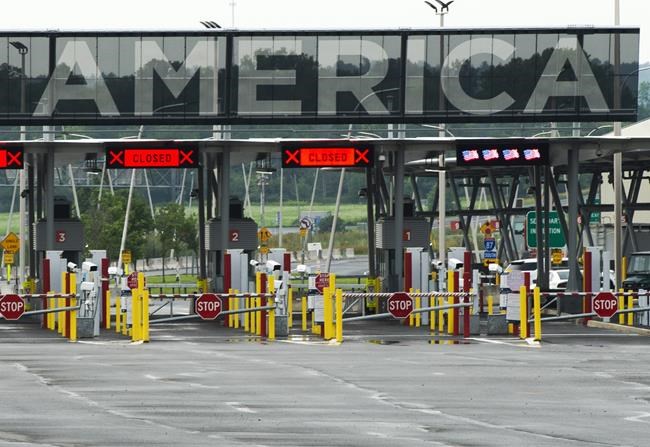
The U.S. border crossing is seen in Lacolle, Que., Monday, Aug. 9, 2021. An end to the 20-month closure of the world's longest undefended frontier marks a sign that restrictions are loosening and more international leisure travel may be on the horizon. THE CANADIAN PRESS/Ryan Remiorz

Chris Bloore, chief executive of the Tourism Industry Association of Ontario, says local visits to hot spots ranging from Niagara Region vineyards to the boutique hotels of Prince Edward County will undoubtedly decline after receiving a boost last summer.

“There is definitely going to be a reduction in some numbers, for sure. That’s absolutely inevitable,” he said.

“But as we start to welcome international visitors now back to Canada, as we try and push for PCR testing, changes to protocols, we’re hoping to make sure that we’re looking further afield to people as well to try and bring them to us.”

Travel and tourism organizations are lobbying the federal government, which opened its border to Americans in August, to end the ongoing COVID-19 test requirement to enter the country.

Currently, any Canadian returning home by land who wants to avoid quarantine needs to provide a recent molecular test that shows a negative result. Non-residents who test positive are turned away at the border.

At a cost of $150 to $300 per test, that can be a pricey proposition, particularly for families.

Chief public health officer Dr. Theresa Tam said Friday that test rules for vaccinated travellers need to be re-examined, especially for short trips. As it stands, Canadians can even get tested on home turf before their trip, as long as they return within 72 hours.

“Unless Canada changes that regulation or that order of not requiring a PCR test to re-enter the country, I don’t think you’re going to see large volumes of people heading into the United States,” said Walt Judas, head of British Columbia’s tourism association. That holds true for both day trippers and vacationers, he said.

However, some areas will feel the pinch more sharply.

Vancouver Island and British Columbia’s Okanagan Valley will likely see a major drop in Canadian trailer and campervan drivers as snowbirds flock south.

“Small communities like Osoyoos managed to retain a lot of Canadians who camped in their RVs for the duration of the winter. So those folks will likely do as they’ve done in years previous and head into the U.S.,” Judas said.

It’s not just the campgrounds that will feel the impact of fewer visitors.

“They’re all users of other venues and facilities and visit grocery stores and they eat in restaurants, some might even choose to stay in a hotel for a bit of a getaway that’s more localized,” he said.

Meanwhile, the ongoing lag in corporate travel — domestically and internationally — hurts stakeholders ranging from airport hotels to mountain resorts and downtown convention centres, as well as attendant services such as catering, housekeeping and audiovisual companies.

But Tourism Industry Association of Canada CEO Beth Potter says a border that lets visitors filter through in both directions for non-essential travel is one more step on the path to pre-pandemic levels of activity.

“More and more Canadians have discovered that Canada has a lot to offer,” she said. “We hope to see that trend continue next summer. And at the same time we would expect to see a return of American visitors as well.”

One incentive for Ontarians to stay put is the province’s staycation tax credit. Premier Doug Ford’s government on Thursday rolled out a plan for the measure, which would give residents a 20-per-cent personal income tax credit for money spent in-province on leisure and accommodations in 2022.

The credit ranges up to a maximum of $1,000 for an individual and $2,000 for a family, yielding a credit ceiling of $200 or $400 respectively.

Despite a more productive year than 2020, 2021 saw tourism activity remain well below that of the pre-pandemic era. In August, activity notched 41 per cent beneath the level reached in the same period two years earlier, according to Statistics Canada.

However, August marked the third consecutive month where tourism increased, “and was much improved from May, when overall tourism activity was 69.3 per cent below the pre-pandemic level,” the agency said Monday.

Nova Scotia, Ontario and B.C. remained far below pre-pandemic levels, while Quebec and Alberta saw tourism fall by a more moderate 37-to-39 per cent, according to StatCan.

Overall tourism from fellow Canadians was down by nearly 22 per cent in August compared with August 2019, while activity from international visitors was down by more than 83 per cent.

This report by The Canadian Press was first published Nov. 8, 2021.

Report Error Submit a Tip

More Stories

Canadian labour market still tight as economy sees slight bump in employment

Nojoud Al Mallees, The Canadian Press 5 minute read Preview

Canadian labour market still tight as economy sees slight bump in employment

Nojoud Al Mallees, The Canadian Press 5 minute read Friday, Oct. 7, 2022

OTTAWA - After sustaining three consecutive months of job losses and propelling fears of an economic slowdown, the Canadian economy posted a modest bump in employment in September, suggesting the labour market is still exceptionally tight.

The unemployment rate for the month fell to 5.2 per cent as fewer people looked for work, down from 5.4 per cent in August, Statistics Canada reported in its labour force survey released on Friday. Meanwhile,the economy added 21,000 jobs.

Economists say the latest jobs report shows employers are still eager to hire, and wages are growing accordingly.

The report showed wages were up by 5.2 per cent in September compared with a year ago, with the average hourly wage at $31.67. It marked the fourth straight month of five per cent or higher wage growth, but still falls short of the rate of inflation.

Read
Friday, Oct. 7, 2022

Fraudster gets six years in Shoppers Drug Mart case

Dean Pritchard 4 minute read Preview

Fraudster gets six years in Shoppers Drug Mart case

Dean Pritchard 4 minute read Monday, Aug. 10, 2026

A Calgary man has been sentenced to six years in prison for his role in a fraud ring that targeted Shoppers Drug Mart stores across four provinces.

Carlo Deguzman, 50, pleaded guilty in a Winnipeg courtroom Monday to six counts of fraud, forgery and identification theft for offences dating back more than four years.

Deguzman’s guilty pleas came on what was to be the first day of his trial — the third to be set and cancelled since his initial arrest in 2022. During that time, he hired and fired seven lawyers.

“These matters could have been dealt with years ago, but for the actions of the accused,” prosecutor Kathy Bueti told provincial court Judge Heather Pullan. “He was hoping delay would make the case harder to prove. That’s not the case. The charges weren’t going away.”

Read
Monday, Aug. 10, 2026

What’s luck got to do with it?

Tim Kist 5 minute read Saturday, Oct. 3, 2026

We all seek certainty in our daily lives. We expect if we make a decision, the outcome will be just as we planned: a direct correlation between the decision and result.

You, as a business leader, seek the same certainty from the decisions you make. And sometimes, the result is what was expected. Sometimes, it isn’t.

The big question is: why is it so difficult to achieve the business results you expect when you carefully craft your plans and seemingly make good decisions?

The truth is we cannot predict the future. This means we almost never know precisely how customers will respond to a sales quote, what competitors are planning, and a myriad of other external variables at play.

City, province, Ottawa strike task force to battle meth

Jessica Botelho-Urbanski 5 minute read Preview

City, province, Ottawa strike task force to battle meth

Jessica Botelho-Urbanski 5 minute read Tuesday, Dec. 18, 2018

The city, province and federal governments are teaming up to create a tri-level task force that will fight distribution of illicit drugs and address the root causes of the province's meth crisis.

"As far as we know, this is the first collaborative initiative like this in the country and it’s something that I’m very proud to be a part of," said Winnipeg Mayor Brian Bowman, who had been calling for such a task force (with unanimous council support) since September. 

In interviews last week, officials from the three levels of government told the Free Press they hadn't yet met in the same room to discuss the surge in meth-related problems.

By Tuesday, it seems they managed to clear their schedules.

Read
Tuesday, Dec. 18, 2018

Broadening prediction-market gambling a bad idea

Editorial 4 minute read Preview

Broadening prediction-market gambling a bad idea

Editorial 4 minute read Saturday, Oct. 3, 2026

Let’s make a prediction: sooner or later, when Canadian governments find a way to take their own cut of the action, prediction-contract gambling on everything from sports to entertainment to political decisions is going to come to Canada.

And that’s a horrible, dangerous, pernicious idea.

Unless you have particular access to information — either inside information or strategic information based on skills or education — you’re not likely to make money at it. In fact, structurally, you’re likely to lose. In prediction markets, you basically pay an amount, plus fees from the company involved, to bet on whether something will or will not happen within a certain time frame. The amount you pay for your contract depends on how other people are also betting.

As Wealthsimple describes it, “You buy whichever side you think is right. Prices move with demand, so if the market leans towards one outcome, the more that side costs. If a lot of people are backing the TSX to finish above 38,000, yes gets more expensive and no gets cheaper.”

Read
Saturday, Oct. 3, 2026

Not making the grade: rethinking student assessment

Maggie Macintosh 5 minute read Preview

Not making the grade: rethinking student assessment

Maggie Macintosh 5 minute read Thursday, Oct. 5, 2023

As most students in B.C. began the new school year without traditional grades, a former Manitoba teacher living in that province is urging colleagues here to do their homework on modern assessment and experiment with marking.

Starting this year, public and private school teachers in British Columbia are assessing kindergarten through Grade 9 with a scale describing a student’s level of understanding — “emerging,” “developing,” “proficient” or “extending” — instead of letter grades.

Grade 10, 11 and 12 students will continue to receive traditional letter grades and percentages.

“What’s wrong with percentages? There’s nothing wrong with them. They are a wonderful little tool, as long as they stay in their lane,” said Myron Dueck, an education consultant who was born in Winnipeg, where he graduated from teachers’ college in 1994.

Read
Thursday, Oct. 5, 2023