EXPLAINER: Why Japan ‘rising sun’ flag provokes Olympic ire

Advertisement

Advertise with us

SEOUL, South Korea (AP) — Japan considers the “rising sun” flag part of its history. But some in the Koreas, China and other Asian countries say the flag is a reminder of Japan’s wartime atrocities, and is comparable to the Nazi swastika.

Read this article for free:


or

Already have an account? Log in here »

To continue reading, please subscribe:

Subscribe and receive a limited-edition Free Press branded hat or tote.

Digital Subscription

One year of digital access for only $205*

  • Enjoy unlimited reading on winnipegfreepress.com
  • Read the E-Edition, our digital replica newspaper
  • Access News Break, our award-winning app
  • Play interactive puzzles

*First annual payment billed as $205.00 + GST for one year. This annual subscription will automatically renew at $233.00 + GST every 52 weeks (10% off the regular annual price of $259.35). Offer available to new and qualified returning subscribers only. Cancel any time.

To continue reading, please subscribe:

Add Free Press access to your Brandon Sun subscription for only an additional

$1 for the first 4 weeks*

  • Enjoy unlimited reading on winnipegfreepress.com
  • Read the E-Edition, our digital replica newspaper
  • Access News Break, our award-winning app
  • Play interactive puzzles
Start now

*Your next Brandon Sun subscription payment will increase by $1.00 and you will be charged $17.95 plus GST for four weeks. After four weeks, your payment will increase to $24.95 plus GST every four weeks.

Hey there, time traveller!
This article was published 22/07/2021 (1870 days ago), so information in it may no longer be current.

SEOUL, South Korea (AP) — Japan considers the “rising sun” flag part of its history. But some in the Koreas, China and other Asian countries say the flag is a reminder of Japan’s wartime atrocities, and is comparable to the Nazi swastika.

That’s why the flag has created anger at the Olympics, with some of the host nation’s neighbors calling for it to be banned during the Tokyo Games, which start Friday.

There’s little prospect that ties between Seoul and Tokyo will improve any time soon. But the flag dispute may ease. Some experts say the COVID-19 restrictions that have banned spectators at most Olympic venues stadiums may prevent the disagreement from growing.
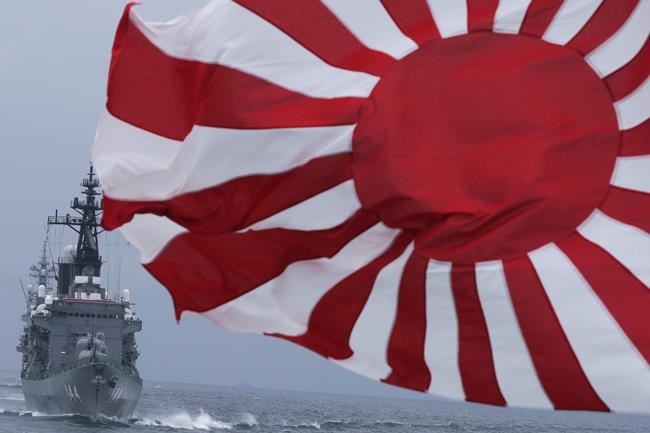
FILE - In this Oct. 14, 2012, file photo, Japan Maritime Self-Defense Force (JMSDF) escort ship
FILE - In this Oct. 14, 2012, file photo, Japan Maritime Self-Defense Force (JMSDF) escort ship "Kurama," left, navigates behind destroyer "Yudachi," with a rising sun flag, during a fleet review in water off Sagami Bay, south of Tokyo. Japan’s “rising sun” flag is raising anger at the Olympics, with some of the host nation’s neighbors calling for it to be banned during the Tokyo Games, which start Friday, July 23, 2021. (AP Photo/Itsuo Inouye, File)

Here’s a look at the “rising sun” flag and the long-running unease it has caused in Northeast Asia.

___

ORIGIN

There are two rising sun flags associated with Japan, whose very name in Japanese means “the sun’s origin.”

One is the country’s national flag, called “nisshoki,” or “hinomaru,” which has a red disc on a white background. Few have a problem with this.

The other one also has a red disc, but it is surrounded by 16 rays that extend outward. Called “kyokujitsuki,” this one has led to vehement protests from some of Japan’s neighbors.

Both flags have been used for centuries. But disputes about the “rising sun” flag date back to the early part of the 20th century. That’s when Japan’s imperial navy used it as its official flag as the nation colonized the Korean Peninsula and invaded or occupied China and other Asian countries until its World War II defeat in 1945.

It’s still Japan’s navy flag, used by the Maritime Self-Defense Force and, in a slightly modified version, by the Ground-Self Defense Force since 1954.

These days, ultra-rightists in Japan often use the flag during rallies or on social media.

___

CONFLICTING VIEWS

Japan’s government emphasizes that both rising sun flags use the sun as a motif and were used across the country even before the wartime period. Even today, the rising sun with rays flag motif is used in everyday life in Japan, such as to celebrate a big catch by fishermen, childbirth and other festivities, the government says.

“An argument that it is a political statement or a symbol of militarism is completely irrelevant. I believe there is a big misunderstanding,” now-Japanese Prime Minister Yoshihide Suga said in 2013, when he served as chief cabinet secretary.

Japan’s neighbors view it differently.

In 2019, South Korea formally requested that the International Olympic Committee ban the flag at the Tokyo Olympics. Seoul said that the flag recalls the “scars and pain” of Asian people who experienced Japan’s wartime military aggression, similar to how the swastika “reminds Europeans of the nightmare of World War II.”

North Korea’s state media, not known for understatement, have accused Japan of trying to turn “the flag of war criminals” into a symbol of peace at the Olympics, saying that is “an intolerable insult to our people and other Asian people.”

China is also highly sensitive to perceived slights from the Japanese government, individuals and companies. However, official outrage over history has diminished somewhat, while China’s political, economic and cultural rivalry with the United States and European democracies has increased in recent years. When it comes to the flag, it’s clearly less sensitive in China than in South Korea.

___
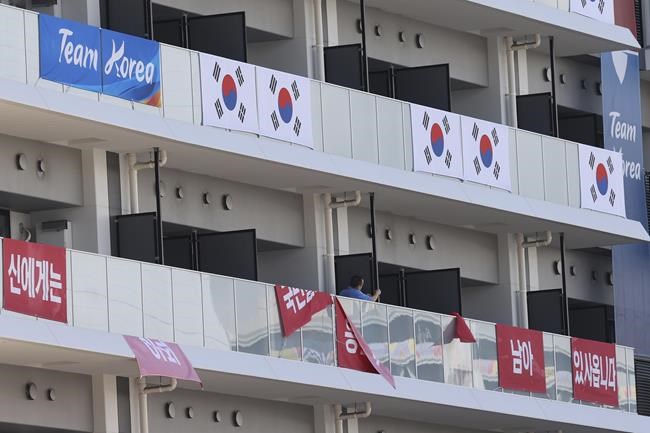
FILE - In this July 17, 2021, file photo, banners with the words
FILE - In this July 17, 2021, file photo, banners with the words "I still have the support of 50 million Korean people," are removed from balconies at the the Olympic athletes' village in Tokyo. South Korea removed the banners that the IOC ruled to be provocative, Seoul said it received an IOC promise that the displaying of the “rising sun” flag would also be banned at stadiums and other Olympic venues. (Jin Sung-chul/Yonhap via AP, File)

USE AT THE GAMES

On Saturday, when South Korea removed banners at the Olympic athletes’ village in Tokyo that the IOC ruled to be provocative, Seoul said it received an IOC promise that the displaying of the “rising sun” flag would also be banned at stadiums and other Olympic venues.

But South Korean media later reported that some activists carried the “rising sun” flag near the athletes’ village. Media reports also said Japan’s organizing committee ruled the flag isn’t banned inside Olympic stadiums.

“It would be inappropriate to ban the flag from naval exchanges because a version is used by the Japanese Maritime Self-Defense Forces,” Leif-Eric Easley, a professor at Ewha University in Seoul, said. “However, you would not expect the Tokyo Olympics hosts or Japanese athletes to use the rising sun emblem because it is not the national flag.”

Ties between Seoul and Tokyo, both U.S. allies, have suffered for years in part because of disputes over history and trade.

South Korean President Moon Jae-in’s office announced Monday that Moon had decided not to visit Japan for the Olympics because the two countries failed to find enough common ground to support a leaders’ summit.

___

WILL THIS GET WORSE?

Some experts say the flag dispute isn’t as serious as other points of contention, like Japan’s wartime mobilization of Koreans into sexual slavery or forced labor, and won’t likely worsen ties.

The flag dispute can still flare, however, if anger among anti-Japan civic groups in the South draw a backlash among the Japanese public, says Lee Myon-woo, deputy head of the private Sejong Institute near Seoul. Lee says South Korea should refrain from a “too excessive, political interpretation” of the flag because there is no sign that Japan is reviving past militarism.

But Bong Youngshik, a research fellow at Yonsei University Institute for North Korean Studies, says the flag wouldn’t have become a major issue if Japan had accepted its neighbors’ demands for making a more “sincere apology” over its wartime abuse.

The dispute may not have much kindling to fuel it, though, for one key reason: The lack of spectators at nearly all Olympics venues means no one is waving that flag — which means the dispute may die down for the time being.

___

Yamaguchi reported from Tokyo. More AP Olympics: https://apnews.com/hub/2020-tokyo-olympics and https://twitter.com/AP_Sports

Report Error Submit a Tip

More Stories

Watershed moment in the fight against misinformation

Editorial 4 minute read Preview

Watershed moment in the fight against misinformation

Editorial 4 minute read Thursday, Aug. 4, 2022

Alex Jones, arguably the world’s best known purveyor of toxic conspiracy theories, is in court this week facing a defamation lawsuit related to the vicious and inhumane lies he spread about the families who lost children in the 2012 mass shooting at Sandy Hook Elementary School. The case could mark a turning point in the war against misinformation.

Read
Thursday, Aug. 4, 2022

Canadians urged to remember all who served

Lee Berthiaume, The Canadian Press 6 minute read Preview

Canadians urged to remember all who served

Lee Berthiaume, The Canadian Press 6 minute read Monday, Nov. 11, 2019

OTTAWA - Thousands of Canadians braved sub-zero temperatures in the nation's capital on Monday to honour and remember all those — no matter their background — who offered up their lives to defend Canada, its values and its principles.

Reminders of that common cause among those who served this country and died for it figured prominently during this year's Remembrance Day ceremony alongside calls from spiritual leaders for peace instead of war, unity rather than division, and respect for diversity.

"Let us continue to make Canada worthy of their dedication and sacrifice, a country in which respect, harmony, inclusion, responsibility and kindness fill the air," Rabbi Reuven Bulka told the assembled crowd, speaking of those who had given their lives for Canada.

He went on to note that this year marked the 75th anniversary of D-Day, when Canada and its allies launched a massive amphibious assault on France that marked the beginning of the end of Nazi Germany in the Second World War, before suggesting every day should be a D-Day of sorts.

Read
Monday, Nov. 11, 2019

What a difference a week makes

Mike McIntyre 6 minute read Preview

What a difference a week makes

Mike McIntyre 6 minute read Tuesday, Sep. 7, 2021

Take a week off, he thought. It's the dog days of summer, the sports world has slowed to a crawl and absolutely nothing of substance is going to happen, he figured.

Swing-and-a-miss on my part, with no shortage of newsworthy developments since we last spoke in this space. Now that I've powered up the laptop once again, let's quickly review the good, the bad and the downright silly that went down.

The NHL is heading back to the Olympics for the first time since 2014, and hockey fans around the world are the true winners. Good on the league, players' association and IIHF for finding a path to make this happen, even if Gary Bettman held his nose at the entire process. Shutting down the season for two weeks to send the best and brightest off to Beijing carries plenty of risk, in addition to the obvious inconvenience as the league tries to finally get back on a normal schedule after two COVID-19 shortened years. However, it's ultimately best for business.

On a local front, there should be no shortage of Winnipeg Jets suiting up for their countries. I'm looking forward to heading over to China in February to cover my first-ever Games for the paper, watching the likes of Mark Scheifele (Canada), Connor Hellebuyck and Kyle Connor (United States), Nikolaj Ehlers (Denmark) and Moose defenceman Leon Gawanke (Germany), who are all locks in my eyes. There could be others, too. Might Blake Wheeler (US), Neal Pionk (US), Ville Heinola (Finland) or Josh Morrissey (Canada) make a late bid? We shall see.

Read
Tuesday, Sep. 7, 2021

Metaphor is dead as Trump ‘renovates’

Editorial 4 minute read Preview

Metaphor is dead as Trump ‘renovates’

Editorial 4 minute read Saturday, Oct. 25, 2025

It appears U.S. President Donald Trump will not stop until he has rendered literally every metaphorical description one could give for his presidency.

Case in point: he’s tearing the White House apart.

Trump, as part of a lifelong effort to make everything about himself, has torn down the entire East Wing of the presidential building as he moves ahead with construction of an ornate, US$350-million ballroom. The demolition was carried out without the approvals that are normally required. He already had the Rose Garden paved over, he evidently needs more change than that.

One could have made the argument during his first term that Trump had already rewritten American politics in his image, an image which persisted through others even during his four-year absence from the Oval Office during former president Joe Biden’s term. Republican policy revolves around his whims. Democrats were, and still are, defined by how hard they will work to oppose him. When he leaves the office one day, his spectre will likely endure, hovering over the American body politic for a generation.

Read
Saturday, Oct. 25, 2025

EXPLAINER: Why Japan 'rising sun' flag provokes Olympic ire

Hyung-jin Kim And Mari Yamaguchi, The Associated Press 6 minute read Preview

EXPLAINER: Why Japan 'rising sun' flag provokes Olympic ire

Hyung-jin Kim And Mari Yamaguchi, The Associated Press 6 minute read Thursday, Jul. 22, 2021

Toronto opens the NHL season against Montreal for the third time in four years.

Read
Thursday, Jul. 22, 2021

Police conduct code long overdue

Editorial 4 minute read Preview

Police conduct code long overdue

Editorial 4 minute read Tuesday, Mar. 22, 2022

It may come as a surprise to many that Manitoba does not have a province-wide code of conduct for police officers. Most other provinces do. Manitoba has had the authority under the Police Services Act since it was passed in 2009 to establish formal rules around policing activity, including mechanisms to respond to allegations of officer misconduct. For reasons neither the former NDP or current Progressive Conservative governments have explained, none was ever put in place.

What Manitobans are left with is a patchwork system that differs from one municipality to the next. It is neither open and transparent nor does it provide the public with an effective process to hold police officers accountable for their actions. Some allegations of non-criminal misconduct are heard by the province’s Law Enforcement Review Agency. However, most complaints made through LERA (a process that has been widely criticized as dysfunctional and ineffective), rarely receive full hearings and almost never result in officer discipline. Allegations of criminal behaviour are investigated through the province’s Independent Investigation Unit.

Justice Minister Kelvin Goertzen says the province intends to create a new set of rules that will govern the conduct of all police officers in the province. The minister introduced Bill 30 last week, amendments to the Police Services Act, which among other things restates government’s ability to establish a province-wide code of conduct.

The wording in the bill is similar to what already exists in the act. The difference now, at least according to Mr. Goertzen, is there is a stated intention to move forward on creating a province-wide code, although it remains discretionary under the proposed legislation.

Read
Tuesday, Mar. 22, 2022