WEATHER ALERT

Top medical adviser says ‘no fans’ safest for Tokyo Olympics

Advertisement

Advertise with us

TOKYO (AP) — The safest way to hold the Tokyo Olympics is without any fans, the top medical adviser to the Japanese government said in a report on Friday.

Read this article for free:


By clicking the button above, an account will be created and you will begin to receive some of our recommended newsletters. You may opt out of any newsletter by visiting your Email and Communication Preferences page or by clicking "unsubscribe" at the bottom of any email.

or

Already have an account? Log in here »

To continue reading, please subscribe:

Digital Subscription

One year of digital access for only $1.44 a week*

  • Enjoy unlimited reading on winnipegfreepress.com
  • Read the E-Edition, our digital replica newspaper
  • Access News Break, our award-winning app
  • Play interactive puzzles

*Billed as $5.77 plus GST every four weeks. After 52 weeks, price increases to the regular rate of $19.95 plus GST every four weeks. Offer available to new and qualified returning subscribers only. Cancel any time.

To continue reading, please subscribe:

Add Free Press access to your Brandon Sun subscription for only an additional

$1 for the first 4 weeks*

  • Enjoy unlimited reading on winnipegfreepress.com
  • Read the E-Edition, our digital replica newspaper
  • Access News Break, our award-winning app
  • Play interactive puzzles
Start now

*Your next Brandon Sun subscription payment will increase by $1.00 and you will be charged $17.95 plus GST for four weeks. After four weeks, your payment will increase to $24.95 plus GST every four weeks.

Hey there, time traveller!
This article was published 18/06/2021 (1963 days ago), so information in it may no longer be current.

TOKYO (AP) — The safest way to hold the Tokyo Olympics is without any fans, the top medical adviser to the Japanese government said in a report on Friday.

Dr. Shigeru Omi’s recommendation seems to put him at odds with organizers and the International Olympic Committee with the Olympics opening in just five weeks on July 23.

Fans from abroad were banned several months ago, and organizers are to announce early next week if some local fans should be allowed.
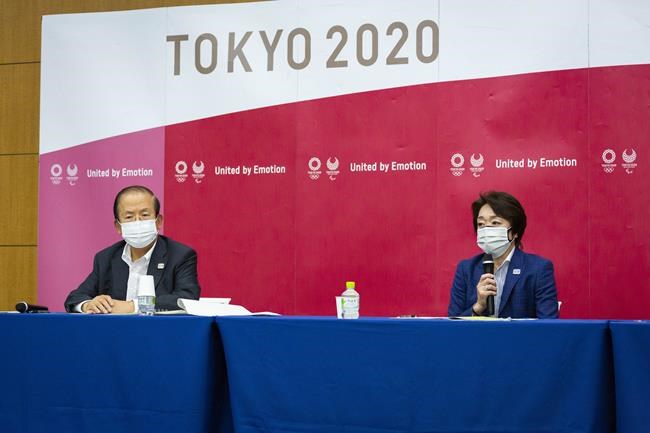
Tokyo 2020 CEO Toshiro Muto, left, and President Seiko Hashimoto attend the news conference after receiving a report from a group of infectious disease experts on Friday, June 18, 2021, in Tokyo. The experts including Shigeru Omi, head of a government coronavirus advisory panel, issued a report listing the risks of allowing the spectators and the measurements to prevent the event from triggering a coronavirus spread. (Yuichi Yamazaki/Pool Photo via AP)

“We believe the risks of infections inside venues would be lowest by holding the event with no fans,” said the report, which was compiled by a group of 26 experts led by Omi, a former World Health Organization official. It was submitted to the government and Olympic officials

Widely circulated reports say the government wants to allow up to 10,000 people at some sports and cultural events. This policy is expected to be applied to the Olympics with smaller ceilings at smaller venues, and differences for indoor and outdoor venues.

“We believe it would be most desirable not to have fans inside venues,” Omi told a news conference on Friday after submitting the written report. “Regardless of holding the Olympics or not, Japan has continuing risks of a resurgence of the infections that puts pressure on the medical systems.”

Omi said that putting fans in the venues increased the risk — and not only there but afterward as people exit. He said the Olympics easily get more attention from the public than other sporting events and are likely to trigger more movements and more partying.

Seiko Hashimoto, the president of the local organizing committee, said that the final decision on fans was likely to be made Monday in a meeting with organizers, the IOC, the Tokyo metropolitan government, the Japanese government, and the International Paralympic Committee.

Hashimoto said if Tokyo decides to allow fans, the rules will have to be much stricter than for half-filled stadiums in Japan for baseball or soccer. She also said organizers would have to be ready to suddenly ban local fans if conditions change.

“Dr. Omi has indicated that ideally the best way is to hold the games without spectators — that was his recommendation,” Hashimoto said. “But if we are to hold the games with spectators, Dr. Omi also had his recommendations.”

Hashimoto said she had consulted with baseball and soccer officials in Japan, where games with fans have been largely problem free.

“But Dr. Omi has also mentioned that the Tokyo Olympics and Paralympics are very special,” Hashimoto said. “Therefore Dr. Omi has mentioned that we need to be even more stringent than the other sports events. So we need to look at stricter rules. There is this risk of people who come to the games, and after watching they stop by bars and restaurants before going home. So it is recommended that we urge people to go straight home after watching the games.”

Ticket sales were to account for $800 million in income for the organizing committee. Much of it will be lost and government entities will have to make up the shortfall.

Organizers say about 3.6 million-3.7 million tickets are still held by residents of Japan. About 800,000 tickets were returned locally.

The total number of tickets originally announced for the Olympics was about 7.8 million.

The official cost of the Tokyo Olympics is $15.4 billion, although government audits suggest it is much higher. All but $6.7 billion is public money.

The IOC is pushing ahead with Tokyo, partly because it depends on broadcast rights sales for almost 75% of its income. Sponsors supply about 18%,

Emergency measures in Tokyo and other prefectures are being lifted on Sunday, although “quasi-emergency” restrictions will remain in place that may limit bar and restaurant hours.

Japan has attributed just over 14,000 deaths to COVID-19 and has controlled the virus better than many countries, but not as well as many in Asia. Only 15% of Japanese have at least one COVID-19 vaccination, and much of the public has been opposed to holding the Olympics.

Poll answers have shifted depending on how the question is phrased, and the country’s second-most widely circulated newspaper, the Asahi Shimbun, has said the games should be called off.

___

More AP Olympics: https://apnews.com/hub/olympic-games and https://twitter.com/AP_Sports

Report Error Submit a Tip

More Stories

Bob Saget, beloved TV dad of 'Full House,' dead at 65

Lynn Elber, The Associated Press 6 minute read Preview

Bob Saget, beloved TV dad of 'Full House,' dead at 65

Lynn Elber, The Associated Press 6 minute read Monday, Jan. 10, 2022

LOS ANGELES (AP) — Bob Saget, the actor-comedian known for his role as beloved single dad Danny Tanner on the sitcom “Full House” and as the wisecracking host of “America’s Funniest Home Videos,” died while on a stand-up tour. He was 65.

Deputies in Orange County, Florida, were called Sunday about an “unresponsive man” in a hotel room at the Ritz-Carlton in Orlando and found Saget dead, according to a sheriff’s statement on Twitter. Detectives found “no signs of foul play or drug use in this case.”

Saget was in Florida as part of his “I Don't Do Negative Comedy Tour.” After warm audience receptions to his gigs Friday in Orlando and Saturday in the Ponte Vedra Beach resort area, he celebrated online.

“I’m back in comedy like I was when I was 26. I guess I’m finding my new voice and loving every moment of it,” he posted Saturday on Instagram.

Read
Monday, Jan. 10, 2022

Walkout creates chaos at St. James Smitty’s

Morgan Modjeski 3 minute read Preview

Walkout creates chaos at St. James Smitty’s

Morgan Modjeski 3 minute read Saturday, Oct. 31, 2026

Gordon Sharpe wanted to eat a meal at the St. James Smitty’s Wednesday, but he got a helping of bad news instead.

He saw several workers walk out of the restaurant, at 1017 St. James St.

“(The waiter) came back about 10 minutes later and stood over the table, looking a little distraught and said, ‘I’m quitting right now and so is everybody else,’” Sharpe said. “He said, ‘This is my last time serving you,’ and he was quite choked up.”

“I’ve never seen anything like it,” he said, adding that the managers scrambled to serve patrons.

Read
Saturday, Oct. 31, 2026

WRHA moves to cut growing echocardiogram wait list

Larry Kusch 6 minute read Preview

WRHA moves to cut growing echocardiogram wait list

Larry Kusch 6 minute read Tuesday, Aug. 21, 2018

Manitobans are waiting a year or more to receive a key test that detects and tracks heart disease.

As of June 15, there were about 6,500 Manitobans on the wait list for an echocardiogram, and the list is growing at a rate of about 265 per month.

Patients facing heart emergencies are receiving tests immediately, while most of those whose conditions are considered urgent or semi-urgent are getting them within established Canadian benchmark times -- about a week, officials say.

However, thousands of patients who are considered candidates for "elective" tests are waiting anywhere from 10 to 15 months, with a median wait of 12 months, according to the Winnipeg Regional Health Authority.

Read
Tuesday, Aug. 21, 2018

Court ruling concludes Canadian Wheat Board saga

Laura Rance-Unger 4 minute read Preview

Court ruling concludes Canadian Wheat Board saga

Laura Rance-Unger 4 minute read Saturday, Oct. 31, 2026

It remains to be seen whether the recent court ruling in a lawsuit filed after Canadian Wheat Board’s dissolution in 2012 puts the whole debate to rest, as some no doubt hope.

But either way, the dust has settled on the post-CWB world. The sun still rises and a new generation of farmers on the land only knows by name an institution that for generations influenced every aspect of Prairie grain farming.

The first Rural Revival column I wrote for this newspaper more than 30 years ago was about a thousand farmers from Western Canada demonstrating in support of the Wheat Board. It was in the aftermath of the Western Grain Marketing Panel report, one of several efforts that eventually included a plebiscite to help the federal government decide what to do about a vocal minority of farmers who wanted marketing “freedom.”

The polls at the time suggested about two-thirds of farmers were comfortable enough with the single-desk system for food wheat and barley to keep it around. It served as a counterbalance to canola, which they sold on the open market. They essentially had a dual market.

Read
Saturday, Oct. 31, 2026

Province tables legislation to cover health-care system changes

Larry Kusch 4 minute read Preview

Province tables legislation to cover health-care system changes

Larry Kusch 4 minute read Wednesday, Mar. 6, 2019

The Pallister government has introduced broad legislation to support several of its key planned health-care reforms.

Health Minister Cameron Friesen said Wednesday that Bill 10 (The Regional Health Authorities Amendment Act) will provide the framework to simplify the administration of the health-care system and improve accountability.

All health services in Manitoba will be delivered through the five current regional health authorities, CancerCare Manitoba and a new provincial authority called Shared Health. The administrative changes are set to begin next month and will continue to be rolled out over the next two to three years.

The Health Department will cease to administer health services directly and focus its activities on planning, policy development, funding and oversight. It will set system-wide performance goals and track results.

Read
Wednesday, Mar. 6, 2019

Khan files document proving teacher commissioner resigned, wasn’t fired

Gabrielle Piché 2 minute read Preview

Khan files document proving teacher commissioner resigned, wasn’t fired

Gabrielle Piché 2 minute read Thursday, Apr. 16, 2026

Opposition Leader Obby Khan says he has proof the teacher commissioner resigned and wasn’t fired, as the government has claimed.

On Thursday, he tabled a government order in council, dated April 8, that revokes Bobbi Taillefer’s appointment as commissioner. The order says Taillefer resigned on April 7.

Education Minister Tracy Schmidt initially told the Free Press Taillefer had resigned. After the article’s publication last week, Premier Wab Kinew told media the government had fired the bureaucrat.

Her departure was announced after he and Schmidt learned Taillefer was working remotely from Florida, he said.

Read
Thursday, Apr. 16, 2026