Tokyo Olympic torch relay pulled off streets in Hiroshima

Advertisement

Advertise with us

TOKYO (AP) — The Tokyo Olympic torch relay is being pulled off the streets in Hiroshima prefecture as COVID-19 cases rise in Japan barely 10 weeks before the opening ceremony.

Read this article for free:


or

Already have an account? Log in here »

To continue reading, please subscribe:

Subscribe and receive a limited-edition Free Press branded hat or tote.

Digital Subscription

One year of digital access for only $205*

  • Enjoy unlimited reading on winnipegfreepress.com
  • Read the E-Edition, our digital replica newspaper
  • Access News Break, our award-winning app
  • Play interactive puzzles

*First annual payment billed as $205.00 + GST for one year. This annual subscription will automatically renew at $233.00 + GST every 52 weeks (10% off the regular annual price of $259.35). Offer available to new and qualified returning subscribers only. Cancel any time.

To continue reading, please subscribe:

Add Free Press access to your Brandon Sun subscription for only an additional

$1 for the first 4 weeks*

  • Enjoy unlimited reading on winnipegfreepress.com
  • Read the E-Edition, our digital replica newspaper
  • Access News Break, our award-winning app
  • Play interactive puzzles
Start now

*Your next Brandon Sun subscription payment will increase by $1.00 and you will be charged $17.95 plus GST for four weeks. After four weeks, your payment will increase to $24.95 plus GST every four weeks.

Hey there, time traveller!
This article was published 11/05/2021 (1951 days ago), so information in it may no longer be current.

TOKYO (AP) — The Tokyo Olympic torch relay is being pulled off the streets in Hiroshima prefecture as COVID-19 cases rise in Japan barely 10 weeks before the opening ceremony.

Hiroshima Governor Hidehiko Yuzaki said that a ceremony next week without the relay is likely to still take place. This is at least the sixth change to the relay — from rerouting to cancellation — in the last several weeks.

Organizers warned before the relay began that changes and delays were expected in the face of the pandemic.
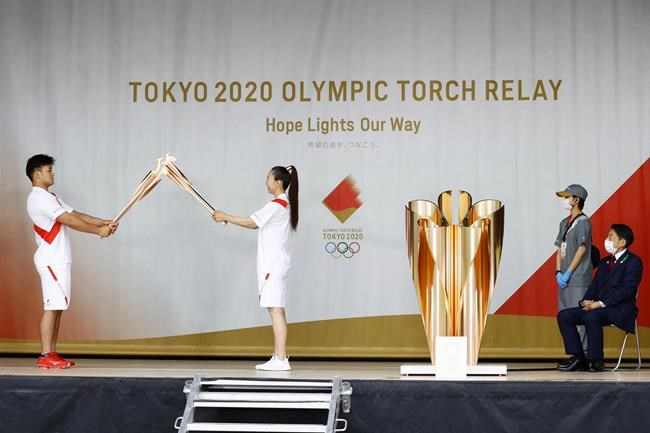
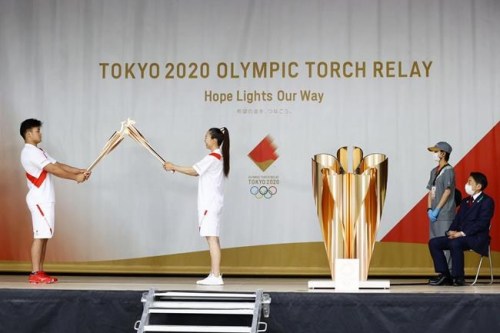
An ignition ceremony for the Tokyo Olympic torch relay is held at Heiwadai Athletic Stadium in Fukuoka, southwestern Japan, Tuesday, May 11, 2021. The torch relay was taken off public roads due to the coronavirus pandemic. The next week's torch relay is being pulled off the streets in Hiroshima prefecture, too, as COVID-19 cases rise in Japan. This is at least the sixth change to the relay - from rerouting to cancellation - in the last several weeks as cases surge in Japan. Organizers warned before the relay began that changes and delays were expected in the face of the pandemic. (Kyodo News via AP)

“It is certain there will be no relay on public streets since we are all trying to reduce going out, and how to do the ceremony without the relay on the streets is still being discussed with the organizers,” Yuzaki said Monday.

The relay began on March 25 in northeastern Japan and is to end on July 23 at the opening ceremony of the Olympics. Tokyo and other areas are under a state of emergency until May 31.

Japan has attributed about 11,000 deaths to COVID-19, but new cases of the virus and its variants are now increasing in Tokyo and the second largest metropolitan area of Osaka.

The relay is heavily sponsored by Toyota and Coca-Cola and has proceeded despite some calls a year ago to cancel it to save money. It involves 10,000 runners crisscrossing Japan with organizers trying to keep crowds off the streets and urging them to maintain social distancing.

International Olympic President Thomas Bach was forced this week to call off a trip to Hiroshima to greet the torch, an embarrassing move with the IOC and local organizers saying the Olympics will be “safe and secure” for fans and athletes.

Yuzaki said the cases were rising at such a rapid pace that it could become an emergency situation unless people curbed their activities.

On Monday, Japan’s Kyodo news agency reported that Hyogo and Okayama prefectures will also take the torch relay off public streets.

___

More AP Olympics: https://apnews.com/hub/olympic-games and https://twitter.com/AP_Sports

Report Error Submit a Tip

More Stories

Is Trump about to poke Quebec’s political beehive?

Peter McKenna 5 minute read Preview

Is Trump about to poke Quebec’s political beehive?

Peter McKenna 5 minute read Yesterday at 2:00 AM CDT

When was the last time that a U.S. president seriously stirred the hornet’s nest of Quebec politics?

My best recollection is former U.S. president Bill Clinton. During the 1994 Quebec referendum campaign, Clinton made clear that the U.S. wholly endorsed a united and strong federal Canada — as opposed to a dismembered one. He went on to add that an independent Quebec would have no guarantee of joining the North American Free Trade Agreement as a full-fledged member.

Today, we see U.S. President Donald Trump inserting himself — unwittingly or wittingly — into the electoral and sovereignty politics of Quebec. It’s pretty clear that the resurgent Coalition Avenir Québec government is trying to make the Oct. 5 provincial election about anything other than its own governmental record and more about Trump’s economic coercion against Canada. Of course, the Parti Québécois, the odds-on-favourite, wants to make the electoral contest a referendum on the CAQ and its party leader, Christine Fréchette.

But what if Trump really wanted to make his presence felt in Quebec’s political life? How much influence could he have on shaping political outcomes in Quebec? How much of an “X factor” could he be?

Read
Yesterday at 2:00 AM CDT

Tokyo Olympic torch relay pulled off streets in Hiroshima

Stephen Wade, The Associated Press 3 minute read Preview

Tokyo Olympic torch relay pulled off streets in Hiroshima

Stephen Wade, The Associated Press 3 minute read Tuesday, May. 11, 2021

TOKYO (AP) — The Tokyo Olympic torch relay is being pulled off the streets in Hiroshima prefecture as COVID-19 cases rise in Japan barely 10 weeks before the opening ceremony.

Hiroshima Governor Hidehiko Yuzaki said that a ceremony next week without the relay is likely to still take place. This is at least the sixth change to the relay — from rerouting to cancellation — in the last several weeks.

Organizers warned before the relay began that changes and delays were expected in the face of the pandemic.

“It is certain there will be no relay on public streets since we are all trying to reduce going out, and how to do the ceremony without the relay on the streets is still being discussed with the organizers,” Yuzaki said Monday.

Read
Tuesday, May. 11, 2021

Sinclair named Canada’s columnist of the year

5 minute read Preview

Sinclair named Canada’s columnist of the year

5 minute read Saturday, May. 4, 2019

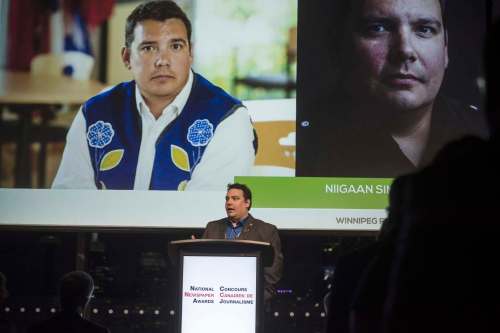
Winnipeg Free Press Indigenous writer Niigaan Sinclair has been named Canada’s best columnist, winning a distinguished National Newspaper Award, which was presented at a gala in Toronto Friday evening.

Sinclair, who is Anishinaabe, joined the Free Press as a regular columnist in June 2018. Sinclair, who is on sabbatical from his job as an associate professor at the University of Manitoba, writes about Indigenous issues.

In accepting the award, Sinclair said it was his childhood dream to write for the Free Press. He said Winnipeg is the centre of reconciliation in Canada, calling it “the most imperfect city, but the most perfect.”

“I’m honoured to receive the National Newspaper Award for column writing, the same award Richard Wagamese received in 1990. It’s a testament to the incredible support and belief the Free Press has in me, and also how critically important the conversations and issues in Winnipeg are for the national stage.”

Read
Saturday, May. 4, 2019

Double climate whammy hits home

Editorial 4 minute read Preview

Double climate whammy hits home

Editorial 4 minute read Wednesday, Sep. 9, 2026

It’s a bit of a one-two punch.

First, the show-and-tell of what global warming could be bringing us.

Then, the fact we’ve already failed our best chance of halting climate change.

On Sept. 3, the World Meteorological Organization released its forecast of the potential effects of the rapidly-developing super El Niño phenomenon.

Read
Wednesday, Sep. 9, 2026

Tory health critic livid after being rebuffed by health officials

Carol Sanders 4 minute read Preview

Tory health critic livid after being rebuffed by health officials

Carol Sanders 4 minute read Yesterday at 11:53 AM CDT

The health critic for the Progressive Conservative party says her ability to get information about the accelerated reopening of Dauphin’s emergency department was stymied by Prairie Mountain Health officials because they refused to meet with her.

“I wanted to meet with PMH staff to discuss the status of the facility and the challenges they’re facing and getting services back online,” Kathleen Cook said Friday.

“I was very disappointed that Prairie Mountain Health declined me that opportunity.”

Cook said she asked for a meeting a few days after the Sept. 7 reopening of a temporary ER at the hospital, that was severely damaged by flooding.

Read
Yesterday at 11:53 AM CDT

Is ‘tornado alley’ moving north?

Editorial 4 minute read Preview

Is ‘tornado alley’ moving north?

Editorial 4 minute read Friday, Sep. 11, 2026

There’s a famous fictional story in which a ruby-slippered, tornado-tossed traveller takes a wide-eyed look around and declares, “I’ve a feeling we’re not in Kansas anymore.”

There are probably some residents of south River Heights, on the other hand, who looked out their windows last Sunday and felt as if Kansas — the U.S. state that lies smack-dab in the middle of meteorological maps outlining the area known as “tornado alley” — was exactly where they’d somehow ended up.

There is now confirmation of a tornado touching down within Winnipeg, after several residents reported seeing funnel-shaped clouds during the intense thunderstorm, and the magnitude and extremely localized nature of the damage — including felled trees, snapped hydro poles, scattered fences and the deposit of a random automobile on one resident’s front lawn — certainly shows forces more formidable than strong wind gusts were at play.

As Manitoba Hydro and City of Winnipeg crews continued the days-long effort to clean up the mess and restore power to thousands of homes affected by the long-weekend weather blast, some of the conversation related to the storm focused on how extreme events such as this have become more commonplace in a region where tornadoes were long considered a rarity.

Read
Friday, Sep. 11, 2026