

Double climate whammy hits home
Advertisement
Read this article for free:
or
Already have an account? Log in here »
To continue reading, please subscribe:

Digital Subscription
One year of digital access for only $205*
- Enjoy unlimited reading on winnipegfreepress.com
- Read the E-Edition, our digital replica newspaper
- Access News Break, our award-winning app
- Play interactive puzzles
*First annual payment billed as $205.00 + GST for one year. This annual subscription will automatically renew at $233.00 + GST every 52 weeks (10% off the regular annual price of $259.35). Offer available to new and qualified returning subscribers only. Cancel any time.
To continue reading, please subscribe:
Add Free Press access to your Brandon Sun subscription for only an additional
$1 for the first 4 weeks*
- Enjoy unlimited reading on winnipegfreepress.com
- Read the E-Edition, our digital replica newspaper
- Access News Break, our award-winning app
- Play interactive puzzles
*Your next Brandon Sun subscription payment will increase by $1.00 and you will be charged $17.95 plus GST for four weeks. After four weeks, your payment will increase to $24.95 plus GST every four weeks.
Read unlimited articles for free today:
or
Already have an account? Log in here »
It’s a bit of a one-two punch.
First, the show-and-tell of what global warming could be bringing us.
Then, the fact we’ve already failed our best chance of halting climate change.
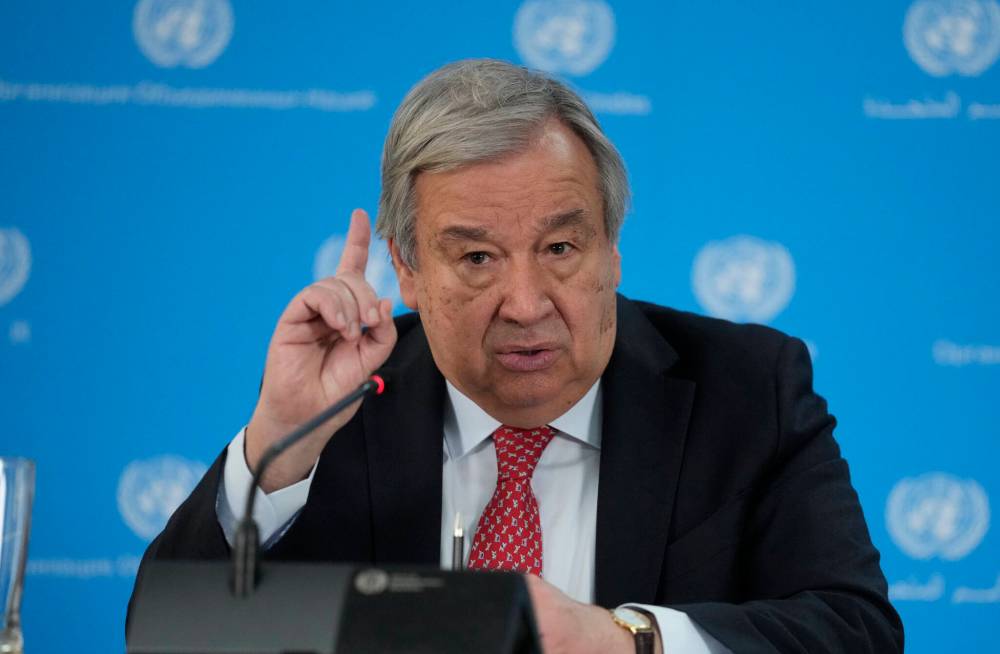
UN Secretary-General António Guterres
On Sept. 3, the World Meteorological Organization released its forecast of the potential effects of the rapidly-developing super El Niño phenomenon.
El Niño is a recurring natural phenomenon whereby the surface of the Pacific Ocean warms significantly, then sheds that heat into the atmosphere, affecting weather patterns.
But this year, the amount of heat building up in the Pacific is extraordinary.
As ocean temperatures peak in the Pacific in November through February, dramatic changes are expected in the weather in much of the world — changing rainfall patterns, extreme and damaging ocean temperatures, and alterations in traditional wind patterns.
“El Niño is being supersized before our eyes. The science leaves no room for doubt: the planet is in uncharted waters, and those waters are heating up,” UN head António Guterres said. The world, he said, is heading into a “danger zone of extreme weather.”
Much of the expected results of the warming waters are likely to hit countries in the southern hemisphere, but the impacts will be global. Crop failures and drought on one hand, coupled with the risks of extremely heavy rainfall in the southern United States and other areas, could drastically affect food production.
WMO Secretary-General Celeste Saulo warned: “El Niño has the potential to deliver a massive blow to communities and economies across the world.”
If that’s not enough, a different global climatic line has been crossed, as well. On Sept. 2, the UN released a report that finally admits what scientists have been warning for several years — holding global warming to the critical 1.5 degrees C threshold has failed.
The UN is now arguing that the world needs to undertake massive projects to remove carbon dioxide from the atmosphere, moving the battle to stop the dangers of climate change from the realms of prevention and into the world of mitigation.
And the costs of that mitigation are immense — either finding ways to surrender a huge amount of land to reforestation, including critical agricultural lands, or mobilizing rapidly developing technologies to remove huge amounts of CO2 from the atmosphere.

Of course, all of that urgency for solutions is going to continue to run up against that most human of dog-in-the-manger stalling — fundamentally “I like what I have now, so I’m going to (in spite of all evidence to the contrary) choose to believe that nothing’s happening and I don’t have to give up anything.”
Unfortunately, the changing media environment has created a world in which you can listen to what you want to hear, rather than what you need to hear. The fracturing of the media into separate ecosystems that deliver audience-specific versions of “facts” make it near-impossible to create the kind of united global effort needed to even attempt to slow down what’s next.
The coming super El Niño may be a limited-time test drive of how things change in a heating world. And we’re almost certain not to like what that change may look like.
Weather isn’t climate but stop and think about the sheer number of examples of record-breaking weather events in the last few months alone. Think about your neighbours and friends talking about experiencing types of weather, or intensities of weather, they have never experienced before.
Stop and think also about the sheer amount of damage and cost of consecutive forest fire years, the impacts of severe weather events on future insurance costs, the flooding from unprecedented rainfalls, and consider what happens — and what you will have to pay to prepare or repair — if the occasional becomes the new regular.