First Pfizer vaccine shots to be given right at delivery sites, not LTC homes: Tam
Advertisement
Read this article for free:
or
Already have an account? Log in here »
To continue reading, please subscribe:
Digital Subscription
One year of digital access for only $1.44 a week*
- Enjoy unlimited reading on winnipegfreepress.com
- Read the E-Edition, our digital replica newspaper
- Access News Break, our award-winning app
- Play interactive puzzles
*Billed as $5.77 plus GST every four weeks. After 52 weeks, price increases to the regular rate of $19.95 plus GST every four weeks. Offer available to new and qualified returning subscribers only. Cancel any time.
To continue reading, please subscribe:
Add Free Press access to your Brandon Sun subscription for only an additional
$1 for the first 4 weeks*
- Enjoy unlimited reading on winnipegfreepress.com
- Read the E-Edition, our digital replica newspaper
- Access News Break, our award-winning app
- Play interactive puzzles
*Your next Brandon Sun subscription payment will increase by $1.00 and you will be charged $17.95 plus GST for four weeks. After four weeks, your payment will increase to $24.95 plus GST every four weeks.
Read unlimited articles for free today:
or
Already have an account? Log in here »
Hey there, time traveller!
This article was published 08/12/2020 (2137 days ago), so information in it may no longer be current.
OTTAWA – Canada’s chief public health officer says the first doses of Pfizer’s COVID-19 vaccine are likely to be given only to people who can physically be at one of the 14 delivery sites identified by provincial governments for the first arrivals of the vaccine.
The news came on a day Alberta’s premier, who has resisted calls from doctors to impose lockdown restrictions, brought in a new slate of measures aimed at curbing runaway rates of infection that have the province’s health system teetering.
Dr. Theresa Tam said at a briefing in Ottawa Tuesday that administering the first batch of vaccine is a “rapidly evolving situation” but acknowledged this will make it difficult to get long-term care residents vaccinated first.
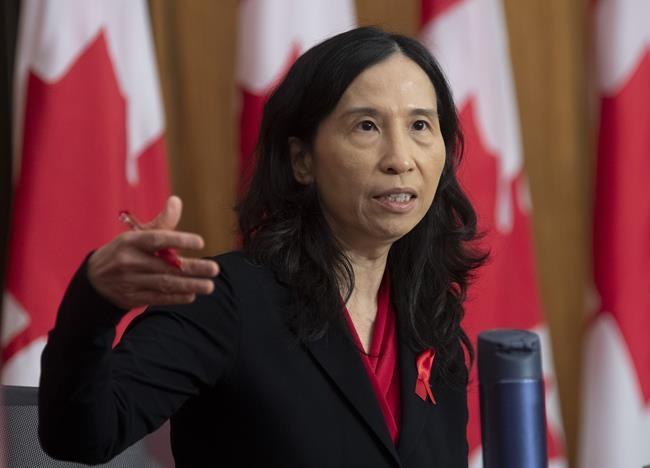
“It’s true you cannot move residents very easily from a long-term care centre to a vaccine site,” she said. “That’s just the reality.”
It is not clear how this jibes with some provincial plans, including in Quebec, where the health minister said Monday the government intends to ship its first vaccine doses to two long-term care homes.
The Pfizer vaccine, being produced in partnership with Germany’s BioNTech, is in the final stages of review by Health Canada, which is expected to issue a decision this week. Prime Minister Justin Trudeau said Monday if the approval comes as expected, Canada will receive the first doses next week, and up to 249,000 doses by the end of the month.
Pfizer Canada spokeswoman Christina Antoniou told The Canadian Press that the company is asking for those doses at first to be given only at the first 14 delivery sites.
She said where the vaccine can be injected is “part of ongoing discussions” with provincial governments, who are in charge of getting the vaccine into patients. But she noted Pfizer’s actual contract for the COVID-19 vaccine is with the federal government.
“Pfizer, the Public Health Agency of Canada and the provinces are working together to finalize preparations at the first point of use sites this week, including training on how to handle the product,” she said.
The Pfizer vaccine has very strict requirements, including that it be kept at temperatures below -70 C, which has made shipping it more difficult logistically.
Maj.-Gen. Dany Fortin, named vice-president for logistics at the Public Health Agency of Canada to oversee the vaccine rollout, said a trial run of deliveries began Monday and is still underway.
Boxes were sent from the manufacturing site in Belgium, filled with dry ice but no vaccines, to all 14 sites identified by provincial governments as capable of maintaining the temperature.
Eventually, Fortin said, there will be more than 200 sites, and they will be added as more doses become available and more people can be trained to properly handle the deliveries.
Initially, there are two sites each in Ontario, Quebec, British Columbia and Alberta, and one in each of the other six provinces. Most of them are at hospitals. Ontario Health Minister Christine Elliott said there are 21 hospitals in her province with the freezer requirements.
It is also too difficult to ship the Pfizer vaccine north to remote Indigenous communities. That means two of the four priority groups identified for initial vaccines aren’t likely to get access to the first rounds of vaccinations.
The National Advisory Committee on Immunization recommended last week the first doses go to residents of long-term care and their caregivers, front-line health workers, people over the age of 80 and adults in Indigenous communities where an outbreak would be harder to manage.
Most provinces are following those recommendations almost exactly.
The United Kingdom began vaccinating people with the Pfizer shots Tuesday, after last week being the first country to approve the vaccine.
Intergovernmental Affairs Minister Dominic LeBlanc said an expected executive order from U.S. President Donald Trump to prioritize Pfizer doses for Americans should not affect Canada’s expected deliveries.
LeBlanc says concerns about dose supplies were contemplated when the contracts were signed to ensure supplies could come from more than one location.
Canada’s first doses of Pfizer’s vaccine are to come from lots produced at the company’s plant in Belgium.
Tam says the exciting news about the vaccine is welcome but warns it will be some time before enough doses are injected to control the COVID-19 pandemic.
She said there are now more than 71,000 active cases of COVID-19 nationally, according to figures from Monday, and an average of 92 people are dying of the illness every day. Hospitals in many provinces are feeling the pandemic’s pressure, with more than 2,680 people being treated for COVID-19 in hospitals, almost one-fifth of those in critical care.
The situation is particularly bad in Alberta where, as of Tuesday, there were more than 21,000 active cases with 654 people in hospital — 112 of them receiving intensive care. Hospitalization rates have risen 371 per cent since Nov. 1.
For weeks, doctors and the Opposition have called on Premier Jason Kenney to bring in tougher measures to quickly stop the spread. But Kenney opted for a more targeted approach, allowing restaurants and other business to stay open while limiting their customer numbers.
On Tuesday, he relented somewhat, limiting restaurants and bars to delivery or takeout and closing casinos and gyms. He also ordered the closure of recreation centres, libraries, theatres and personal service providers, such as hair salons, barbers and nail bars.
Retail stores and churches are allowed remain open at 15 per cent capacity, but masks are now mandatory provincewide in indoor public spaces and people can’t gather socially with anyone outside their home anywhere.
The measures are to remain in effect for at least four weeks.
“This is not academic, this is very real. People will lose their life savings as a result of this,” Kenney said. “Why didn’t we do this earlier? Because we have sought to limit the damage on our broader society.”
Elsewhere, Quebec Premier Francois Legault warned there may be more lockdown measures coming in that province as hospitalizations continued to rise, hitting 835 Tuesday. That is up by nearly 100 patients compared to a week ago.
Saskatchewan logged its deadliest day from the virus thus far, with six deaths, including one person in their 30s.
British Columbia recorded 566 new cases of COVID-19 on Tuesday.
The provincial government says 352 people with the illness were being treated in hospital, with 74 of them in intensive care. Sixteen more people have died, for a total of 543 fatalities in the province.
“While we have seen the start of encouraging trends in our COVID-19 curve, the number of new cases and people with serious illness requiring care in hospital remains high,” provincial health officer Dr. Bonnie Henry and Health Minister Adrian Dix said in a joint statement.
Premier John Horgan said on Twitter that about 4,000 high-risk people in B.C. will be immunized by the end of next week.

“The first vaccine doses are just days away,” he said.
Henry is to provide details of B.C.’s vaccine rollout plan on Wednesday.
Nunavut provided a bright spot of news in the pandemic fight Tuesday, with chief public health officer Dr. Michael Patterson noting a milestone had occurred in the territory’s recovery from its first outbreak.
Last month Patterson warned the limited health capacity in Nunavut couldn’t handle much more as four communities struggled with cases. On Tuesday he said three of those four were back to zero cases. There was one new case in Arviat.
This report by The Canadian Press was first published Dec. 8, 2020.
Related Articles
Health Canada approves COVID-19 vaccine









Advertisement Advertise With Us
Advertisement Advertise With Us