Canada, U.S. in touch ‘almost daily’ in coronavirus battle: minister
Advertisement
Read this article for free:
or
Already have an account? Log in here »
To continue reading, please subscribe:

Digital Subscription
One year of digital access for only $205*
- Enjoy unlimited reading on winnipegfreepress.com
- Read the E-Edition, our digital replica newspaper
- Access News Break, our award-winning app
- Play interactive puzzles
*First annual payment billed as $205.00 + GST for one year. This annual subscription will automatically renew at $233.00 + GST every 52 weeks (10% off the regular annual price of $259.35). Offer available to new and qualified returning subscribers only. Cancel any time.
To continue reading, please subscribe:
Add Free Press access to your Brandon Sun subscription for only an additional
$1 for the first 4 weeks*
- Enjoy unlimited reading on winnipegfreepress.com
- Read the E-Edition, our digital replica newspaper
- Access News Break, our award-winning app
- Play interactive puzzles
*Your next Brandon Sun subscription payment will increase by $1.00 and you will be charged $17.95 plus GST for four weeks. After four weeks, your payment will increase to $24.95 plus GST every four weeks.
Read unlimited articles for free today:
or
Already have an account? Log in here »
Hey there, time traveller!
This article was published 09/03/2020 (2403 days ago), so information in it may no longer be current.
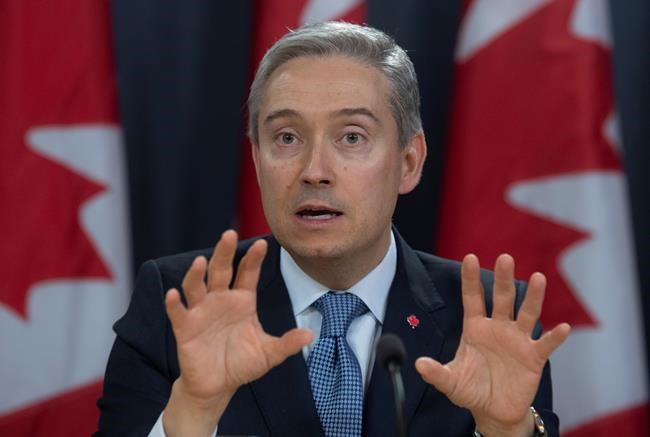
WASHINGTON – The federal government and the United States are communicating “almost daily” in a collective effort to mitigate the spread of the novel coronavirus north of the border and across North America, Canada’s foreign affairs minister said Monday.
Francois-Philippe Champagne struck a diplomatic tone as he described a “science-first” approach that includes the government’s Five Eyes security partners — the U.S., the U.K., Australia and New Zealand — to keep COVID-19, the respiratory disease caused by the virus, from running amok across the continent.
“We have been guided by science, we have been guided by the World Health Organization advisory and we’re continuing to work with our Five Eyes partners,” Champagne said Monday. “I would say our relationship and our interaction (with the U.S.) is going well — it’s almost daily at all levels of government — to make sure that we protect the safety of all Canadians.”
The muted statement stood in contrast to alarm in the U.S., where critics fear President Donald Trump and members of his administration are more preoccupied with managing the political fallout in an election year than they are with the crisis itself.
“The notion that we can’t do our day jobs and work on this very serious issue is absurd,” Health and Human Services Secretary Alex Azar told a conference call. “We’re taking COVID-19 incredibly seriously, and our teams, our public-health agencies, are actively working as we sit here and also trying to reform the entire health-care system.”
Champagne said the U.S. asked for Canada’s help repatriating some of the 237 Canadians from the Grand Princess cruise ship, which docked Monday in Oakland, Calif. Those who are healthy will be quarantined at a military base in Trenton, Ont., while any Canadians who test positive will stay behind and undergo treatment in the United States.
Canada has been working closely with the U.S. on the cruise passengers “to make sure that not only do we protect the health and safety of Canadians both at home and abroad, but we also are mindful of how we can protect North America from the threat of the virus,” he said.
Dr. Robert Kadlec, the assistant secretary for preparedness and response in the U.S. Department of Health and Human Services, said local California residents would leave the ship first, followed by the foreign nationals, including the Canadians. The remaining passengers will remain on board until Tuesday.
All passengers are being tested before disembarking. No details about the health of the Canadian passengers were released.
In an election year, it’s hardly surprising that Trump would be preoccupied with the political consequences.
“The more we know about this developing crisis, the more it is becoming clear that not only is the Trump administration incompetent, but that our current dysfunctional health-care system is vastly underprepared for this pandemic,” Democratic presidential hopeful Bernie Sanders said in an email to supporters.
“Sadly, I have very little confidence in the Trump administration to do anything that is right or decent, or certainly based on science.”
Then there was the market reaction: a 2,000-point plunge in the Dow Jones index on a frantic day that saw trading halted temporarily to give investors a chance to catch their breath and resist panic selling.
Cross-border supply chains are already beginning to feel the impact, said Dan Ujczo, a trade lawyer in Columbus, Ohio, who specializes in the Canada-U.S. corridor.
One central issue for suppliers and manufacturers is the question of “force majeure” — a legal principle that refers to a major disruption like a war, civil unrest, a natural disaster or “act of God” that makes it impossible to fulfil the terms of a contract. Whether the outbreak can be considered as such is sure to be a major point of future litigation, Ujczo said.
“At the moment, everyone is just putting out the fires of the day to keep supply chains moving,” he said. “The fallout will come later in the spring, as companies regroup to assess economic impact, restructure procurement and suppliers, and, of course, litigate for damages.”
The political and the practical intersected in other ways Monday.
Liberal MP Anthony Housefather and Toronto city councillor Josh Matlow said they would be self-isolating for precautionary reasons after three people who attended a prominent pro-Israel conference in Washington last week tested positive for the virus. Housefather attended the conference in person, while Matlow said he had contact with an attendee. Neither has symptoms.
Trump himself may have had contact, too: he was photographed shaking hands with Matt Schlapp, chairman of the American Conservative Union, during the Conservative Political Action Conference last month. Schlapp reportedly shook hands with an attendee who later tested positive. The president has also had close contact with two House Republicans who are now self-isolating after attending CPAC.
He did not acknowledge those encounters Monday during a late-day news conference, where he teased plans coming Tuesday for a payroll-tax cut and other measures to mitigate the economic impact of the crisis. Nor did he answer shouted questions about whether he had been tested.

He did — repeatedly — insist that no one could have seen the outbreak coming.
“This blindsided the world,” Trump said. “I think we’ve handled it very well.”
There were 583 active cases and 26 deaths in the U.S. as of late Monday.
This report by The Canadian Press was first published March 9, 2020.
— Follow James McCarten on Twitter @CdnPressStyle
Related Articles
Spotty sick leave policies limit options for avoiding virus







Advertisement Advertise With Us
Advertisement Advertise With Us