Spotty sick leave policies limit options for avoiding virus

Advertisement

Advertise with us

LONDON - A barber in Beijing is supporting his wife and child by charging food and other expenses to a credit card while he waits for his employer's shop to reopen. A waiter at a barbecue restaurant in Kansas City, Missouri, washes his hands more often and hopes for the best. A parcel delivery driver in Britain worries about getting sick from the people who sign for their packages.

Read this article for free:


or

Already have an account? Log in here »

To continue reading, please subscribe:

Subscribe and receive a limited-edition Free Press branded hat or tote.

Digital Subscription

One year of digital access for only $205*

  • Enjoy unlimited reading on winnipegfreepress.com
  • Read the E-Edition, our digital replica newspaper
  • Access News Break, our award-winning app
  • Play interactive puzzles

*First annual payment billed as $205.00 + GST for one year. This annual subscription will automatically renew at $233.00 + GST every 52 weeks (10% off the regular annual price of $259.35). Offer available to new and qualified returning subscribers only. Cancel any time.

To continue reading, please subscribe:

Add Free Press access to your Brandon Sun subscription for only an additional

$1 for the first 4 weeks*

  • Enjoy unlimited reading on winnipegfreepress.com
  • Read the E-Edition, our digital replica newspaper
  • Access News Break, our award-winning app
  • Play interactive puzzles
Start now

*Your next Brandon Sun subscription payment will increase by $1.00 and you will be charged $17.95 plus GST for four weeks. After four weeks, your payment will increase to $24.95 plus GST every four weeks.

Hey there, time traveller!
This article was published 09/03/2020 (2373 days ago), so information in it may no longer be current.

LONDON – A barber in Beijing is supporting his wife and child by charging food and other expenses to a credit card while he waits for his employer’s shop to reopen. A waiter at a barbecue restaurant in Kansas City, Missouri, washes his hands more often and hopes for the best. A parcel delivery driver in Britain worries about getting sick from the people who sign for their packages.

While white collar workers trying to avoid contagion can work from home or call in sick if they experience symptoms of the virus, that’s not an option for the millions of waiters, delivery workers, cashiers, ride-hailing drivers, museum attendants and countless others who routinely come into contact with the public.

Their dilemma is often compounded by spotty sick leave policies or inadequate health insurance coverage, leaving them vulnerable to the fast-spreading coronavirus that has already claimed thousands of lives and put them in a financially precarious position.
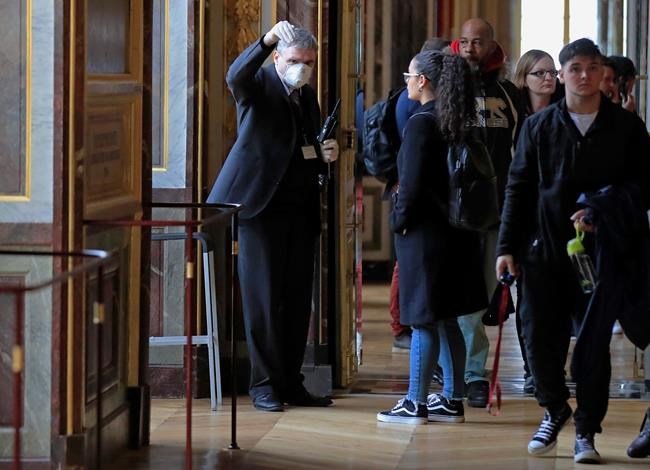
FILE - In this Thursday, March 5, 2020 file photo, an employee of the Palace of Versailles wearing a mask and gloves guides a tourist at the castel in Versailles, west of Paris. While white collar workers trying to avoid contagion can work from home or call in sick if they experience symptoms of the new virus, such precautions are not an options for the millions of waiters, delivery workers, cashiers, ride-hailing drivers, museum attendants and countless others who routinely come into contact with the public. (AP Photo/Michel Euler, File)

“The recommendations on what people should be doing to protect themselves really gives a sharp indication of the divide between white collar and blue collar workers,” said Shannon Liss-Riordan, a workers rights attorney in Boston. “Our social safety net is just not equipped at this moment to deal with a crisis like this, and it will disproportionately affect the most vulnerable low wage workers.”

For most people, the new coronavirus causes only mild or moderate symptoms, such as fever and cough. For some, especially older adults and people with existing health problems, it can cause more severe illness, including pneumonia.

The vast majority of people recover. According to the World Health Organization, people with mild illness recover in about two weeks, while those with more severe illness may take three to six weeks to recover. In mainland China, where the outbreak emerged in December, almost three-fourths of more than 80,000 patients have recovered.

While tech companies like Facebook, Amazon and Microsoft have implemented work-from-home policies, only 29% of U.S. workers have that option, according to the Bureau of Labor Statistics. That means retail workers like Mendy Hughes must fend for themselves. The Walmart cashier in Malvern, Arkansas, serves hundreds of people a day and her big worry is what will happen to her income if she catches the virus or comes in contact with someone who’s had it and must self-quarantine for 14 days.

“If I can’t go to work, I could try to take a leave but it will be unpaid,” said Hughes, who earns $11.60 an hour. “I don’t know what I would be doing about taking care of my family.”

Hughes, a diabetic and mother of four, gets 48 hours of sick leave a year but she fears it wouldn’t be nearly enough time to recover.

On Tuesday, Walmart announced a new policy that might offer her some relief: employees who work in a region that is required to quarantine by the government or by the retailer, as well as those who have a confirmed case of the new virus, will receive two weeks of pay. If they are not able to return to work after that time, additional pay may be provided for up to 26 weeks for both full-time and part-time hourly workers.

In the United States, about 27% of private sector workers don’t have access to paid sick leave, according to the Bureau of Labor Statistics. Some countries, like Britain, are looking into helping out non-permanent workers. There is no federal sick leave policy in the U.S., but 12 of the 50 states and Washington D.C. require employers to offer paid sick leave.

Some House and Senate Democrats have been pushing legislation that would require employers to allow workers to accrue seven days of paid sick leave and to provide an additional 14 days in the event of any public health emergency, including the current coronavirus crisis. President Donald Trump said he was seeking help for hourly-wage workers to ensure they’re “not going to miss a paycheque,” and he would outline the proposals Tuesday.

In Britain, parcel delivery driver Ed Cross worries about catching the virus from the machine he hands people who sign for their packages.

“People have coughed on their hand and then got hold of my machine and you sort of make a joke of it trying to point it out,” Cross, 53, said. “But yeah, it’s what we face daily.”

“We only have to go to the wrong house and we could catch it, as simple as that,” said Cross, who on a recent day handed packages to 110 people on his route in Whitby, northern England.

The British government last week made it easier to collect statutory sick pay and is working on changes to help millions of non-permanent workers like Cross who aren’t eligible for it. In a sign the industry is waking up to the problem, his parcel company, Hermes, announced a 1 million pound ($1.3 million) fund to help couriers who need to self-isolate.
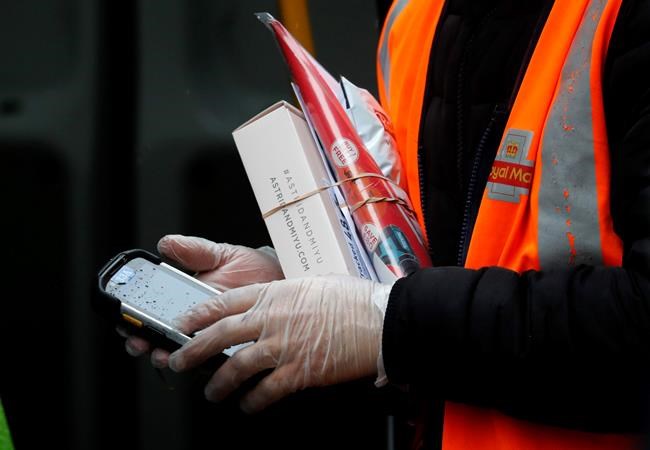
In this March 5, 2020, photo, a Royal Mail employee wears gloves as he hold parcels and the signature handheld as he delivers in London. While white collar workers trying to avoid contagion can work from home or call in sick if they experience symptoms of the new virus, such precautions are not an options for the millions of waiters, delivery workers, cashiers, ride-hailing drivers, museum attendants and countless others who routinely come into contact with the public. (AP Photo/Frank Augstein)

Uber, meanwhile, said it would compensate drivers and couriers for up to 14 days if they get sick or have to be quarantined.

The viral outbreak has revealed gaping holes in health care coverage at a time when people may need it most. Most European countries and Canada have universal healthcare systems, but the U.S. relies on a patchwork of public and private insurance. About 69% of private industry workers in the U.S. have access to healthcare benefits, but that drops to 43% of service workers. U.S. employers with 50 or more employees are required to offer health insurance. But the same protection isn’t provided to part-time workers or independent contractors.

Waiter Joey Ingham, who works at a barbecue restaurant in Kansas City, Missouri, popular with business travellers, says he doesn’t have insurance. His protection? Washing his hands more often.

“If I wasn’t able to come into work, it would be hard to make ends meet,” said Ingham, who waits on 80 to 120 people a shift. If he felt sick, he’d “probably talk to a manager” about what to do, but noted management hasn’t yet outlined any policies.

Liss-Riordan said most gig workers — independent or temporary contractors — she represents don’t have health insurance.

“We won’t have a fully insured population until we get universal healthcare,” he said. “There are going to be these huge gaps. The burden is falling on the poorest and most vulnerable in our society. This is just another example.”

The American Academy of Family Physicians recommends workers without insurance contact a local health department or community health centre for help. The U.S. Centers for Disease Control and Prevention recommends emergency room visits only for patients who are very sick.

In France, where people have the right not to work and get full pay when they consider their workplaces to be dangerous, some service staff briefly stayed home because of contagion concerns. Workers at the Louvre, the world’s most-visited museum, refused to work for two days and were only coaxed back after management introduced a raft of new anti-virus measures.

“We are asking for gloves. We are asking for disinfectant gels, and masks for the drivers,” said Bastien Berthier, of the Paris metro’s UNSA union.

In China, where the outbreak has been raging for two months, many service industry workers have it far worse, with business evaporating as people are forced to hunker down at home.

A barber in Beijing who would give only his surname, Long, said he is supporting his wife and child by charging food and other expenses to a credit card while he waits for his employer to reopen.

“I can ask for sick leave or compassionate leave, but I get nothing without working,” said Long, 33.

Jiang Yanlin, a tour guide in eastern China’s Huangshan region, said she hasn’t earned anything since mid-January and doesn’t have any social welfare benefits to fall back on. Usually she can earn up 300 yuan ($42) a day during the normally busy Lunar New Year holiday.
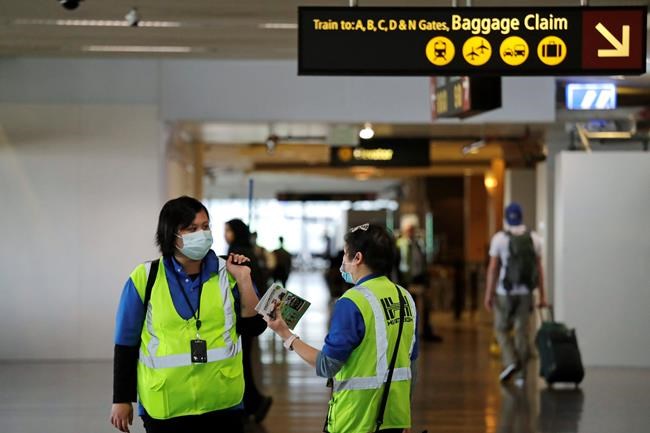
FILE - In this Tuesday, March 3, 2020, file photo, a pair of workers at Seattle-Tacoma International Airport wear masks in SeaTac, Wash. While white collar workers trying to avoid contagion can work from home or call in sick if they experience symptoms of the new virus, such precautions are not an options for the millions of waiters, delivery workers, cashiers, ride-hailing drivers, museum attendants and countless others who routinely come into contact with the public. (AP Photo/Elaine Thompson, File)

“If I don’t work, I don’t get paid. Everyone here in the Huangshan tourist zone is like this,” said Jiang, 33. “No one is coming to travel. Everyone is so scared.”

___

This story has corrected the misspelled name of an attorney in Boston. It is Shannon Liss-Riordan, not Shannon Liss-Reardon.

___

The Associated Press receives support for health and science coverage from the Howard Hughes Medical Institute’s Department of Science Education. The AP is solely responsible for all content.

___

Anderson reported from New York. Associated Press writers John Leicester in Paris, Jill Lawless in London, AP researcher Yu Bing in Beijing contributed.

___

Follow AP’s virus coverage at: https://apnews.com/VirusOutbreak

Report Error Submit a Tip

More Stories

Senior cats have lots to offer… including mice

Melissa Martin 6 minute read Preview

Senior cats have lots to offer… including mice

Melissa Martin 6 minute read Saturday, Jan. 9, 2016

The first gift Princess gave us was a wee black mouse, not fur but threadbare felt, one that rattled when she grasped it in her tiny mouth.

She dropped it on the bed in front of us, stood up straight and waited. Fleckless yellow eyes fixated on our faces: she wanted a response.

OK, I'm only slightly embarrassed to admit this, but - we gushed. We fawned over the thumb-sized toy with the cloying fervour typically deployed after Christmas recitals by small children. We lifted its slightly slobbered body to our faces, admired it from every angle, and cooed a sticky approval.

"Oh, Princess!" we exclaimed, voices leaping an octave over normal range. "Thank you sooooooo much. Wow, what a great mouse."

Read
Saturday, Jan. 9, 2016

Throne speech offers glimpse of PCs’ priorities

Shannon Sampert 5 minute read Preview

Throne speech offers glimpse of PCs’ priorities

Shannon Sampert 5 minute read Thursday, Nov. 22, 2018

Throne speeches are more than just pomp and circumstance and the opportunity for selfies between political rivals on the beautiful marble floors of the Manitoba legislature building on Broadway. They set the agenda for the legislative session and set the tone for the government as it moves into its new session. Looked at carefully, they also reveal the priorities of the government by what is said, and also what is not said.

But they are also highly symbolic. They are delivered by the lieutenant-governor of the province, who acts as the symbol of the head of state, the Queen, but they are written by speechwriters for the government of the day.

Political scientists have studied the throne speeches delivered at the federal level to understand the thematic commonalities and what they say about nationalism over the past 30 years. Janine Brodie of the University of Alberta, for example, determined that Canadian throne speeches delivered before the 2000s embraced a more neo-liberal tone that was tied to the global economy.

After 2000, an analysis by Tim Nieguth (Laurentian University) and Tracey Raney (Ryerson University) found that Conservative throne speeches tended to focus on neo-conservative themes — emphasizing the family, the military and threats to security — while Liberals’ speeches talked about health care and Indigenous issues.

Read
Thursday, Nov. 22, 2018

Today’s horoscope

Georgia Nicols 4 minute read 2:00 AM CDT

MOON ALERT: Avoid shopping (except food and gas) and important decisions from 8 a.m. until noon today. After that, the moon moves from Cancer into Leo.

ARIES (March 21-April 19)

Hang in there, because as this day progresses, it becomes more lighthearted and fun-loving. Admittedly, power struggles with a friend or member of a group might squelch things. Be patient with kids. Basically, this is a friendly and productive day.

TAURUS (April 20-May 20)

Brian Sinclair's legacy will be visible for years, but there was so much we failed to see as he neared death

Melissa Martin 8 minute read Preview

Brian Sinclair's legacy will be visible for years, but there was so much we failed to see as he neared death

Melissa Martin 8 minute read Thursday, Sep. 20, 2018

Ten years later, the ghost of Brian Sinclair still haunts the edges of Winnipeg's consciousness. It whispers, moves, seems to shimmer; a phantasmic video image reconstructed from hundreds of pages of documents.

In my mind's eye, veiled by the fog of imagination and time, this is how that ghostly video begins.

It's a perfect September afternoon in Winnipeg, moments before 3 p.m. The skies above the city are gentle. Outside the Health Sciences Centre's emergency room entrance, a white Handi-Transit taxi slows to a stop.

There is a man in a wheelchair. Hands resting on his thighs, clad in a dark jacket. The cab driver pushes his wheelchair to the triage desk, and then leaves. A man in scrubs, holding a notepad, walks over to greet him.

Read
Thursday, Sep. 20, 2018

Letters, Sept. 5

7 minute read Saturday, Sep. 5, 2026

Clearing the air

Re: QDoc patients in middle of billing dispute (Sept. 4)

QDoc has been fortunate to have a genuine partner in the Manitoba government over the past several years. Premier Wab Kinew and Health Minister Uzoma Asagwara have been consistently clear that no Manitoban should go without care because of where they live, and that commitment is exactly why virtual care exists as a permanent, publicly available option today. We built MediNav, the province’s online appointment booking system, together with Manitoba Health, and that same collaborative spirit has helped make more than 350,000 patient visits possible through our platform — many of them evenings, overnights and weekends, reaching rural and underserviced communities that need it most.

We want to be direct with the people who rely on us: QDoc is not going anywhere. We continue to see patients today, and we will keep doing so tomorrow. The issue reported this week is a technical billing matter, not a service disruption, and we are actively working with the province to resolve it quickly, so we can keep growing our capacity to serve Manitobans rather than limiting it.

Tokyo Olympics sponsorship scandal widens with more arrests

Yuri Kageyama, The Associated Press 3 minute read Preview

Tokyo Olympics sponsorship scandal widens with more arrests

Yuri Kageyama, The Associated Press 3 minute read Tuesday, Sep. 6, 2022

TOKYO (AP) — Bribery allegations against a former Tokyo Olympics organizing committee member widened Tuesday as Japanese prosecutors “re-arrested” Haruyuki Takahashi in a case involving suspected payments from a publisher which became a sponsor for the Games.

The latest allegations center on 76 million yen ($540,000) Takahashi received from Tokyo-based publishing company Kadokawa, according to Tokyo District prosecutors. The sponsorship allowed Kadokawa, which also makes films and games, to publish programs and other books related to the Tokyo Olympics.

Also arrested Tuesday were two Kadokawa officials, Toshiyuki Yoshihara and Kyoji Maniwa, who allegedly deposited the money.

Takahashi has been in detention since being arrested last month on suspicion of receiving bribes from clothing manufacturer Aoki Holdings. He was formally charged Tuesday with receiving 51 million yen ($360,000) in bribes from Aoki.

Read
Tuesday, Sep. 6, 2022