Global Inuit organization concerned about potential spread of COVID-19 in North

Advertisement

Advertise with us

OTTAWA - If the novel coronavirus spreads to the North, Inuit communities in Canada and elsewhere in the Arctic are at a much higher risk of exposure because of a chronic lack of basic infrastructure and resources, according to the Inuit Circumpolar Council.

Read this article for free:


By clicking the button above, an account will be created and you will begin to receive some of our recommended newsletters. You may opt out of any newsletter by visiting your Email and Communication Preferences page or by clicking "unsubscribe" at the bottom of any email.

or

Already have an account? Log in here »

To continue reading, please subscribe:

Digital Subscription

One year of digital access for only $1.44 a week*

  • Enjoy unlimited reading on winnipegfreepress.com
  • Read the E-Edition, our digital replica newspaper
  • Access News Break, our award-winning app
  • Play interactive puzzles

*Billed as $5.77 plus GST every four weeks. After 52 weeks, price increases to the regular rate of $19.95 plus GST every four weeks. Offer available to new and qualified returning subscribers only. Cancel any time.

To continue reading, please subscribe:

Add Free Press access to your Brandon Sun subscription for only an additional

$1 for the first 4 weeks*

  • Enjoy unlimited reading on winnipegfreepress.com
  • Read the E-Edition, our digital replica newspaper
  • Access News Break, our award-winning app
  • Play interactive puzzles
Start now

*Your next Brandon Sun subscription payment will increase by $1.00 and you will be charged $17.95 plus GST for four weeks. After four weeks, your payment will increase to $24.95 plus GST every four weeks.

Hey there, time traveller!
This article was published 06/03/2020 (2429 days ago), so information in it may no longer be current.

OTTAWA – If the novel coronavirus spreads to the North, Inuit communities in Canada and elsewhere in the Arctic are at a much higher risk of exposure because of a chronic lack of basic infrastructure and resources, according to the Inuit Circumpolar Council.

The council, which represents about 180,000 Inuit living in Canada, Alaska, Greenland and Russia, said they must be considered in government responses to the coronavirus because of the potential compounding threat to basic health and well-being in those communities.

Many communities lack sewers and running water, putting people at greater risk of getting sick from COVID-19, the respiratory disease linked to the virus, the council said this week, noting there is already a high prevalence of tuberculosis and other respiratory infections in those communities.

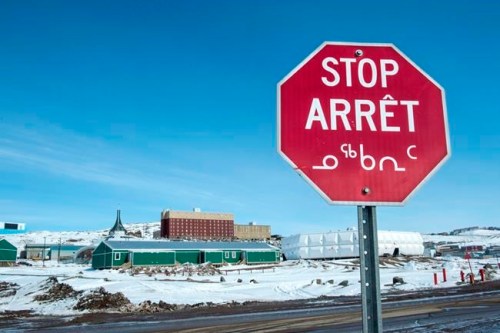
A stop sign in English, French and Inuit is seen in Iqaluit, Nunavut on April 25, 2015. The Inuit Circumpolar Council says if the novel coronavirus spreads to the north its communities in Canada, Alaska and Greenland are at a much higher risk of exposure because of a chronic lack of basic infrastructure and resources. The group says the Inuit must be considered in the government's national and regions response and preparedness plans for coronavirus and the potential compounding threat to basic health and well-being in those communities. THE CANADIAN PRESS/Paul Chiasson

“Despite being the original inhabitants of some of the most affluent countries in the world, gaps in basic infrastructure continue to contribute to severe health risks,” the council said in a news release.

The council has also called on governments to close those infrastructure gaps to protect against future health threats.

Prime Minister Justin Trudeau held a meeting with the Inuit-Crown partnership committee Friday, where he acknowledged gaps in Canada’s Inuit communities range “from housing to health care.”

He did not specifically address COVID-19 in his public remarks, but said that he and his cabinet ministers were there to listen to Inuit leaders’ concerns.

Natan Obed, the president of Inuit Tapiriit Kanatami and co-chair of the committee, also did not mention the virus in his comments. But he said eliminating the infrastructure deficit is on the suggested work plan for the committee, and he was pleased to see it in the Liberal campaign platform too.

NDP leader Jagmeet Singh wrote a letter to Trudeau Friday, urging him to make sure Indigenous and Inuit communities are not disproportionately affected if Canada ends up dealing with a widespread outbreak of the virus.

Singh cautioned the government not to repeat mistakes made during the H1N1 outbreak in 2009. A research review by the National Collaborating Centres for Public Health found a fairly strong association between severe manifestations of the H1N1 influenza and the isolation of Indigenous communities after that outbreak.

“To date, we have seen little evidence to indicate that the federal government learned from these mistakes,” Singh wrote in the letter.

He called on the government to appoint Indigenous Services Minister Marc Miller as a permanent member of the new COVID-19 cabinet committee, struck earlier this week to provide an whole-of-government approach to combating the virus.

There are eight cabinet ministers on the committee, which Miller listed as one of seven alternates.

Indigenous Services Canada is also working with the Public Health Agency of Canada, other relevant departments, and its provincial and territorial counterparts to protect the health and safety of First Nations, Metis and Inuit and support them in responding to public health threats, including COVID-19, according to a statement from the office of Deputy Prime Minister Chrystia Freeland.

The department is also represented on the other response committees in place to respond to the coronavirus threat.

This report by The Canadian Press was first published March 6, 2020.

— With files from Teresa Wright in Ottawa

Report Error Submit a Tip

More Stories

Brian Bowman wins mayoral battle

Aldo Santin and Mary Agnes Welch 6 minute read Preview

Brian Bowman wins mayoral battle

Aldo Santin and Mary Agnes Welch 6 minute read Thursday, Oct. 23, 2014

In the end, it wasn’t even close.

A mayoral race that was supposed to be a head-to-head battle between privacy lawyer Brian Bowman and former NDP MP and MLA Judy Wasylycia-Leis turned into a rout on election night. Wasylycia-Leis, the experienced politician, had held what looked like an unassailable lead for months, but Bowman, the outsider who promised Winnipeggers a better, prosperous future, chipped doggedly away at it.

“I’m excited to tell you that positive change is coming to city hall,” Bowman told roaring supporters at the Inn At The Forks after making his way into the small ballroom accompanied by his wife and two young sons.

He said he hadn’t expecting such a landslide victory, but had believed that the campaign was building momentum.

Read
Thursday, Oct. 23, 2014

Waiting for Cormier verdict the ‘calm before the storm’

Katie May 6 minute read Preview

Waiting for Cormier verdict the ‘calm before the storm’

Katie May 6 minute read Thursday, Feb. 22, 2018

As the jury room door closed behind the seven women and four men who are now deliberating on the evidence against Tina Fontaine’s accused killer, Thelma Favel rose from the chair she’s occupied for most of Raymond Cormier’s second-degree murder trial.

Almost every day over the past three weeks, Favel, the woman who raised 15-year-old Tina, has sat right up front, directly across from the jury box, listening, sobbing and soaking in disturbing details of the teen’s last days that have come to light over the course of Cormier’s second-degree murder trial.

On Wednesday afternoon, after Court of Queen’s Bench Chief Justice Glenn Joyal instructed the jury and sent them off to be sequestered until they decide whether 56-year-old Raymond Cormier is guilty of killing Tina, Favel got up and hugged Crown prosecutor Breta Passler. It was one of many moments, this one shielded from jurors, that have long since proven the emotional impact of the case and the lasting power of Tina’s legacy.

Tina’s death sparked a public outcry that renewed calls for a national inquiry into disproportionately high rates of missing and murdered Indigenous women and girls across Canada, and the criminal trial for the man accused of killing her hasn’t happened in a vacuum.

Read
Thursday, Feb. 22, 2018

One-on-one Journalism Training

0 minute read Wednesday, Jun. 18, 2025

Inuit concerned about spread of COVID-19

Laura Osman, The Canadian Press 4 minute read Preview

Inuit concerned about spread of COVID-19

Laura Osman, The Canadian Press 4 minute read Friday, Mar. 6, 2020

A collection of breaking news briefs filed on March 11, 2020

• Jets, Oilers tied 2-2 through 40 minutes

• Jets, Oilers scoreless through 20 minutes

• NDP blocks Manitoba budget

• Winnipeg Jewish Theatre announces 2020-21 season

• Jets to face McDavid tonight in Edmonton

• RCMP investigating exposure death

• Downtown tents, utility pole burn

• Blaze guts Burrows Avenue building

Read
Friday, Mar. 6, 2020

Transit driver killed in knife attack on U of M campus

8 minute read Preview

Transit driver killed in knife attack on U of M campus

8 minute read Tuesday, Feb. 14, 2017

A Winnipeg Transit driver was killed early this morning after he was stabbed by the only passenger on his bus at the University of Manitoba campus.

Irvine Jubal Fraser, 58, was rushed to hospital in critical condition but later died, police said.

The attack occurred at about 2 a.m. in the area of Dafoe Road West and Gillson Street.

Witnesses pointed officers led by the canine unit in the direction of the Red River, where a 22-year-old suspect trying to cross to the St. Vital side was arrested and taken into custody.

Read
Tuesday, Feb. 14, 2017

Wife’s witchy wonderment won’t spell trouble

Maureen Scurfield 6 minute read 2:00 AM CDT

DEAR MISS LONELYHEARTS: My wife believes in magic potions, which used to make me laugh. But since Halloween season started this year, she’s been acting in a way that frightens me. She seems to think she’s a modern-day “witch.” Give me a break!

Now she has three friends who think they are really casting spells when they get together! And this year on Halloween night she’s being formally accepted into their little witchy group meeting at one of their homes, and is getting a new sorceress name. It’s creepy! How do I cope? I’ve had enough of this.

— Seriously Upset, South St. Vital

Dear Upset: Don’t buy into the hocus pocus by being afraid of it and expressing any trepidation to your wife. She needs you to be strong, so she knows she has a solid anchor and can drop out of this witchy group if it becomes too scary or silly for her.