WEATHER ALERT

Doctor’s death unleashes mourning, fury at Chinese officials

Advertisement

Advertise with us

BEIJING - The death of a young doctor who was reprimanded for warning about China’s new virus triggered an outpouring Friday of praise for him and fury that communist authorities put politics above public safety.

Read this article for free:


By clicking the button above, an account will be created and you will begin to receive some of our recommended newsletters. You may opt out of any newsletter by visiting your Email and Communication Preferences page or by clicking "unsubscribe" at the bottom of any email.

or

Already have an account? Log in here »

To continue reading, please subscribe:

Digital Subscription

One year of digital access for only $1.44 a week*

  • Enjoy unlimited reading on winnipegfreepress.com
  • Read the E-Edition, our digital replica newspaper
  • Access News Break, our award-winning app
  • Play interactive puzzles

*Billed as $5.77 plus GST every four weeks. After 52 weeks, price increases to the regular rate of $19.95 plus GST every four weeks. Offer available to new and qualified returning subscribers only. Cancel any time.

To continue reading, please subscribe:

Add Free Press access to your Brandon Sun subscription for only an additional

$1 for the first 4 weeks*

  • Enjoy unlimited reading on winnipegfreepress.com
  • Read the E-Edition, our digital replica newspaper
  • Access News Break, our award-winning app
  • Play interactive puzzles
Start now

*Your next Brandon Sun subscription payment will increase by $1.00 and you will be charged $17.95 plus GST for four weeks. After four weeks, your payment will increase to $24.95 plus GST every four weeks.

Hey there, time traveller!
This article was published 07/02/2020 (2460 days ago), so information in it may no longer be current.

BEIJING – The death of a young doctor who was reprimanded for warning about China’s new virus triggered an outpouring Friday of praise for him and fury that communist authorities put politics above public safety.

In death, Dr. Li Wenliang became the face of simmering anger at the ruling Communist Party’s controls over information and complaints that officials lie about or hide disease outbreaks, chemical spills, dangerous consumer products or financial frauds.

The 34-year-old ophthalmologist died overnight at Wuhan Central Hospital, where he worked and likely contracted the virus while treating patients in the early days of the outbreak.

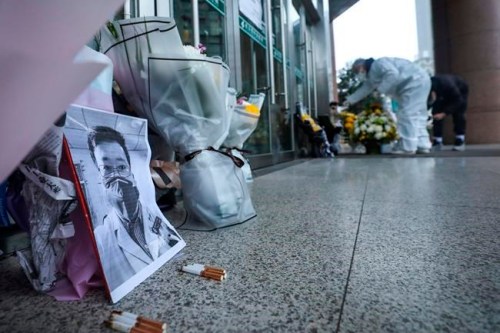
People pay condolence in front of flowers lying near a photo of the late Dr. Li Wenliang at a hospital in Wuhan in central China's Hubei province, Friday, Feb. 7, 2020. The death of the doctor who was reprimanded for warning about China's new virus triggered an outpouring Friday of praise for him and fury that communist authorities put politics above public safety. In death, Dr. Li Wenliang became the face of simmering anger at the ruling Communist Party's controls over information and complaints that officials lie about or hide disease outbreaks, chemical spills, dangerous consumer products or financial frauds. (Chinatopix via AP)

“A hero who released information about Wuhan’s epidemic in the early stage, Dr. Li Wenliang is immortal,” the China Center for Disease Control’s chief scientist, Zeng Guang, wrote on the Sina Weibo microblog service.

Police in December had reprimanded eight doctors including Li for warning friends on social media about the emerging threat. China’s supreme court later criticized the police, but the ruling party also has tightened its grip on information about the outbreak.

Weibo users have left hundreds of thousands of messages below Li’s last post.

A post by one of Li’s coworkers, an emergency room nurse, said the freezing Wuhan weather was “as gloomy as my mood.”

“To you, we are angels and so strong. But how strong a heart can watch the people around me fall one by one without being shocked?” wrote Li Mengping on her verified account.

Others placed blame for the deaths on Chinese officials, not an animal species from where the virus might have spread, and said those who made trouble for the doctor should face consequences. The most pointed online comments were quickly deleted by censors.

The ruling party has faced similar accusations of bungling or thuggish behaviour following previous disasters. They include the 2003 outbreak of severe acute respiratory syndrome, a 2005 chemical spill that disrupted water supplies to millions of people in China’s northeast, sales of tainted milk that sickened thousands of children and the failure of private finance companies after the global economic crisis.

In each case, officials were accused of trying to conceal or delay release of information members of the public said they needed to protect themselves.

The party often responds by allowing the public to vent temporarily, then uses its control of media and the internet to stifle criticism. Critics who persist can be jailed on vague charges of spreading rumours or making trouble.

On the streets of Beijing, the capital, residents expressed sadness and said that China should learn from Li.

“He is such a nice person, but still didn’t pull through,” said Ning Yanqing. “Those left do not dare to speak out. Alas, I don’t know what to say.”

Some online comments Friday hinted at broader dissatisfaction with the party and Chinese President Xi Jinping, who has tightened controls on society since taking power in 2012.

The most powerful Chinese leader since at least the 1980s, Xi gave himself the option of remaining president for life by changing the Chinese constitution in 2018 to remove a two-term limit.

Referring to one of Xi’s propaganda initiatives, a message that circulated on social media said, “My ‘Chinese Dream’ is broken.”

In Wuhan, local leaders were accused of telling doctors in December not to publicize the spreading virus in order to avoid casting a shadow over the annual meeting of a local legislative body.

As the virus spread, doctors were ordered to delete posts on social media that appealed for donations of medical supplies. That prompted complaints authorities were more worried about image than public safety.

Li was detained by police after warning about the virus on a social media group for his former classmates.

The latest episode is unusually awkward for the ruling party because Li was a physician, part of a group who are regarded as overworked, underpaid heroes who are China’s line of defence against a frightening new disease.

“He showed a responsible attitude toward the society,” said Cai Lin, a Beijing resident. “He is honest and faithful. So I think the whole society should reflect on this.”

The World Health Organization, which has complimented China’s response to the outbreak, said in a tweet that “We are deeply saddened by the passing of Dr. Li Wenliang. We all need to celebrate work that he did on” the virus.

The official propaganda apparatus tried Friday to mollify the public.

“Some of Li Wenliang’s experiences during his life reflect shortcomings and deficiencies in epidemic prevention and control,” said state television on its website.

The Chinese ambassador to Washington, Cui Tiankai, said in Twitter, a service the ruling party’s internet censorship blocks the public from seeing, “Really saddened by the death of Dr. Li Wenliang. He was a very devoted doctor. We are so grateful to him for what he has done in our joint efforts fighting against #2019nCoV.”

The government announced a team from Beijing would be sent to Wuhan to investigate “issues reported by the masses involving Dr. Li Wenliang.”

___

AP researcher Chen Si in Zhengzhou, China, and video journalist Olivia Zhang and researcher Yu Bing in Beijing contributed to this report.

Report Error Submit a Tip

More Stories

Doctor's death unleashes mourning, fury at Chinese officials

Joe McDonald, The Associated Press 6 minute read Preview

Doctor's death unleashes mourning, fury at Chinese officials

Joe McDonald, The Associated Press 6 minute read Friday, Feb. 7, 2020

BEIJING - The death of a young doctor who was reprimanded for warning about China’s new virus triggered an outpouring Friday of praise for him and fury that communist authorities put politics above public safety.

In death, Dr. Li Wenliang became the face of simmering anger at the ruling Communist Party's controls over information and complaints that officials lie about or hide disease outbreaks, chemical spills, dangerous consumer products or financial frauds.

The 34-year-old ophthalmologist died overnight at Wuhan Central Hospital, where he worked and likely contracted the virus while treating patients in the early days of the outbreak.

“A hero who released information about Wuhan’s epidemic in the early stage, Dr. Li Wenliang is immortal,” the China Center for Disease Control’s chief scientist, Zeng Guang, wrote on the Sina Weibo microblog service.

Read
Friday, Feb. 7, 2020

Imperialist crusades: 21st-century style

John R. Wiens 5 minute read Preview

Imperialist crusades: 21st-century style

John R. Wiens 5 minute read Wednesday, Jul. 8, 2026

In the 11th century and lasting into the 13th, the papacy launched a series of at least eight military campaigns we now refer to as the Crusades, or Holy Wars. They were an imperialistic call to arms for Christians to retake Jerusalem, which was at the time under Muslim rule.

Spiritual rewards for participation were implied, and other incentives offered, to dull the extra taxation demanded to fund the campaigns. Over time, the “crusades” morphed to become massacres of not only Muslims but also Jews and Christian dissidents — in other words, any enemies of the papacy. If today’s news sounds like déjà vu all over again, it probably should.

The stories keep repeating themselves in many forms. We now know that two 20th century world wars, global in scope, were caused by imperialistic ambitions, changes in the balance of international powers and corresponding arms races. The first was attributed to the assassination of the heir to the Austro-Hungarian throne by a Bosnian Serb, a kind of “regime change” initiative. The second resulted from rising tensions between Allied and Axis powers, triggered by the rise of European fascism and Japanese militarism. The human toll of both was unimaginable.

In the First World War, 15 to 22 million people, including soldiers and civilians, were killed and another 23 million were wounded. These numbers do not account for those otherwise affected — victims of chemical warfare whose compromised health shortened their lives; of the subsequent Spanish flu epidemic amplified by the displacement of peoples; others who died from other diseases caused by war conditions; and those who were malnourished or starved. Nor do they account for the ongoing trauma and resentments passed on intergenerationally to this day.

Read
Wednesday, Jul. 8, 2026

Fact Check

1 minute read Thursday, Nov. 30, 2023

Fact Check

Having problems with the form?Contact Us Directly |

SNC planned U.S. move if no deal: documents

Jordan Press and Christopher Reynolds, The Canadian Press 5 minute read Preview

SNC planned U.S. move if no deal: documents

Jordan Press and Christopher Reynolds, The Canadian Press 5 minute read Thursday, Mar. 28, 2019

OTTAWA - SNC-Lavalin warned federal prosecutors last fall about a possible plan to split the company in two, move its offices to the United States and eliminate its Canadian workforce if it didn't get a deal to avoid criminal prosecution, newly obtained documents show.

The documents, part of a PowerPoint presentation obtained by The Canadian Press, describe something called "Plan B" — what Montreal-based SNC might have to do if it can't convince the government to grant a so-called remediation agreement to avoid criminal proceedings in a fraud and corruption case related to projects in Libya.

Under that plan, SNC would move its Montreal headquarters and corporate offices in Ontario and Quebec to the U.S. within a year, cutting its workforce to just 3,500 from 8,717, before eventually winding up its Canadian operations.

“The government of Canada needs to weigh the public interest impact of the prosecution of SNC-Lavalin," the presentation reads.

Read
Thursday, Mar. 28, 2019

The long and winding road

Editorial 4 minute read Preview

The long and winding road

Editorial 4 minute read Yesterday at 2:01 AM CDT

As theatre goes, it sent a strong message.

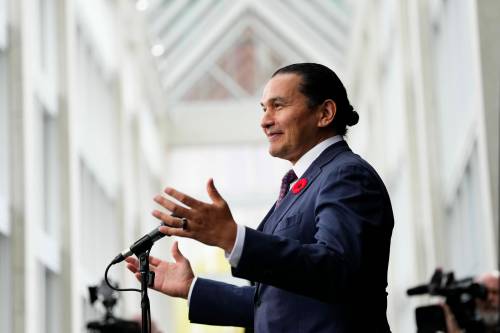
Manitoba Premier Wab Kinew, standing in front of microphones and television cameras, holding up his Indigenous status card and saying that he didn’t feel Canada should have “a race-based form of identification in this country, but that is a reality,” adding that it was time to abolish the Indian Act.

“I think it’s time to abolish the Indian Act, get rid of the Indian Act, move past the Indian Act, and it needs to be done with First Nations people and First Nations governments, of course. I think it’s long overdue that we have a relationship with Indigenous Peoples in Canada that reflects who we are as Canadians today,” he said.

The Indian Act — the name alone suggests how out-dated and out of place the law has become. Originally dating from 1876, the law was put in place to “amend and consolidate the laws respecting Indians” and gave the Minister of the Interior the responsibility to “control and management of the reserves, lands, moneys and property of Indians in Canada.”

Read
Yesterday at 2:01 AM CDT

Court ruling concludes Canadian Wheat Board saga

Laura Rance-Unger 4 minute read Preview

Court ruling concludes Canadian Wheat Board saga

Laura Rance-Unger 4 minute read Yesterday at 2:01 AM CDT

It remains to be seen whether the recent court ruling in a lawsuit filed after Canadian Wheat Board’s dissolution in 2012 puts the whole debate to rest, as some no doubt hope.

But either way, the dust has settled on the post-CWB world. The sun still rises and a new generation of farmers on the land only knows by name an institution that for generations influenced every aspect of Prairie grain farming.

The first Rural Revival column I wrote for this newspaper more than 30 years ago was about a thousand farmers from Western Canada demonstrating in support of the Wheat Board. It was in the aftermath of the Western Grain Marketing Panel report, one of several efforts that eventually included a plebiscite to help the federal government decide what to do about a vocal minority of farmers who wanted marketing “freedom.”

The polls at the time suggested about two-thirds of farmers were comfortable enough with the single-desk system for food wheat and barley to keep it around. It served as a counterbalance to canola, which they sold on the open market. They essentially had a dual market.

Read
Yesterday at 2:01 AM CDT