Under quarantine: what life will be like at CFB Trenton for evacuees from Wuhan

Advertisement

Advertise with us

OTTAWA - The evacuees from Wuhan expected to arrive in Canada Friday face two weeks of isolation, as they are confined to their assigned motel rooms on a Canadian Forces base in southern Ontario, where they will be monitored for signs of the novel coronavirus.

Read this article for free:


By clicking the button above, an account will be created and you will begin to receive some of our recommended newsletters. You may opt out of any newsletter by visiting your Email and Communication Preferences page or by clicking "unsubscribe" at the bottom of any email.

or

Already have an account? Log in here »

To continue reading, please subscribe:

Digital Subscription

One year of digital access for only $1.44 a week*

  • Enjoy unlimited reading on winnipegfreepress.com
  • Read the E-Edition, our digital replica newspaper
  • Access News Break, our award-winning app
  • Play interactive puzzles

*Billed as $5.77 plus GST every four weeks. After 52 weeks, price increases to the regular rate of $19.95 plus GST every four weeks. Offer available to new and qualified returning subscribers only. Cancel any time.

To continue reading, please subscribe:

Add Free Press access to your Brandon Sun subscription for only an additional

$1 for the first 4 weeks*

  • Enjoy unlimited reading on winnipegfreepress.com
  • Read the E-Edition, our digital replica newspaper
  • Access News Break, our award-winning app
  • Play interactive puzzles
Start now

*Your next Brandon Sun subscription payment will increase by $1.00 and you will be charged $17.95 plus GST for four weeks. After four weeks, your payment will increase to $24.95 plus GST every four weeks.

Hey there, time traveller!
This article was published 06/02/2020 (2460 days ago), so information in it may no longer be current.

OTTAWA – The evacuees from Wuhan expected to arrive in Canada Friday face two weeks of isolation, as they are confined to their assigned motel rooms on a Canadian Forces base in southern Ontario, where they will be monitored for signs of the novel coronavirus.

Public health officials and members of the armed forces have said they hope to keep the Canadian evacuees as safe and comfortable as they can throughout 14 days of mandatory isolation at Canadian Forces Base Trenton to protect against the possible spread of infection disease.

That follows having already endured an unprecedented quarantine in Wuhan, a city of 11 million in central China at the centre of the outbreak.

Minister of Health Patty Hajdu speak about Canada's efforts to evacuate citizens from China during a news conference in Ottawa, Thursday, February 6, 2020. THE CANADIAN PRESS/Adrian Wyld

“It will be very stressful for them,” federal Health Minister Patty Hajdu warned Thursday.

There will be social and mental health support available as they are placed in even further isolation on the base, even from each other.

“This is part of the stress of being in a quarantine situation,” Hajdu said.

“Individuals will have to find ways to occupy themselves with very little movement on the base.”

Canada has not called for a public health emergency in the wake of the coronavirus, but has the authority as part of an emergency order under the federal Quarantine Act to keep those returning from Wuhan from leaving the base.

So far, there’s no indication any of the 176 Canadians ion board the first government-chartered flight from Wuhan show signs of the illness.

They will take a short bus ride to the Yukon Lodge, a 290-room motel on the base typically reserved for military personnel and their families. There, they will be confined to their rooms throughout the quarantine period and be delivered meals prepared by the military.

Families will remain together.

Hajdu said staff, including those from the Red Cross, will visit the rooms to check on their health and well-being.

People under quarantine will be given clothes, diapers, baby formula, games and other things they need.

The rooms are usually set up with single or queen-sized beds, but the military has been busy rearranging rooms to accommodate families so they can stay together. They each feature their own full bathroom, high-speed internet, a TV with a DVD player, as well as a fridge and microwave.
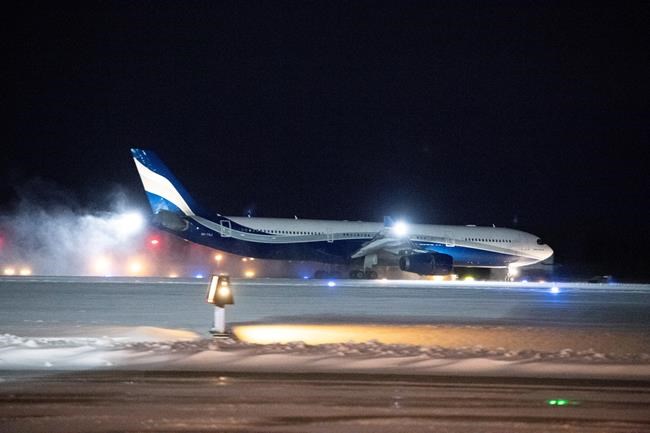
A plane carrying 176 Canadian citizens from the centre of the global novel coronavirus outbreak in Wuhan, China, lands at CFB Trenton, in Trenton, Ont., on Friday, Feb. 7, 2020. THE CANADIAN PRESS/Justin Tang

Military officials have assured the people in the area of CFB Trenton that the risk of transmission is low.

“These returnees are healthy Canadians,” Maj.-Gen. Andrew Downes, surgeon general of the Canadian Armed Forces, told the Commons health committee Wednesday. “There is a risk of course that one or more of them might have been exposed to this virus, but I think that the risk is low.”

Earlier this week, Ontario’s chief medical officer of health, Dr. David Williams, cautioned that passengers will need to be monitored for more than just possible symptoms of the novel coronavirus.

“We’re looking at the facilities there,” Williams said Monday in Toronto.

“Is it adequate, is it nice lodging, and proper food? All those day-to-day needs are going to be met because these people coming will need to be handled in that way.”

After two weeks, when the threat of the virus manifesting itself has finally passed, the evacuees will be taken to the Ottawa, Montreal or Toronto airports for the final leg of the journey home.

This report by The Canadian Press was first published Feb. 6, 2020.

Report Error Submit a Tip

More Stories

Teemu Selanne living the good life in southern California

Mike McIntyre 19 minute read Preview

Teemu Selanne living the good life in southern California

Mike McIntyre 19 minute read Friday, Oct. 15, 2021

LAGUNA BEACH — He likes his coffee black. His steak “medium rare plus.” And he’s an extremely generous pour, especially when it comes to a Moscow mule.

His left knee is giving him all sorts of trouble these days, he’s admittedly almost always running behind schedule and his biggest pride and joy are his four children, who keep him and his wife Sirpa hopping with their numerous athletic pursuits.

He is Teemu Selanne, the beloved Winnipeg Jets legend who, you’ll be happy to know, is still living the good life just a stone’s throw from the Pacific Ocean in this little piece of southern California paradise.

Despite being nearly eight years removed from the end of a Hall of Fame hockey career, the Finnish Flash remains a big deal around here. That was clear as we sat down earlier this week for an exclusive chat inside “Selanne’s Steak Tavern” — a high-end eatery he owns that sits along the stunning Pacific Coast Highway.

Read
Friday, Oct. 15, 2021

Ottawa announces $500 million for North End sewage plant upgrade

Joyanne Pursaga 5 minute read Preview

Ottawa announces $500 million for North End sewage plant upgrade

Joyanne Pursaga 5 minute read Friday, Oct. 30, 2026

The federal government will provide $500 million to help complete the major upgrade to Winnipeg’s North End sewage treatment plant.

Winnipeg South MP Terry Duguid confirmed the total funding at a news conference at the plant Friday, calling the work critical to Winnipeg’s future.

“The stakes could not be higher. Without expanded wastewater treatment, Winnipeg would run out of capacity to build new homes and accommodate new industries within six years,” said Duguid.

The commitment offers the final funding needed to cover the $1.57-billion third and final phase of the upgrade. The city and province will also pay $500 million each for the work.

Read
Friday, Oct. 30, 2026

Go with the snow

Eva Wasney 7 minute read Preview

Go with the snow

Eva Wasney 7 minute read Tuesday, Feb. 8, 2022

Wearing a dusty pink snowsuit and a face mask emblazoned with colourful Dala horses, Sonja Lundstrom is excited.

“This is going to be my 80th birthday present to myself,” she says, pointing to a nearby wooden kicksled poised for takeoff. “My grandma had one of these and my dad made me one out of hockey sticks for all my children… but these are the new modern ones and I haven’t had one of those.”

But today’s frosty jaunt is less of a test drive and more of a diplomatic adventure. Lundstrom is the president of the Swedish Cultural Association of Manitoba and is at The Forks to give Urban Ahlin, the Swedish Ambassador to Canada, a little taste of home.

“In my part of Sweden we use the (kicksleds) when we go out on the ice for ice fishing,” says Ahlin, who was in town recently with several other Nordic ambassadors to meet with the premier. “This is a very climate-friendly means of transportation and you can use it for lots of different reasons… it’s actually pretty fun to ride as well.”

Read
Tuesday, Feb. 8, 2022

Imperialist crusades: 21st-century style

John R. Wiens 5 minute read Preview

Imperialist crusades: 21st-century style

John R. Wiens 5 minute read Wednesday, Jul. 8, 2026

In the 11th century and lasting into the 13th, the papacy launched a series of at least eight military campaigns we now refer to as the Crusades, or Holy Wars. They were an imperialistic call to arms for Christians to retake Jerusalem, which was at the time under Muslim rule.

Spiritual rewards for participation were implied, and other incentives offered, to dull the extra taxation demanded to fund the campaigns. Over time, the “crusades” morphed to become massacres of not only Muslims but also Jews and Christian dissidents — in other words, any enemies of the papacy. If today’s news sounds like déjà vu all over again, it probably should.

The stories keep repeating themselves in many forms. We now know that two 20th century world wars, global in scope, were caused by imperialistic ambitions, changes in the balance of international powers and corresponding arms races. The first was attributed to the assassination of the heir to the Austro-Hungarian throne by a Bosnian Serb, a kind of “regime change” initiative. The second resulted from rising tensions between Allied and Axis powers, triggered by the rise of European fascism and Japanese militarism. The human toll of both was unimaginable.

In the First World War, 15 to 22 million people, including soldiers and civilians, were killed and another 23 million were wounded. These numbers do not account for those otherwise affected — victims of chemical warfare whose compromised health shortened their lives; of the subsequent Spanish flu epidemic amplified by the displacement of peoples; others who died from other diseases caused by war conditions; and those who were malnourished or starved. Nor do they account for the ongoing trauma and resentments passed on intergenerationally to this day.

Read
Wednesday, Jul. 8, 2026

Court ruling concludes Canadian Wheat Board saga

Laura Rance-Unger 4 minute read Preview

Court ruling concludes Canadian Wheat Board saga

Laura Rance-Unger 4 minute read Yesterday at 2:01 AM CDT

It remains to be seen whether the recent court ruling in a lawsuit filed after Canadian Wheat Board’s dissolution in 2012 puts the whole debate to rest, as some no doubt hope.

But either way, the dust has settled on the post-CWB world. The sun still rises and a new generation of farmers on the land only knows by name an institution that for generations influenced every aspect of Prairie grain farming.

The first Rural Revival column I wrote for this newspaper more than 30 years ago was about a thousand farmers from Western Canada demonstrating in support of the Wheat Board. It was in the aftermath of the Western Grain Marketing Panel report, one of several efforts that eventually included a plebiscite to help the federal government decide what to do about a vocal minority of farmers who wanted marketing “freedom.”

The polls at the time suggested about two-thirds of farmers were comfortable enough with the single-desk system for food wheat and barley to keep it around. It served as a counterbalance to canola, which they sold on the open market. They essentially had a dual market.

Read
Yesterday at 2:01 AM CDT

Walkout creates chaos at St. James Smitty’s

Morgan Modjeski 3 minute read Preview

Walkout creates chaos at St. James Smitty’s

Morgan Modjeski 3 minute read Yesterday at 2:01 AM CDT

Gordon Sharpe wanted to eat a meal at the St. James Smitty’s Wednesday, but he got a helping of bad news instead.

He saw several workers walk out of the restaurant, at 1017 St. James St.

“(The waiter) came back about 10 minutes later and stood over the table, looking a little distraught and said, ‘I’m quitting right now and so is everybody else,’” Sharpe said. “He said, ‘This is my last time serving you,’ and he was quite choked up.”

“I’ve never seen anything like it,” he said, adding that the managers scrambled to serve patrons.

Read
Yesterday at 2:01 AM CDT