WEATHER ALERT

Hurricane Fiona highlights gaps in insurance as climate change worsens, experts say

Advertisement

Advertise with us

TORONTO - Many Atlantic Canadian homeowners may be on the hook for a significant portion of the damages to their homes caused by hurricane Fiona due to a lack of insurance covering flooding caused by storms.

Read this article for free:


By clicking the button above, an account will be created and you will begin to receive some of our recommended newsletters. You may opt out of any newsletter by visiting your Email and Communication Preferences page or by clicking "unsubscribe" at the bottom of any email.

or

Already have an account? Log in here »

To continue reading, please subscribe:

Digital Subscription

One year of digital access for only $1.44 a week*

  • Enjoy unlimited reading on winnipegfreepress.com
  • Read the E-Edition, our digital replica newspaper
  • Access News Break, our award-winning app
  • Play interactive puzzles

*Billed as $5.77 plus GST every four weeks. After 52 weeks, price increases to the regular rate of $19.95 plus GST every four weeks. Offer available to new and qualified returning subscribers only. Cancel any time.

To continue reading, please subscribe:

Add Free Press access to your Brandon Sun subscription for only an additional

$1 for the first 4 weeks*

  • Enjoy unlimited reading on winnipegfreepress.com
  • Read the E-Edition, our digital replica newspaper
  • Access News Break, our award-winning app
  • Play interactive puzzles
Start now

*Your next Brandon Sun subscription payment will increase by $1.00 and you will be charged $17.95 plus GST for four weeks. After four weeks, your payment will increase to $24.95 plus GST every four weeks.

Hey there, time traveller!
This article was published 27/09/2022 (1497 days ago), so information in it may no longer be current.

TORONTO – Many Atlantic Canadian homeowners may be on the hook for a significant portion of the damages to their homes caused by hurricane Fiona due to a lack of insurance covering flooding caused by storms.

Residential home insurance policies usually cover wind damage, including falling trees, and certain kinds of water damage, according to Amanda Dean, vice-president, Atlantic, for the Insurance Bureau of Canada.

However, they normally require an add-on policy in order to cover floods, she said.
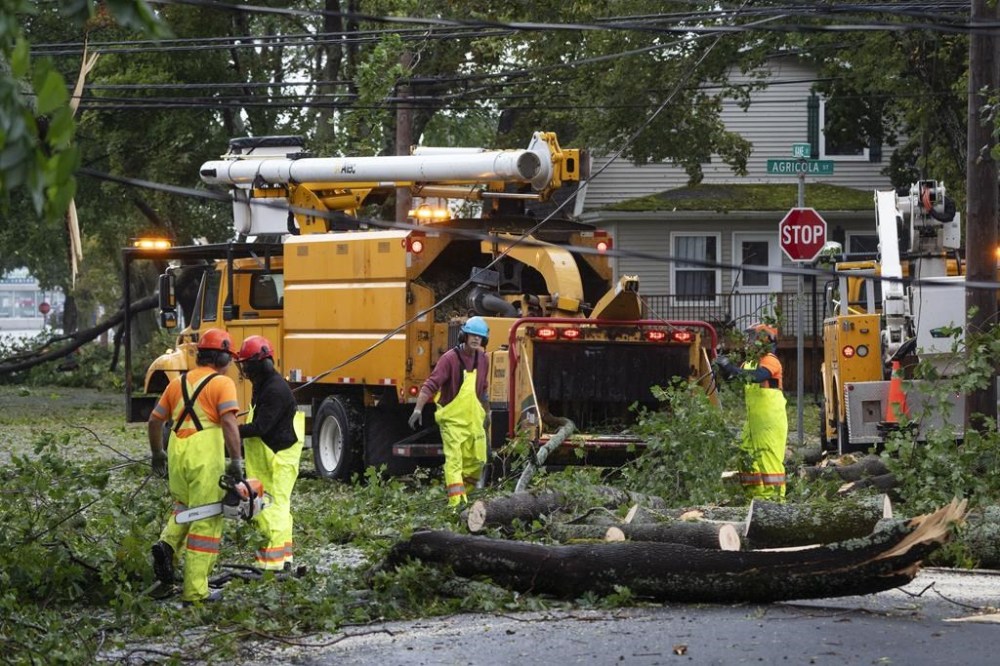
Arborists work to clear fallen trees and downed wires from damage caused by post-tropical storm Fiona in Halifax on Saturday, September 24, 2022. THE CANADIAN PRESS/Darren Calabrese

These overland flood endorsements didn’t exist in Canada before 2015, she said, when an increasing number of flooding events made it clear that additional coverage was needed.

But even those flood policies don’t normally cover damages from storm surges, which are difficult for insurers to model as sea levels rise and coastlines erode, said Dean.

“Without accurate risk modeling, the risk is deemed too high to make the coverage affordable and/or available,” she said.

Some uninsurable damage to residential properties may be eligible for coverage under the federal Disaster Financial Assistance Arrangements program (DFAA).

There are gaps in the Canadian insurance industry when it comes to natural disasters, said Nadja Dreff, senior vice-president of global insurance at DBRS Morningstar.

Because of these gaps, “a large proportion” of the people affected by hurricane Fiona in Atlantic Canada likely won’t be fully covered for the damage to their homes, said Dreff.

The industry is trying to catch up even as these disasters become more frequent and unpredictable, she said.

The Co-operators Group Limited began offering storm surge insurance to homeowners in Atlantic Canada and British Columbia in 2018, according to news releases from the insurance co-operative.

The storm surge insurance includes rising water levels and waves caused by storms in its coverage.

“To our knowledge, Co-operators is the only Canadian insurer that offers storm surge protection,” said the agency’s vice-president George Hardy in a statement.

The insurance industry is “eager to continue working with government to create a national public-private insurance program for overland flooding that offers protection to all Canadians,” said Dean.

Dean said climate change has drastically increased the amount that insurers pay annually in severe weather-related claims.

Insurers in Canada currently pay on average more than $2 billion in claims related to severe weather annually, said Dean.

That’s compared to an annual average of $632 millionbetween 2001 and 2010.

DBRS Morningstar estimated hurricane Fiona will cause between $300 million and $700 million in insured losses in Atlantic Canada for a record high in the region.

The credit rating agency said in a report that that amount is roughly in line with previous natural disasters in other provinces such as the flooding in B.C. last year that saw $515 million in insured losses.

Atlantic Canada represents a small portion of the Canadian property insurance market, according to the report.

However, hurricane Fiona will likely go down as one of the region’s largest catastrophic events and more could be on the horizon.

Climate change is worsening the region’s risk to major storms like hurricane Fiona.

DBRS Morningstar said insurers may be more cautious when assessing risk in the region, likely raising premiums to cover the rising costs of payouts.

Dreff said as severe weather events become more common, insurers will raise premiums and work on more sophisticated risk modeling.

This report by The Canadian Press was first published Sept. 27, 2022.

Report Error Submit a Tip

More Stories

Brandon manufacturer says Canadian steel in demand, but high costs, long delivery times hit hard

Gabrielle Piché 6 minute read Preview

Brandon manufacturer says Canadian steel in demand, but high costs, long delivery times hit hard

Gabrielle Piché 6 minute read Yesterday at 2:01 AM CDT

Something’s different in a Brandon plant.

Building envelope panels — or shells for homes and commercial buildings — keep being produced at Greenstone Building Products.

But the galvanized steel used by workers has been arriving later and the price is constantly increasing, according to company leadership.

“It’s just a little bit nerve-wracking for us to hear the opposite narrative,” said Tilda Fortier, Greenstone Building Products’ business manager.

Read
Yesterday at 2:01 AM CDT

Imperialist crusades: 21st-century style

John R. Wiens 5 minute read Preview

Imperialist crusades: 21st-century style

John R. Wiens 5 minute read Wednesday, Jul. 8, 2026

In the 11th century and lasting into the 13th, the papacy launched a series of at least eight military campaigns we now refer to as the Crusades, or Holy Wars. They were an imperialistic call to arms for Christians to retake Jerusalem, which was at the time under Muslim rule.

Spiritual rewards for participation were implied, and other incentives offered, to dull the extra taxation demanded to fund the campaigns. Over time, the “crusades” morphed to become massacres of not only Muslims but also Jews and Christian dissidents — in other words, any enemies of the papacy. If today’s news sounds like déjà vu all over again, it probably should.

The stories keep repeating themselves in many forms. We now know that two 20th century world wars, global in scope, were caused by imperialistic ambitions, changes in the balance of international powers and corresponding arms races. The first was attributed to the assassination of the heir to the Austro-Hungarian throne by a Bosnian Serb, a kind of “regime change” initiative. The second resulted from rising tensions between Allied and Axis powers, triggered by the rise of European fascism and Japanese militarism. The human toll of both was unimaginable.

In the First World War, 15 to 22 million people, including soldiers and civilians, were killed and another 23 million were wounded. These numbers do not account for those otherwise affected — victims of chemical warfare whose compromised health shortened their lives; of the subsequent Spanish flu epidemic amplified by the displacement of peoples; others who died from other diseases caused by war conditions; and those who were malnourished or starved. Nor do they account for the ongoing trauma and resentments passed on intergenerationally to this day.

Read
Wednesday, Jul. 8, 2026

Submit a news tip

1 minute read Monday, Mar. 16, 2026

Submit a news tip

Winnipeg novelist's latest offering a riveting fictional account of missionaries' plight

Reviewed by Julienne Isaacs 5 minute read Preview

Winnipeg novelist's latest offering a riveting fictional account of missionaries' plight

Reviewed by Julienne Isaacs 5 minute read Saturday, Sep. 7, 2019

In 1955, five American missionary couples set out to evangelize the Waorani, an Indigenous people group of the Ecuadorian rainforest that had never had contact with the outside world. They dubbed their mission “Operation Auca.”

After a few months of airdropping gifts, the five men — Jim Elliot, Peter Fleming, Nate Saint, Ed McCully and Roger Youderian — opted to set up camp on a beach near a Waorani settlement. Just a few days later, they were all speared to death. Thanks to the swift arrival of a Life magazine photographer, the brutal conclusion to Operation Auca became global news.

In her new novel, Five Wives, Winnipeg writer Joan Thomas tells this story again.

“In the missionaries’ memoirs, ‘God’s leading’ explains almost every impulse,” Thomas writes in a postscript. “I set out to peer behind that, to explore in human terms actions that astonished me.”

Read
Saturday, Sep. 7, 2019

Taxi and ride-hailing services receive 58 complaints since March

Jessica Botelho-Urbanski 5 minute read Preview

Taxi and ride-hailing services receive 58 complaints since March

Jessica Botelho-Urbanski 5 minute read Friday, Aug. 17, 2018

The City of Winnipeg has fielded 58 formal complaints about vehicle-for-hire operations since taking over industry oversight from the province in March.

According to freedom of information request results, the city mostly received complaints about taxi operations, and the two largest companies – Duffy’s Taxi and Unicity Taxi – were the main culprits.

From March 1, 2018 to July 13, 2018, the Winnipeg Parking Authority received 20 complaints about Duffy’s, mostly to do with driver road habits (five complaints), driver conduct (three), service refusal (three) or poor service (three), among other issues.

During the same period, Unicity had 19 complaints, five of them related to poor service and three about driver conduct, plus other misdeeds.

Read
Friday, Aug. 17, 2018

Court ruling concludes Canadian Wheat Board saga

Laura Rance-Unger 4 minute read Preview

Court ruling concludes Canadian Wheat Board saga

Laura Rance-Unger 4 minute read Yesterday at 2:01 AM CDT

It remains to be seen whether the recent court ruling in a lawsuit filed after Canadian Wheat Board’s dissolution in 2012 puts the whole debate to rest, as some no doubt hope.

But either way, the dust has settled on the post-CWB world. The sun still rises and a new generation of farmers on the land only knows by name an institution that for generations influenced every aspect of Prairie grain farming.

The first Rural Revival column I wrote for this newspaper more than 30 years ago was about a thousand farmers from Western Canada demonstrating in support of the Wheat Board. It was in the aftermath of the Western Grain Marketing Panel report, one of several efforts that eventually included a plebiscite to help the federal government decide what to do about a vocal minority of farmers who wanted marketing “freedom.”

The polls at the time suggested about two-thirds of farmers were comfortable enough with the single-desk system for food wheat and barley to keep it around. It served as a counterbalance to canola, which they sold on the open market. They essentially had a dual market.

Read
Yesterday at 2:01 AM CDT