Residents of coastal N.L. town sift through debris of their homes after Fiona

Advertisement

Advertise with us

BURNT ISLANDS, N.L. - Paula Keeping pointed to the window that was once her son's bedroom.

Read this article for free:


By clicking the button above, an account will be created and you will begin to receive some of our recommended newsletters. You may opt out of any newsletter by visiting your Email and Communication Preferences page or by clicking "unsubscribe" at the bottom of any email.

or

Already have an account? Log in here »

To continue reading, please subscribe:

Digital Subscription

One year of digital access for only $1.44 a week*

  • Enjoy unlimited reading on winnipegfreepress.com
  • Read the E-Edition, our digital replica newspaper
  • Access News Break, our award-winning app
  • Play interactive puzzles

*Billed as $5.77 plus GST every four weeks. After 52 weeks, price increases to the regular rate of $19.95 plus GST every four weeks. Offer available to new and qualified returning subscribers only. Cancel any time.

To continue reading, please subscribe:

Add Free Press access to your Brandon Sun subscription for only an additional

$1 for the first 4 weeks*

  • Enjoy unlimited reading on winnipegfreepress.com
  • Read the E-Edition, our digital replica newspaper
  • Access News Break, our award-winning app
  • Play interactive puzzles
Start now

*Your next Brandon Sun subscription payment will increase by $1.00 and you will be charged $17.95 plus GST for four weeks. After four weeks, your payment will increase to $24.95 plus GST every four weeks.

Hey there, time traveller!
This article was published 27/09/2022 (1498 days ago), so information in it may no longer be current.

BURNT ISLANDS, N.L. – Paula Keeping pointed to the window that was once her son’s bedroom.

It lay on top of the crumpled remains of her former house, a mess of wood siding and household items in the middle of a road. The debris was piled metres away from where the house stood last week before post-tropical storm Fiona blasted the southwestern Newfoundland community of Burnt Islands.

“I figure my kitchen is out where my porch is too,” she said. “It’s devastating. Just in disbelief.”
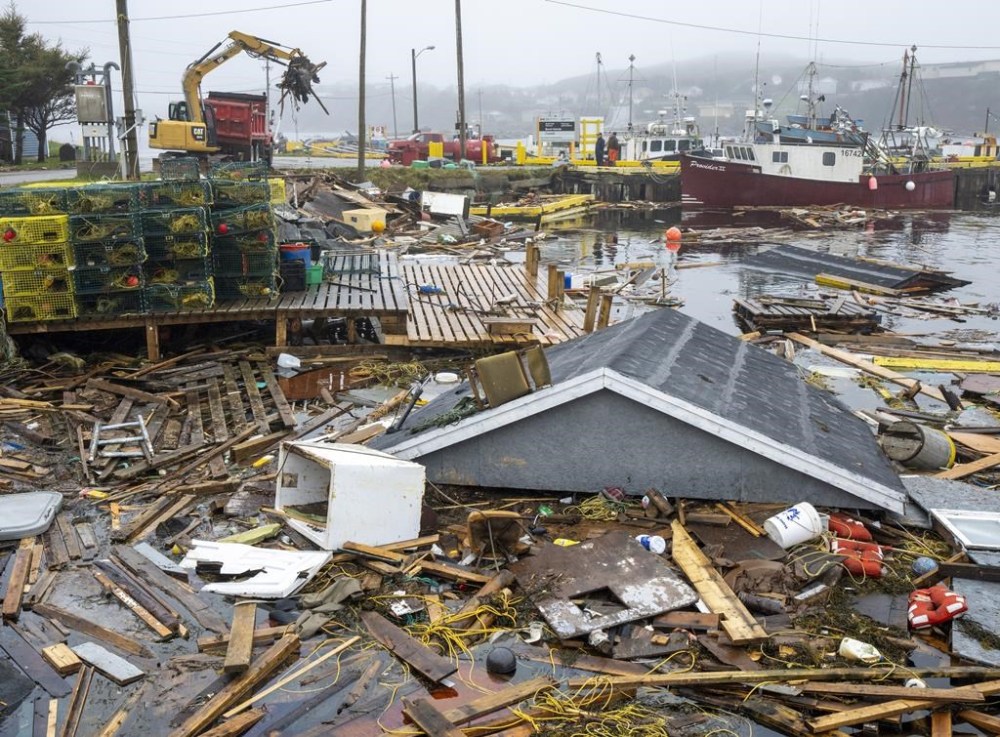
Heavy machinery clears up washed-up buildings and rubble in the harbour in Burnt Islands, N.L., on Tuesday, Sept. 27, 2022. Fiona left a trail of destruction across much of Atlantic Canada, stretching from Nova Scotia's eastern mainland to Cape Breton, Prince Edward Island and southwestern Newfoundland. THE CANADIAN PRESS/Frank Gunn

Keeping said she is living day by day and still processing the loss of the house where she raised her family.

Her husband, who was away when the storm hit, and their grown children are on the way back to see the scene first-hand, but there’s some urgency behind the cleanup process. Keeping’s home and others along her street that faced the rocky coast were knocked into the path of a now washed-out road.

Officials in the community said three people living in one home behind the damaged street were still stranded as of Tuesday, with efforts underway to help them get out.

Earlier this week, provincial and federal responders were assessing the situation along Newfoundland’s southwestern coast, where the town of Port aux Basques was also hit hard with property loss and one death as Fiona swept through with powerful waves and storm surges on a scale that lifelong residents said they had never witnessed before.

Similar scenes of devastation were visible 30 minutes down the road from Port aux Basques in the smaller community of Burnt Islands, where Keeping’s neighbours were out in the streets in the rain on Tuesday helping pick up.

Local contractors brought in heavy machinery to aid the recovery, lifting large chunks of road and other debris. Other people used tools and their hands, while children rode bicycles and played outside amid the wreckage.

Jeremy Pope was using an excavator to sift through the remains of a damaged fishing stage by the town’s harbour. Several of the structures were almost fully submerged and others appeared shattered, with their contents floating in the water.

It’s an overwhelming job, the likes of which Pope said he hasn’t tackled before. “We only are just getting started,” he said during a short break from the work. “Do what we can do for now and try to get started, try to get a plan.”

The side of town with the small craft harbour saw less severe damage overall, but some people were still sorting through their damaged homes amid the wind and wet weather on Tuesday.

Jamie King was wading with a neighbour through the pile of debris spilling from the torn-away wall of the house he grew up in, trying to salvage what he could and prevent more damage before bad weather hits again.

Paula Keeping stands in the remains of her house that was destroyed by hurricane Fiona in Burnt Islands, Newfoundland and Labrador on Tuesday September 27, 2022. Fiona left a trail of destruction across much of Atlantic Canada, stretching from Nova Scotia's eastern mainland to Cape Breton, Prince Edward Island and southwestern Newfoundland. THE CANADIAN PRESS/Frank Gunn

He became emotional standing in front of the destruction, running through questions about insurance coverage, future income and where he and his family would stay.

“I lost everything,” he said. “I don’t know what to do or where to go.”

The weather and lack of cell service in the community have made recovery work more difficult, King said. While he’d like to be out helping in his capacity as a fire brigade member, his personal losses have taken up his time and energy.

Sharon King, his sister-in-law, was helping him out. Her own home was largely untouched, but seeing her town destroyed by the storm has been like a “nightmare” that’s brought her to tears, she said.

“I’m out just doing what I can for everybody else … whether it’s a phone call, a hug, anything else,” she said. “We’re a small community, but we’re all joined together as one.”

This report by The Canadian Press was first published Sept. 27, 2022.
Report Error Submit a Tip

More Stories

The AI snake is eating its tail

David Nutbean 5 minute read 2:01 AM EST

Computer technology has become the dominant force in the modern world. New technology subsuming older technology is the raison d’être of modern capitalism.

Pioneers of this new digital age took advantage of the profound difference between what they were building and what came before, advancing their influence and predominance. Little by little, the advantages ate away at the influence of non-digital technology, until the snake consumed most of modern information technology.

And now it is eating itself.

The beginning of the modern era of computing began with the Graphical User Interface (GUI, pronounced “gooey”). Back in the ’80s this was a new commercial technology exclusive to Apple’s Lisa computer and, later, the MacIntosh.

With the start of 2022 comes a new framework for Manitoba’s real estate industry

Ben Waldman 6 minute read Preview

With the start of 2022 comes a new framework for Manitoba’s real estate industry

Ben Waldman 6 minute read Monday, Jan. 10, 2022

New year, new rules for Manitoba real estate.

On Jan. 1, the Real Estate Services Act came into effect in the province, bringing with it an updated regulatory framework for the local industry to follow, along with some key changes for parties on either side of a real estate transaction.

One of the most notable changes to consumers is likely the introduction of a service agreement requirement: any buyers, sellers, or renters of residential or commercial properties are now required to sign such an agreement with a realtor prior to any services being rendered. But there are other moves that will impact real estate business moving forward.

The regulatory Manitoba Securities Commission’s real estate division consulted with industry groups such as the Manitoba Real Estate Association in drafting the legislation, which replaces the Real Estate Brokers Act, and which the commission’s website says “reflects the changing face” of the provincial real estate landscape.

Read
Monday, Jan. 10, 2022

Another embarrassing loss: Arniel

Mike McIntyre 7 minute read Preview

Another embarrassing loss: Arniel

Mike McIntyre 7 minute read Sunday, Nov. 1, 2026

RALEIGH — No sticks were smashed. No walls punched. And nary a naughty word was uttered.

Instead, the Winnipeg Jets filed off the ice here at Lenovo Center on Sunday afternoon much like they’d just played the preceding game against the Carolina Hurricanes — with no emotion, no passion, no urgency.

You’d have thought yet another loss, this one in truly humiliating fashion and a ninth consecutive overall, might have triggered something.

Anything.

Read
Sunday, Nov. 1, 2026

iPhone started fire, Winnipegger says

Kevin Rollason 3 minute read Preview

iPhone started fire, Winnipegger says

Kevin Rollason 3 minute read Tuesday, Nov. 26, 2019

The iPhone has long been a hot item, but for one Winnipeg family, it got too hot.

Wally Hill says earlier this month, he, along with his wife and daughter, were watching television, with his daughter's iPhone 6 sitting unplugged on the cushion between them, when the smartphone set the couch on fire.

"It was frightening," Hill said. "It didn't explode... it fizzled and popped open at the back, and then smoke and flames came out the back. It then ignited the cushion."

Hill said he quickly picked up the entire couch cushion, with the burning phone still on it, to move the device to a tile floor in his residence.

Read
Tuesday, Nov. 26, 2019

Netherlands Canada's top source for illicit meth shipments in 2018

Dylan Robertson 6 minute read Preview

Netherlands Canada's top source for illicit meth shipments in 2018

Dylan Robertson 6 minute read Monday, Mar. 9, 2020

OTTAWA — While Winnipeg was in the midst of its ongoing meth crisis in 2018, quantities of the drug were coming from an unexpected country, and through Canadians' most common mode of delivery.

According to documents obtained by the Free Press, there was an increase in "inbound seizures destined to Winnipeg addresses," of postal mail containing meth in 2018 from a year prior. "However, such shipments are likely for personal consumption,” as they were under 35 grams.

And though Canadian officials have called out meth smugglers in China and Mexico, the mailed drugs came from Europe.

"The Netherlands is the top transit country by number of seizures (of meth), while Mexico is the main transit country by quantity,” reads an internal Canada Border Services Agency report from mid-2018.

Read
Monday, Mar. 9, 2020

NDP should heed own advice, bring back 50-50 funding

Mark Hudson 5 minute read 2:01 AM EST

Transit riders have a love-hate relationship with our “people’s limousine.” For many, it’s their only means of mobility. Others ride because they believe urban life is better when people use public transit rather than choking the roads with single-occupancy cars.

At the same time, one of life’s mid-sized stressors is peering into the distance on a cold, snowy Winnipeg morning to see whether your late bus is yet on the horizon and, when it appears, whether it’s full to capacity and going to roll past. It’s the kind of thing that pushes you back into the car, if you have access to one.

We could make a big dent in this daily anxiety, help pay transit workers fairly and do our part to stave off climate disaster by restoring a tried-and-true funding scheme: the 50-50 model. This shared-cost model, in which the provincial government pays half of transit operating costs over and above service revenues, was brought in when I was a kid waiting to board the bus with my parents in the 1970s.

The Progressive Conservative government of Gary Filmon initially ditched it in 1993. New Democrats reinstalled it in 2007, with then-Lt.-Gov. John Harvard announcing in the 2006 throne speech: “Manitoba is committed to increased provincial funding for transit operating costs in Thompson, Flin Flon, Brandon and Winnipeg, restoring the 50-50 funding partnership that was in place prior to the cutbacks of the 1990s.”