Trudeau says stronger infrastructure needed after viewing Fiona damage in Maritimes
Advertisement
Read this article for free:
or
Already have an account? Log in here »
To continue reading, please subscribe:
Digital Subscription
One year of digital access for only $1.44 a week*
- Enjoy unlimited reading on winnipegfreepress.com
- Read the E-Edition, our digital replica newspaper
- Access News Break, our award-winning app
- Play interactive puzzles
*Billed as $5.77 plus GST every four weeks. After 52 weeks, price increases to the regular rate of $19.95 plus GST every four weeks. Offer available to new and qualified returning subscribers only. Cancel any time.
To continue reading, please subscribe:
Add Free Press access to your Brandon Sun subscription for only an additional
$1 for the first 4 weeks*
- Enjoy unlimited reading on winnipegfreepress.com
- Read the E-Edition, our digital replica newspaper
- Access News Break, our award-winning app
- Play interactive puzzles
*Your next Brandon Sun subscription payment will increase by $1.00 and you will be charged $17.95 plus GST for four weeks. After four weeks, your payment will increase to $24.95 plus GST every four weeks.
Read unlimited articles for free today:
or
Already have an account? Log in here »
Hey there, time traveller!
This article was published 27/09/2022 (1494 days ago), so information in it may no longer be current.
STANLEY BRIDGE, P.E.I. – Justin Trudeau travelled Tuesday to Nova Scotia and P.E.I., where he pledged to find ways to build more resilient infrastructure after inspecting the extensive damage caused by post-tropical storm Fiona.
“There’s always lessons to be learned,” the prime minister told reporters in Stanley Bridge, P.E.I., where a massive storm surge and hurricane-force winds upended buildings and tossed fishing boats onto the shore.
“Unfortunately, the reality with climate change is that there’s going to be more extreme weather events. We’re going to have to think about how to make sure we’re ready for whatever comes at us.”
Trudeau also paid a brief visit to the Cape Breton community of Glace Bay, where he met with residents and surveyed a blustery, rain-soaked neighbourhood where he was shown two homes with their roofs torn off.
Afterwards he was asked whether it’s time to consider stronger building codes given the increasing intensity of storms. “How we make sure that families don’t have to go through this level of anxiety … is certainly part of the conversation we can have around building codes, around expectations,” he said.
On Saturday morning, Fiona left a trail of destruction across a wide swath of Atlantic Canada, stretching from Nova Scotia’s eastern mainland to Cape Breton, Prince Edward Island and southwestern Newfoundland.
Power was knocked out, scores of homes were flattened, roads were washed out and the resulting cleanup is expected to take months if not years to complete. As well, the record-breaking storm is being blamed for two deaths — one in Newfoundland and Labrador and the other in Nova Scotia.
“The federal government is here as a partner,” Trudeau said in Stanley Bridge. “We were working in advance of the storm to prepare for the worst, and the worst happened. But at the same time, we’ve heard tremendous stories of resilience.”
More than 180,000 Atlantic Canadian homes and businesses were still without electricity by late Tuesday afternoon — more than 122,000 of them in Nova Scotia and about 61,000 in P.E.I.
When asked if it was time for Ottawa to invest more in burying overhead power lines, Trudeau said: “We’re looking at ways of building more resilient infrastructure.”
“The reality is that extreme weather events are going to get more intense over the coming years because our climate is changing.”
Marvin Graham, owner of Graham’s Deep Sea Fishing in Stanley Bridge, said Trudeau asked him how much the storm would cost in terms of lost business, considering his fishing boat had been lifted out of the water and dumped on the town’s wharf.
Graham said it was too early to tell, and he told Trudeau that something had to be done about recurring storm surges battering the coastline.
“Those loose sand dunes, if they keep washing away, there’s going to be a wide-open hole there for the ocean to come right through,” Graham said. “We have to save them first.”
On Tuesday, the Canadian Space Agency posted two satellite photos of Prince Edward Island, one taken on Aug. 21, the other on Sept. 25, a day after Fiona lashed the island with hurricane-force winds that exceeded 140 kilometres per hour.
The second photo shows the blue waters around the Island streaked by huge underwater plumes of sand and soil extending far offshore.
The agency posted a tweet saying the photos illustrate “the extent to which the extreme wind and wave action of the storm has churned up the sea floor and eroded the coastline.”
P.E.I. Premier Dennis King said damage to the Island’s economy is coming into focus, especially when it comes to the farming sector, which has reported huge setbacks for those who grow potatoes, soybeans, apples and feed corn.
As well, the premier said many dairy barns, fishing boats and potato storage buildings had been damaged or destroyed. And he cited extensive damage reported by mussel and oyster farms.
“We’ve been hit by something bigger than we’ve ever been hit with before,” King told a news conference. “We’re all feeling the effects of that. We’re all very fragile.”

Earlier in the day, the province announced a wage subsidy program, and King said he met with Trudeau and asked for more financial support.
In Ottawa, Defence Minister Anita Anand confirmed there are now about 300 military members assisting with recovery efforts in Atlantic Canada, with Nova Scotia, P.E.I. and Newfoundland each getting 100 troops. Anand said the military is mobilizing another 150 troops in Nova Scotia and 150 for Newfoundland.
HMCS Margaret Brooke, one of the navy’s new Arctic patrol vessels, was also scheduled to visit the remote community of Francois on the south coast of Newfoundland to check on residents.
“They’re helping to move people away from damaged and high-risk homes, and they’re being as helpful as possible,” Anand said.
Indigenous Services Minister Patty Hajdu said 13 Indigenous communities had been affected by the storm, and that local authorities are now scrambling to ensure they have enough food and fuel. “They are focused as well on the recovery of their fishing supplies and boats, in particular, as it relates to their ongoing livelihood,” Hajdu said.
In Halifax, the region’s largest city, more than 24,000 customers were spending their fourth day without electricity. During the day, the snarl of chainsaws provides most of the background noise in the city, and at night the soundscape changes to the low drone of generators.
Nova Scotia’s electric utility issued a statement Tuesday saying it had 1,300 technicians and assessors in the field, the company’s largest mobilization in its history. That number includes crews from New Brunswick, Newfoundland and Labrador, Quebec, Ontario and New England.
As well, the company said military members were assisting by removing trees and brush, delivering supplies and providing security for trucks and equipment.

At the height of the storm 415,000 Nova Scotia homes and businesses were in the dark, which included 210,000 in the Halifax region and 65,000 in Cape Breton.
Schools and government offices remained closed in all of P.E.I. and much of Nova Scotia, and P.E.I. announced its public schools will remain closed until at least Monday.
King Charles issued a statement Tuesday expressing concern at the “appalling devastation” caused by Fiona and extending sympathy to Atlantic Canadians “whose lives, livelihoods and properties have been so badly affected by this disaster.”
This report by The Canadian Press was first published Sept. 27, 2022.
— With files from Michael MacDonald in Halifax, Keith Doucette in Glace Bay, N.S., and Lee Berthiaume in Ottawa.
Related Articles
After the storm: Hurricane Fiona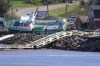


Advertisement Advertise With Us
Advertisement Advertise With Us