Saskatchewan to bring in own carbon price on fuel following SCOC decision: premier

Advertisement

Advertise with us

REGINA - Saskatchewan, one of the biggest foes of a federal carbon tax, plans to charge one of its own after a legal defeat in its drawn-out battle against Ottawa.

Read this article for free:


or

Already have an account? Log in here »

To continue reading, please subscribe:

Subscribe and receive a limited-edition Free Press branded hat or tote.

Digital Subscription

One year of digital access for only $205*

  • Enjoy unlimited reading on winnipegfreepress.com
  • Read the E-Edition, our digital replica newspaper
  • Access News Break, our award-winning app
  • Play interactive puzzles

*First annual payment billed as $205.00 + GST for one year. This annual subscription will automatically renew at $233.00 + GST every 52 weeks (10% off the regular annual price of $259.35). Offer available to new and qualified returning subscribers only. Cancel any time.

To continue reading, please subscribe:

Add Free Press access to your Brandon Sun subscription for only an additional

$1 for the first 4 weeks*

  • Enjoy unlimited reading on winnipegfreepress.com
  • Read the E-Edition, our digital replica newspaper
  • Access News Break, our award-winning app
  • Play interactive puzzles
Start now

*Your next Brandon Sun subscription payment will increase by $1.00 and you will be charged $17.95 plus GST for four weeks. After four weeks, your payment will increase to $24.95 plus GST every four weeks.

Hey there, time traveller!
This article was published 25/03/2021 (2020 days ago), so information in it may no longer be current.

REGINA – Saskatchewan, one of the biggest foes of a federal carbon tax, plans to charge one of its own after a legal defeat in its drawn-out battle against Ottawa.

Premier Scott Moe announced the policy shift hours after the Supreme Court of Canada ruled 6-3 that the federal government has the constitutional right to bring in a carbon price in provinces without one.

“This was a battle that was for the right reasons,” Moe said Thursday.
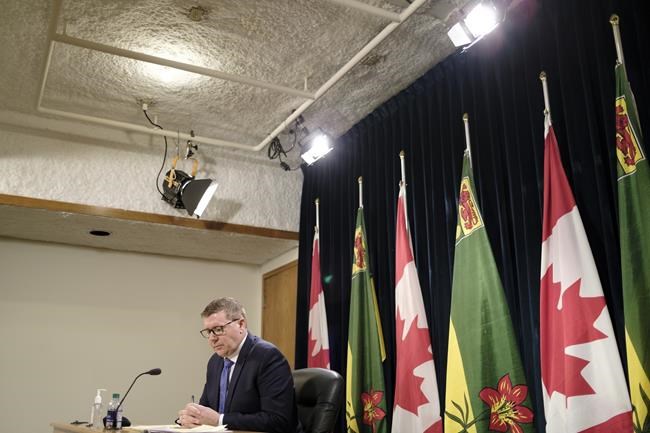
Saskatchewan Premier Scott Moe speaks at a press conference at the Legislative Building in Regina, Thursday, March 25, 2021. Saskatchewan, one of the biggest foes of a federal carbon tax, plans to charge one of its own after a legal defeat in its drawn-out battle against Ottawa. THE CANADIAN PRESS/Michael Bell

“We don’t agree with the ruling, but I’ve played enough hockey to know that we’re not going to do a lot of fruitful arguing with the referees after the game is over.”

Saskatchewan was the first province to mount a legal challenge against the Liberal government’s Greenhouse Gas Pollution Pricing Act and looked to Canada’s highest court after losing in its own Appeal Court in 2019.

It argued the legislation overstepped into provincial territory, a sentiment Moe repeated on Thursday.

He also reiterated his long-standing belief that developing technology like carbon capture and storage for coal plants and small modular nuclear reactors is a better way to reduce emissions than a carbon tax, which he criticized as making industries less competitive.

His Saskatchewan Party government will focus on reducing the policy’s effect on consumers and industries. He pitched doing that by replacing the federal tax with a made-in-Saskatchewan plan, which will include its own carbon price.

“The government will submit a proposal that will see Saskatchewan design its own carbon-pricing system for fuel … that will be similar to one the federal government has approved in the province of New Brunswick,” Moe said.

“This would provide an immediate rebate right at the pump to Saskatchewan people.”

Federal Environment Minister Jonathan Wilkinson said in a statement that provinces can have their own carbon-pricing plans, as long as they meet minimum national standards.

“We said in December when we released our strengthened climate plan that those national minimum standards need to be strengthened, but certainly we are open to conversations with provinces – including Saskatchewan,” Wilkinson said.

Moe said that under its plan, Saskatchewan will seek exemptions for different uses of fuel, including that used by farmers in grain dryers — a call also made by the provincial Opposition NDP.

“We”ll be looking towards refunding as much of the carbon tax as possible right at the outset.”

A political scientist at the University of Regina said much of Moe’s political identity has been built around fighting the carbon tax, which has also come to define Saskatchewan’s relationship with Ottawa.

That’s why Jim Farney said the court ruling is a turning point.

“I don’t think this issue being put to bed is going to hurt Moe politically though, or take away opportunities for him to argue for a more autonomous vision of Saskatchewan.”

Farney said he believes Moe’s supporters won’t see the court decision as a loss for the premier. And when it comes to a made-in-Saskatchewan carbon price, public reaction will depend on what kind of exemptions are included.

“Politically, one of the big question marks will be: Do people see the cost directly or not?”

Moe said Saskatchewan’s new plan would also bring electrical generation and natural gas transmission under provincial regulations also being developed. These are subject to Ottawa’s rules and not included in Saskatchewan’s existing pollution plan.

Moe said bringing them under provincial legislation would allow for more control and flexibility in how carbon tax revenues are spent.

He also said a greenhouse gas offset program will be designed to allow companies to meet their emissions targets by buying carbon credits from farmers and other businesses that can sequester carbon.

The premier is asking Ottawa to send Saskatchewan millions it hasn’t been able to get from a low-carbon economy fund, because it refused to sign onto the federal framework that includes a carbon price.

This report by The Canadian Press was first published March 25, 2021.

Report Error Submit a Tip

More Stories

Province looks to boost safety for cannabis workers

Free Press staff 2 minute read 2:56 PM CDT

The province is introducing new legislation it hopes will improve safety for those working in cannabis stores.

“The safety of Manitobans is always a main priority for this government, so when we heard from the Manitobans that work in these stores that this is what was needed to help keep them safe, we listened,” Justice Minister Matt Wiebe said in a news release.

The province introduced Bill 56 on Monday, which would amend the Liquor, Gaming and Cannabis Control Act.

The first of two amendments would remove the requirement for cannabis stores to have window coverings on storefronts, which the province said will increase visibility from the outside and ensure workers are not secluded from public view.

Figure skating coach Callaghan banned by SafeSport

The Associated Press 2 minute read Preview

Figure skating coach Callaghan banned by SafeSport

The Associated Press 2 minute read Wednesday, Aug. 21, 2019

Richard Callaghan, who coached Tara Lipinski to Olympic gold, has been banned from figure skating by the U.S. Center for SafeSport for sexual misconduct.

Callaghan, who also coached six-time U.S. champion Todd Eldredge, was ruled "permanently ineligible" on Wednesday for actions involving a minor. Callaghan was accused by a former student, Adam Schmidt, in a lawsuit. Schmidt alleged that Callaghan sexually abused him from 1999-2001. Schmidt was 14 in 1999.

Also in 1999, Callaghan was investigated for sexual misconduct involving another coach, Craig Maurizi, but U.S. Figure Skating dismissed those charges. Maurizi said the incidents began in 1976 when he was 13, and continued for years.

Now 73, Callaghan was suspended in March 2018 by SafeSport and by the federation. He sued SafeSport, but the lawsuit was dismissed.

Read
Wednesday, Aug. 21, 2019

All-Japan committee meets to promote Sapporo Olympic bid

Stephen Wade And Yuri Kageyama, The Associated Press 4 minute read Preview

All-Japan committee meets to promote Sapporo Olympic bid

Stephen Wade And Yuri Kageyama, The Associated Press 4 minute read Tuesday, May. 10, 2022

TOKYO (AP) — Yasuhiro Yamashita, the head of the Japanese Olympic Committee, acknowledged the biggest stumbling block to holding the Olympics is the billions in costs.

However, in another breath on Tuesday at a so-called “All Japan” meeting to promote Sapporo's bid for the 2030 Winter Olympics, he said that if the northern Japanese city lands the Games, little new construction will be needed — a major expense for every Olympics.

“From both inside and outside our country, there are many views about hosting the Olympic and Paralympic Games,” Yamashista said, among politicians and business leaders online — and in Sapporo — talking up the bid. “I realize there are also concerns about the huge costs involved.”

The official cost for last year's delayed Tokyo Olympics was $13.6 billion, although government audits suggest it may have been much more. At least 60% was public money.

Read
Tuesday, May. 10, 2022

HBC closing downtown Bay store in February

Martin Cash 2 minute read Preview

HBC closing downtown Bay store in February

Martin Cash 2 minute read Friday, Oct. 2, 2020

In February, just five years shy of its 100th anniversary, the Portage Avenue Bay store, the mammoth icon of a bygone era of downtown department store shopping, will shut down for good.

HBC's decision to close the 650,000-square-foot store at Portage Avenue and Memorial Boulevard — twice the size of the Winnipeg Ikea store — won't come as a surprise to most people in the city.

Over the years, the company has closed some of the store's six floors and its basement, consolidating stock on just two levels. Last year a company-wide valuation of HBC's real estate holdings valued the downtown Winnipeg building at precisely $0.

"The decision to close this store was a difficult one," said Iain Nairn, president and CEO, Hudson's Bay Co.

Read
Friday, Oct. 2, 2020

Letters, Oct. 5

7 minute read 2:01 AM CDT

Fighting the good fight

Re: Transit, roads and city council’s priorities (Oct. 2)

Many thanks to Erna Buffie for once again speaking up for transit.

When will Winnipeg finally make the shift from a car-dependent culture to a greener and more efficient way?

The freedom to create can be a balm for the soul

Deborah Schnitzer 5 minute read 2:01 AM CDT

My mother-in-law, Malka, came to Toronto in 1958 from postwar Poland. She came with unbearable losses authored by the Third Reich fascist fantasies that had destroyed her world.

She suffered the murder of her husband and second child, a newborn. She endured a hatred of her very being that defies reason and reckoning, yet she came, nonetheless, with profound wits about her and a courage groomed by the black market in Siberia where she somehow kept her first-born toddler alive by placing her in an unlit closet where the child would be safe while Malka bartered for food.

After the war, she married a survivor whose wife and children and been exterminated. Together, they had a son; I married that son, his story and the longest hatred it embodied.

Even given the profound and forbidding ugliness of the world Malka fled, she somehow created, in her third act, a single piece of art she found beautiful.