Five ways Joe Biden’s victory in the U.S. presidential election could affect Canada

Advertisement

Advertise with us

OTTAWA - The election of Democrat Joe Biden as the next president of the United States is expected to have wide-ranging implications for Canadian politics and policy.

Read this article for free:


By clicking the button above, an account will be created and you will begin to receive some of our recommended newsletters. You may opt out of any newsletter by visiting your Email and Communication Preferences page or by clicking "unsubscribe" at the bottom of any email.

or

Already have an account? Log in here »

To continue reading, please subscribe:

Digital Subscription

One year of digital access for only $1.44 a week*

  • Enjoy unlimited reading on winnipegfreepress.com
  • Read the E-Edition, our digital replica newspaper
  • Access News Break, our award-winning app
  • Play interactive puzzles

*Billed as $5.77 plus GST every four weeks. After 52 weeks, price increases to the regular rate of $19.95 plus GST every four weeks. Offer available to new and qualified returning subscribers only. Cancel any time.

To continue reading, please subscribe:

Add Free Press access to your Brandon Sun subscription for only an additional

$1 for the first 4 weeks*

  • Enjoy unlimited reading on winnipegfreepress.com
  • Read the E-Edition, our digital replica newspaper
  • Access News Break, our award-winning app
  • Play interactive puzzles
Start now

*Your next Brandon Sun subscription payment will increase by $1.00 and you will be charged $17.95 plus GST for four weeks. After four weeks, your payment will increase to $24.95 plus GST every four weeks.

Hey there, time traveller!
This article was published 07/11/2020 (2185 days ago), so information in it may no longer be current.

OTTAWA – The election of Democrat Joe Biden as the next president of the United States is expected to have wide-ranging implications for Canadian politics and policy.

Environment

The day after the election, the United States became the first and only country in the world to withdraw from the Paris climate change pact.
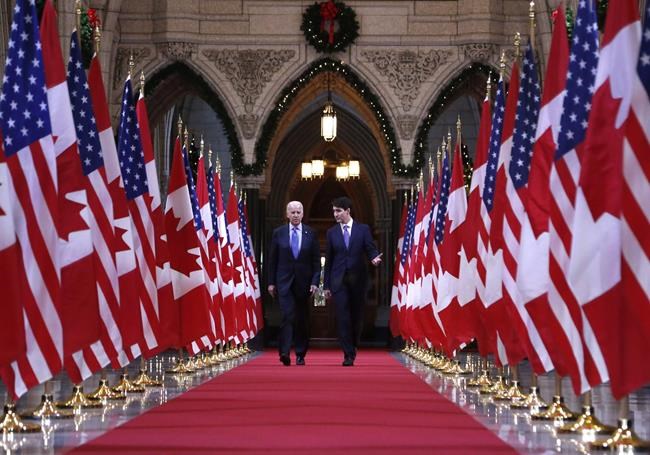
Prime Minister Justin Trudeau and US vice-president Joe Biden walk down the Hall of Honour on Parliament Hill in Ottawa on Friday, December 9, 2016. The election of Democrat Joe Biden as the next president of the United States is expected to have wide-ranging implications for Canadian politics and policy. THE CANADIAN PRESS/Patrick Doyle

Biden has promised to put the U.S. back into the agreement as soon as possible, and that, plus his own domestic environmental policies, could be a boon for Canada, including by opening markets for Canadian clean energy technology.

In the last four years, Canada has in some places slowed or amended its own environment policies to reflect concerns American companies facing fewer environmental regulations and taxes might hurt Canada’s competitiveness.

That includes methane regulations, which Canada delayed by three years when outgoing U.S. President Donald Trump paused similar targets in the U.S., and limiting the carbon pricing on industries that face heavy competition from U.S. firms that don’t pay the same kind of tax.

Immigration

Trump made wide-ranging changes to U.S. immigration policy that did have an effect on the flow of people to Canada.

Among them, a surge in asylum seekers who crossed irregularly into this country due to a loophole in the Safe Third Country Agreement. Canada has been trying to renegotiate that deal and might find a more willing dance partner in Biden — or the flow might dry up.Trump’s move to make it harder for people from certain countries to enter the U.S., and for people to obtain skilled worker visas, also saw a jump in immigration to Canada. Biden may reverse those changes, and there could be a subsequent “brain drain” from here.

Trade

Trump’s years in office were marked by turbulence in Canada-U. S. trade relations, including the rewriting of the North American free trade deal.A Biden victory likely means an end to the persistent threat of the steel and aluminum tariffs that Trump imposed on Canada in 2018, using executive powers under U.S. trade law that gave the president the right to impose them on national-security grounds.Still, Biden is also advocating Buy American protectionist policies that could prevent Canadian companies from bidding on U.S. infrastructure projects at the state and municipal level. Existing workarounds with state governors should be able to continue, but there remains political will in Biden’s own camp to stick to a protectionist trade approach.

Foreign Affairs

Ahead of the vote, Prime Minister Justin Trudeau met with the most senior political leaders of the European Union, a trio that has been standing up for the values of multilateralism in a world of rising nationalist politics personified by Trump.

In Biden, other Western leaders are likely to find more of an ally for international institutions such as the World Health Organization and NATO. Trump was widely believed to be on the cusp of pulling the U.S. out of that military alliance, raising serious questions about its future.

Biden’s platform calls for a more active role for NATO, and a return to the U.S. working more in concert with its allies on global threats.

Politics

A few months before former U.S. President Barack Obama left office, he gave a speech to the Canadian House of Commons widely interpreted as being a handover of responsibility for progressive politics to Trudeau.Biden himself said as much in a speech in Ottawa later that year, where he told Trudeau the world was counting on him to uphold the international liberal order.

“Vive le Canada … because we need you very badly,” said Biden, who was on his way out as vice-president at the time.

With Biden back, Trudeau’s international star may dim. In Canada, his foes may have more breathing room.

Trump’s loss could dampen what’s been a common political attack against Conservatives in recent years — that they are merely trying to impose a Trumpian approach to Canadian politics — and give them political space to promote a Canadian conservatism without Trump’s shadow.

This report by The Canadian Press was first published Nov. 7, 2020.

Report Error Submit a Tip

More Stories

The long and winding road

Editorial 4 minute read Preview

The long and winding road

Editorial 4 minute read Yesterday at 2:01 AM CDT

As theatre goes, it sent a strong message.

Manitoba Premier Wab Kinew, standing in front of microphones and television cameras, holding up his Indigenous status card and saying that he didn’t feel Canada should have “a race-based form of identification in this country, but that is a reality,” adding that it was time to abolish the Indian Act.

“I think it’s time to abolish the Indian Act, get rid of the Indian Act, move past the Indian Act, and it needs to be done with First Nations people and First Nations governments, of course. I think it’s long overdue that we have a relationship with Indigenous Peoples in Canada that reflects who we are as Canadians today,” he said.

The Indian Act — the name alone suggests how out-dated and out of place the law has become. Originally dating from 1876, the law was put in place to “amend and consolidate the laws respecting Indians” and gave the Minister of the Interior the responsibility to “control and management of the reserves, lands, moneys and property of Indians in Canada.”

Read
Yesterday at 2:01 AM CDT

A little toponder, a lot to celebrate

Erna Buffie 5 minute read Yesterday at 2:01 AM CDT

Well, another civic election season has come and gone, and I have to say it was a doozy. The most surprising event was the steady climb in support for young mayoral candidate Noah Redden, who started out with just four per cent public support in September but had reached a solid 14 per cent support in October.

On election day, Redden nearly came in second, less than one percentage point behind Kevin Klein, an experienced politician.

Indeed, the 27-year-old’s accomplishment was nothing short of astonishing. Particularly given that his shoestring campaign was given very little coverage — largely, according to one pundit, because he didn’t send out any press releases.

This when Redden’s unwritten press releases were there for everyone to see on Instagram, as he popped up in locations across the city, posting videos about what he hoped to achieve as mayor.

Two U.S. presidents, and America’s decline

Editorial 4 minute read Preview

Two U.S. presidents, and America’s decline

Editorial 4 minute read Friday, Sep. 25, 2026

“Let us have faith that right makes might, and in that faith, let us, to the end, dare to do our duty as we understand it.” — Abraham Lincoln in his Cooper Union address, given in New York City in 1860.

“When you add the United States and Venezuela together, we have more than 60 per of the oil in the world. So it’s perhaps the biggest deal. It was a war, but it’s perhaps the biggest deal ever made. To the victor belong the spoils.” — U.S. President Donald Trump, speaking to the United Nations on Tuesday. (And a point of clarification — combining U.S. and Venezuelan oil would amount to 22 per cent of global oil reserves.)

It is quite the juxtaposition: Lincoln speaking in one of his strongest speeches, making the case that slavery should not be extended to the Northern Territories of the U.S. It was a sentence — the closing line in his speech, in fact — which argued that moral truth and justice will prevail against brute force, and that moral behaviour will, in itself, become power.

Donald Trump essentially argued that the obverse is true: that brute force justifies all behaviour — saying that might is right. The end of seizing control justifies the means, the means in this case being an invasion of Venezuela and the end being gaining de facto control of an independent nation’s resources.

Read
Friday, Sep. 25, 2026

RRC Polytech program cuts take bite out of hospitality, tourism sector

Maggie Macintosh 4 minute read Preview

RRC Polytech program cuts take bite out of hospitality, tourism sector

Maggie Macintosh 4 minute read Saturday, May. 2, 2026

Manitoba’s tourism industry is bracing for the disappearance of hospitality training programs — once-popular courses among international students.

Citing budgetary challenges related to a shift in federal immigration policy, Red River College Polytechnic is scrapping 11 programs and scaling back three others in 2026-27. Its hospitality business management diploma is one of seven permanent casualties.

The announcement, while unsurprising, is but the latest blow to a sector trying to “build back the workforce” in the wake of the COVID-19 pandemic, said Michael Juce, president of the Manitoba Hotel Association.

“Are people going to go outside of Manitoba for training? And if they leave, are they going to come back?” Juce said, adding that rural hotels in particular are already grappling with staffing shortages.

Read
Saturday, May. 2, 2026

Five ways a Biden victory could affect Canada

Stephanie Levitz, The Canadian Press 4 minute read Preview

Five ways a Biden victory could affect Canada

Stephanie Levitz, The Canadian Press 4 minute read Saturday, Nov. 7, 2020

OTTAWA - The election of Democrat Joe Biden as the next president of the United States is expected to have wide-ranging implications for Canadian politics and policy.

Environment

The day after the election, the United States became the first and only country in the world to withdraw from the Paris climate change pact.

Biden has promised to put the U.S. back into the agreement as soon as possible, and that, plus his own domestic environmental policies, could be a boon for Canada, including by opening markets for Canadian clean energy technology.

Read
Saturday, Nov. 7, 2020

Affordable southwest Winnipeg attached two-storey home designed with families in mind

Todd Lewys 5 minute read Preview

Affordable southwest Winnipeg attached two-storey home designed with families in mind

Todd Lewys 5 minute read Yesterday at 2:01 AM CDT

Those in the market for a new entry-level home tend to have one main thought in mind. That thought, in most cases, centres on how much value a dwelling delivers — in both price and livability.

Spencer Curtis, owner of Hilton Homes, says he and his design team are acutely aware of how meticulously prospective buyers scrutinize entry-level new house options, which in most cases are attached two-storey models.

“That’s why we keep tweaking plans to make those homes better,” Curtis says. “This model, the Wilkens, is by far our most popular plan. We put a lot of thought into its design, and are always working at making it as functional and family-friendly as possible.”

Right from the get-go, the Wilkens distinguishes itself from other attached two-storey homes with its square footage.

Read
Yesterday at 2:01 AM CDT