Tokyo’s drinkers drown frustrations over virus limits, Games

Advertisement

Advertise with us

TOKYO (AP) — On the eve of the Tokyo Olympics’ opening ceremony, the government’s attempts to curb a coronavirus surge by targeting drinkers is drowning in liquor, frustration and indifference.

Read this article for free:


or

Already have an account? Log in here »

To continue reading, please subscribe:

Subscribe and receive a limited-edition Free Press branded hat or tote.

Digital Subscription

One year of digital access for only $205*

  • Enjoy unlimited reading on winnipegfreepress.com
  • Read the E-Edition, our digital replica newspaper
  • Access News Break, our award-winning app
  • Play interactive puzzles

*First annual payment billed as $205.00 + GST for one year. This annual subscription will automatically renew at $233.00 + GST every 52 weeks (10% off the regular annual price of $259.35). Offer available to new and qualified returning subscribers only. Cancel any time.

To continue reading, please subscribe:

Add Free Press access to your Brandon Sun subscription for only an additional

$1 for the first 4 weeks*

  • Enjoy unlimited reading on winnipegfreepress.com
  • Read the E-Edition, our digital replica newspaper
  • Access News Break, our award-winning app
  • Play interactive puzzles
Start now

*Your next Brandon Sun subscription payment will increase by $1.00 and you will be charged $17.95 plus GST for four weeks. After four weeks, your payment will increase to $24.95 plus GST every four weeks.

Hey there, time traveller!
This article was published 20/07/2021 (1901 days ago), so information in it may no longer be current.

TOKYO (AP) — On the eve of the Tokyo Olympics’ opening ceremony, the government’s attempts to curb a coronavirus surge by targeting drinkers is drowning in liquor, frustration and indifference.

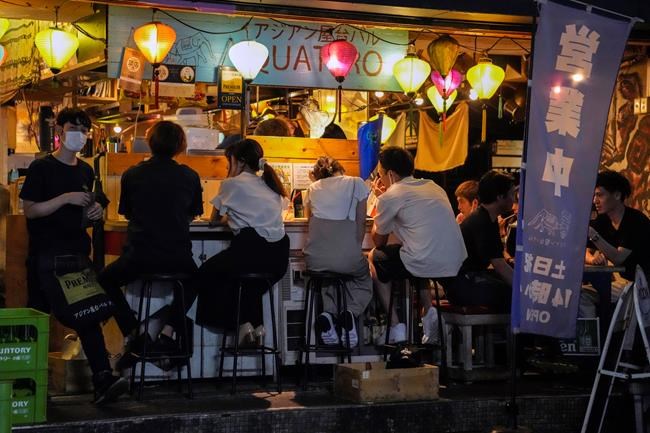
Japan has asked the city’s restaurants and bars to close by 8 p.m., if not entirely, to keep people from socializing in close contact with strangers and spreading the virus, but the state of emergency hasn’t deterred many. Instead, drinkers moved outdoors, and many bars in Tokyo’s famed nightlife districts are bustling with defiant customers.

“Nobody is convinced when (the government) victimizes people who are drinking alcohol without showing decent scientific evidence, even while going ahead with the Olympics,” said Mio Maruyama, a 28-year-old real estate industry worker who was chatting with her colleagues on the street in Tokyo’s Shinjuku district.

People gather at a bar after government imposed 8 p.m. closing time for restaurants and bars under Tokyo's fourth state of emergency Saturday, July 17, 2021, in Tokyo. The latest state of emergency has asked restaurants and bars to close by 8 p.m., if not entirely. This has pushed people to drink outside, although many bars remain open and bustling with customers who are defying the rules and expressing frustration and indifference. (AP Photo/Kiichiro Sato)

She says she’s interested in watching the Games, especially new sports like skateboarding and Japan’s Rui Hachimura, an NBA star, “but when I think of how politicians are playing around with this, I’m not quite rooting for this event from my heart.”

“It’s not that we are breaking the rules just because we’re against the inconsistency between politicians’ words and actions,” she said, referring to a 40-person reception for International Olympic Committee members on Sunday that included the prime minister and the governor of Tokyo. “But when you see such things, you might think that rulebreakers were right in doing what they’re doing.”

The IOC reception happened at a time when the public is barred from going to parties or even attending most Olympic events. Many Japanese are frustrated by that contrast — but are hardly staying home.

At around 9:30 p.m. in Shinjuku, people crisscrossed in front of the world’s busiest train terminal. Nighttime turnout was modest compared to before the pandemic, but bar districts like Kabukicho were still illuminated with neon lights from a few food establishments that were still open after 8 p.m.

Exempted from the emergency state mandate, 24/7-open convenience stores were busy with shoppers. Near one of the shops, some drinkers were talking with city workers wearing green Tokyo Metropolitan Government vests who were asking people to refrain from drinking and chatting outside.
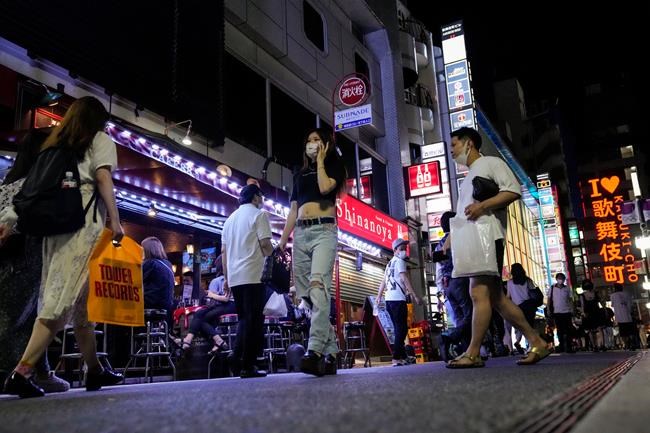
People walk around and gather at a bar after government imposed 8 p.m. closing time for restaurants and bars under Tokyo's fourth state of emergency Saturday, July 17, 2021, in Tokyo. The latest state of emergency has asked restaurants and bars to close by 8 p.m., if not entirely. This has pushed people to drink outside, although many bars remain open and bustling with customers who are defying the rules and expressing frustration and indifference. (AP Photo/Kiichiro Sato)

On a quiet street in east Shinjuku, Naoto Suga picked up a can of lemon-flavored liquor that his friend had just brought him. They sat on a curbside, along with around a dozen others who were also drinking on the street.

“We’ve been here every night for the past three days or so,” said Suga, 25, who works in a nearby apparel shop.

“I don’t think the Olympics itself made this (situation), but even before the Games, things like the state of emergency have remained half measures, and I think that’s making things worse,” he said. “People are all used to the state of emergency, so it’s getting less meaningful now.”

Suga, who hasn’t received the COVID-19 vaccine yet, also lamented the slower rollout in Japan, especially for younger people. Everyone 12 and older is eligible to be vaccinated, but younger people are last in line. Only 22% of Japan’s population has been fully vaccinated so far.

“To be honest, I’m for hosting the Olympics; it’s better than not doing so given the debt of venue buildings,” he said. “But I don’t quite have a particular sport I want to watch. I’ve lost interest.”
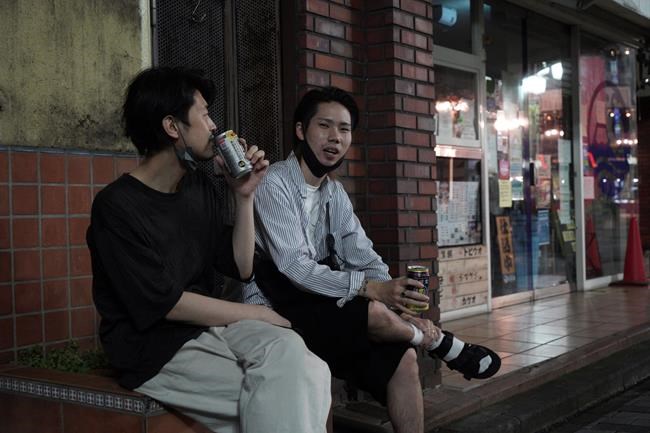
Naoto Suga, right, 25, drinks canned alcohol roadside with his friend in Tokyo’s Shinjuku district Monday, July 19, 2021.
Naoto Suga, right, 25, drinks canned alcohol roadside with his friend in Tokyo’s Shinjuku district Monday, July 19, 2021. "I don’t think the Olympics itself made this (situation), but even before the Games, things like the state of emergency have remained half measures, and I think that's making things worse," Suga said. "People are all used to the state of emergency, so it's getting less meaningful now." (AP Photo/Kantaro Komiya)
People gather at a bar after government imposed 8 p.m. closing time for restaurants and bars under Tokyo's fourth state of emergency Saturday, July 17, 2021, in Tokyo. The latest state of emergency has asked restaurants and bars to close by 8 p.m., if not entirely. This has pushed people to drink outside, although many bars remain open and bustling with customers who are defying the rules and expressing frustration and indifference. (AP Photo/Kiichiro Sato)
Report Error Submit a Tip

More Stories

Around the NSL: A corner to remember; De Filippo’s boot; a highlight-reel brace

Grace Anne Paizen 4 minute read Preview

Around the NSL: A corner to remember; De Filippo’s boot; a highlight-reel brace

Grace Anne Paizen 4 minute read Friday, Sep. 25, 2026

You better believe the race to the finish line is on and this weekend’s action proved just that.

The standings picture didn’t get any clearer — aside from the Roses securing their playoff ticket in a 2-2 road draw against the Rise last Saturday — with five of the league’s six club’s still very much in the post-season race.

Words of advice? Embrace the chaos of the final four weeks. But first, here’s the highlights and storylines out of an eventful Week 22.

Highlight of the week

Read
Friday, Sep. 25, 2026

Educational drone survey of canopy targets sick trees

Maggie Macintosh 6 minute read Preview

Educational drone survey of canopy targets sick trees

Maggie Macintosh 6 minute read Monday, Jun. 13, 2022

Drones could help save Winnipeg’s elm trees from being tagged with a fatal orange mark, owing to the work of experienced pilots and their student assistants.

Throughout the 2021-22 school year, Volatus Aerospace Corp., a so-called “drone solution company,” has recruited high school students to take part in a research project that aims to streamline canopy surveillance in Winnipeg.

City employees typically survey trees for Dutch elm disease either on foot or by driving past them. It’s a laborious process — and by the time a human eye can spot wilting, curling or yellowing leaves, it may be too late to reverse the damage caused by the fungal infection.

In partnership with the City of Winnipeg, University of Winnipeg and Seven Oaks School Division, Volatus is using drone technology to try and speed up the diagnosis process.

Read
Monday, Jun. 13, 2022

Bigger story: Jets’ playoff run or Bombers’ Cup victory?

Steve Lyons and Paul Wiecek 18 minute read Preview

Bigger story: Jets’ playoff run or Bombers’ Cup victory?

Steve Lyons and Paul Wiecek 18 minute read Wednesday, Dec. 11, 2019

Steve Lyons: Hello there. How’s it going? Hope you are staying warm. Guess winter is here now. Man, it’s been nice so far — especially, the lack of snow. Thought we were in for a long one after that dump of white stuff in October. I bought a new shovel on the weekend just in case. I’m sure it will show up at some point. Yes, I’ve been doing my own shoveling.

So, lots going on since we last chatted. Like the whole world changing with the Bombers winning the Grey Cup! More on that in a bit…

The Jets won AGAIN on Tuesday night, beating the Red Wings. The team is now 19-10-1-1, good for 40 points. As we chat on Wednesday morning, they are just two points behind the Blues, who hold down top spot in the Central. Heady stuff. They certainly look like they are going to make me eat my words about not making the playoffs.. I think.. maybe.. haha

One caution: Since Nov. 1, the Jets have won 13 games, but only four of those victories have been against current playoff teams — Vegas, Florida, and the Dallas Stars twice. They’ve certainly made hay in this soft spot in their schedule, but it will be interesting to see how they fare once they start playing the Caps, Bruins, Isles, Blues and Avs of the world. The one game they had against a top tier team in November, they got whacked 4-0 at home by Colorado.

Read
Wednesday, Dec. 11, 2019

Letters, Oct. 20

6 minute read Monday, Oct. 20, 2025

Stefanson’s legacy

Re: Is Stefanson’s fine fitting punishment? (Editorial, Oct. 17)

It’s appropriate to thank outgoing politicians for their service. For many reasons, my thanks to former premier Heather Stefanson are highly qualified and grudgingly offered.

The fine that she will pay certainly does not match the gravity of her offence. At the time she remained the caretaker premier, it was on her to behave with integrity and she deliberately chose not to do so. She wasn’t forced into anything; she made a deliberate choice to try to circumvent an important rule.

Manitoba marks end of sending simple workplace problems to doctor’s office

Tory McNally 7 minute read Preview

Manitoba marks end of sending simple workplace problems to doctor’s office

Tory McNally 7 minute read 2:01 AM CDT

There are some changes in the workplace that make you think: “Well, it’s about time.”

This is one of them.

Starting Oct. 1, Manitoba changed the rules around sick notes. I think it is going to be a wonderful change — not just for doctors and patients, but for employers, employees and the way we think about accountability at work.

The change comes from Bill 11, the Employment Standards Code Amendment Act (Sick Notes for Employee Absences), which received royal assent on June 1 and came into force Thursday. Under the new rules, employers generally cannot require a sick note for an illness or injury unless the employee is away for more than one week or has been absent because of illness or injury for more than 10 scheduled workdays in the calendar year.

Read
2:01 AM CDT

Letters, Oct. 2

6 minute read Yesterday at 2:00 AM CDT

Are clinical psychologists next?

Re: Province hires 17 psychiatrists to work in Winnipeg, Selkirk (Sept. 25)

Manitoba’s government has shown that it knows how to solve a specialist staffing crisis in health care. Clinical psychologists are still left to wonder when it will be their turn.

The Manitoba Psychological Society (MPS) welcomes the recent announcement of 17 new psychiatrists in the public system. Any investment in mental health deserves to be celebrated, especially in light of the Canadian Alliance on Mental Illness and Mental Health’s report card that was released in August 2026. Manitoba received overall grades of F and D for mental health and substance use health, respectively. Although disappointing, this is not surprising given that Manitoba spends five to six per cent of its health budget on mental health and addictions, about half the recommended rate of 12 per cent.