Stepping out of comfort zone comes with positives, pitfalls

Advertisement

Advertise with us

The pressure to be successful (or appear so) in today’s society is all too real. A few minutes online will show you that your job isn’t making you enough money, your house isn’t perfectly curated and you don’t have a million followers.

Read this article for free:


or

Already have an account? Log in here »

To continue reading, please subscribe:

Subscribe and receive a limited-edition Free Press branded hat or tote.

Digital Subscription

One year of digital access for only $205*

  • Enjoy unlimited reading on winnipegfreepress.com
  • Read the E-Edition, our digital replica newspaper
  • Access News Break, our award-winning app
  • Play interactive puzzles

*First annual payment billed as $205.00 + GST for one year. This annual subscription will automatically renew at $233.00 + GST every 52 weeks (10% off the regular annual price of $259.35). Offer available to new and qualified returning subscribers only. Cancel any time.

To continue reading, please subscribe:

Add Free Press access to your Brandon Sun subscription for only an additional

$1 for the first 4 weeks*

  • Enjoy unlimited reading on winnipegfreepress.com
  • Read the E-Edition, our digital replica newspaper
  • Access News Break, our award-winning app
  • Play interactive puzzles
Start now

*Your next Brandon Sun subscription payment will increase by $1.00 and you will be charged $17.95 plus GST for four weeks. After four weeks, your payment will increase to $24.95 plus GST every four weeks.

The pressure to be successful (or appear so) in today’s society is all too real. A few minutes online will show you that your job isn’t making you enough money, your house isn’t perfectly curated and you don’t have a million followers.

In her new novel Definitely Thriving, Kerry Clare asks us to redefine what “thriving” actually means — or, more specifically, what else it could mean.

Clare is the Toronto author of three previous novels and a blog entitled Pickle Me This. Her essays have been nominated for the National Magazine Award, and she is the editor of the literary website 49th Shelf and the book The M Word: Conversations About Motherhood.
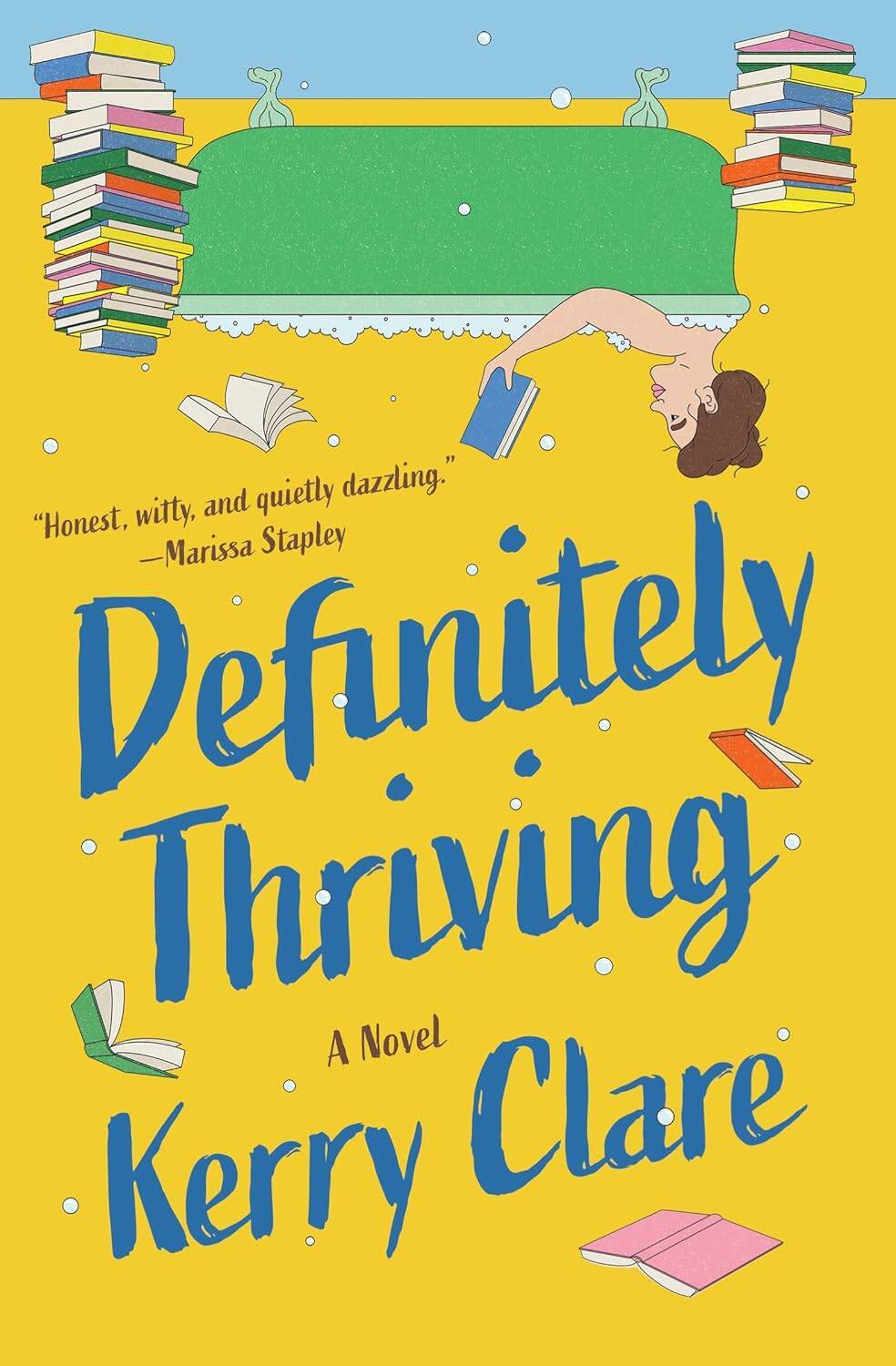
Definitely Thriving

Definitely Thriving

At first glance, Clemence Lathbury is definitely not thriving. She’s self- sabotaged herself out of her marriage, and is now residing in a run-down studio flat with a hot plate instead of a stove — a glorified “nun’s cell,” as she puts it. She’s also out of work.

But it’s all part of a plan. She’s returned to her hometown of Toronto after having been away for a decade, determined to reinvent herself and her life “to become one of those excellent women that Barbara Pym wrote about in her mid-century novels, helping out at church bazaars, fortified with a nice mug of Ovaltine.”

Ovaltine aside, perhaps if she does penance in her decrepit studio apartment, she’ll discover the road to excellence: “Mild depravity and lumpy beds — could this be the road to excellent womanhood?”

Definitely Thriving looks at what can happen if we step outside our comfort zone — whether purposefully or not — and begin anew. It’s a funny, lighthearted read that isn’t trying too hard to be anything else. Clare’s characters are ridiculous but endearing for all their quirks, and Clemence herself, a lovable hot mess, still manages to inspire.

The road to excellent womanhood involves learning to be alone. Clemence has never lived alone before, and her friends are worried about her, not least because her sole companion seems to be a one-eyed cat who wanders into her apartment through the balcony door. But Clemence feels free, particularly of her marriage, which felt like a prison.

Soon, though, she’s making acquaintances: her suspicious but well-meaning landlady, Mrs Yeung; Crampton, the landlady’s son with the great biceps; the surly cashier at the corner store; and Toby, the “pale book man” at the used bookstore, which she begins to frequent, if only to advise them that they need a section devoted to women’s fiction.

In doing so, Clemence somehow earns herself a part-time job reorganizing the books and (spoiler alert) a quasi- relationship with Toby. Readers may find this attraction difficult to digest; Clemence finds Toby rude, and is concerned he is malnourished. Nonetheless, she enters into an attachment with him — which, though it remains undefined, brings her a kind of peace.

As does her new life. The apartment with the stained ceiling and hallways that smell are somehow enough. Clemence comes to this realization even as she struggles to sever ties with her ex-husband.

The life she has now may not be much, but she has chosen it, even the hard parts. Sometimes when we stop ourselves from just going through the motions, real life steps in.

Lindsay McKnight works in the arts in Winnipeg and is partial to Ovaltine.
Report Error Submit a Tip

More Stories

Stepping out of comfort zone comes with positives, pitfalls

Reviewed by Lindsay McKnight 4 minute read Preview

Stepping out of comfort zone comes with positives, pitfalls

Reviewed by Lindsay McKnight 4 minute read Saturday, Apr. 18, 2026

The pressure to be successful (or appear so) in today’s society is all too real. A few minutes online will show you that your job isn’t making you enough money, your house isn’t perfectly curated and you don’t have a million followers.

In her new novel Definitely Thriving, Kerry Clare asks us to redefine what “thriving” actually means — or, more specifically, what else it could mean.

Clare is the Toronto author of three previous novels and a blog entitled Pickle Me This. Her essays have been nominated for the National Magazine Award, and she is the editor of the literary website 49th Shelf and the book The M Word: Conversations About Motherhood.

At first glance, Clemence Lathbury is definitely not thriving. She’s self- sabotaged herself out of her marriage, and is now residing in a run-down studio flat with a hot plate instead of a stove — a glorified “nun’s cell,” as she puts it. She’s also out of work.

Read
Saturday, Apr. 18, 2026

Final hurdles are moving on in your mind and life

Maureen Scurfield 3 minute read 2:01 AM CDT

DEAR MISS LONELYHEARTS: I just ran into my former husband with his new woman. It was a shock. She looked nothing like me — not nearly as good. In fact, she’s the opposite of me — red-haired, freckled, tall and skinny like a rake. I’m short, dark, with golden skin from my Italian background. That was what my husband used to say he loved in a woman.

Does that mean he lied — that he really didn’t like my looks and secretly longed for the opposite? That seems crazy to me. But I should mention that in our last miserable years together he didn’t even want to hold me in his arms and look at me. He sometimes slept at his office (or so he said) because he was “too tired to drive home.”

He could have been elsewhere — like in some other woman’s home — because he always used his cellphone to call me, not his office line.

How can I forget about the man I loved so much and finally move on?

'Wake-up call': 9/11 prompted some to move away to new lives

Jennifer Peltz, The Associated Press 10 minute read Preview

'Wake-up call': 9/11 prompted some to move away to new lives

Jennifer Peltz, The Associated Press 10 minute read Tuesday, Sep. 11, 2018

NEW YORK - On 9/11, Stephen Feuerman saw the World Trade Center aflame through the window of his Empire State Building office and watched, transfixed, as a second fireball burst from the twin towers.

He ran through the 78th floor urging everyone to get out, thinking their skyscraper could be next. With transit hubs shut down, he couldn't get home to his family in suburban Westchester for hours. Among the dead were someone he knew from college and people he recognized from his commuter train.

Feuerman had always seen himself as a New Yorker, but "everything changed that day," he says.

Shaken by the experience, the apparel broker and his wife put their home on the market weeks later. Within four months, they and their two small children moved to a gracious South Florida suburb they figured would be safer than New York.

Read
Tuesday, Sep. 11, 2018

Nature doesn’t waste its time

Russell Wangersky 7 minute read Preview

Nature doesn’t waste its time

Russell Wangersky 7 minute read 2:01 AM CDT

Sixteen months in and the black burn from a forest fire somehow transitions from the foreground to the background. I’m not sure if it actually softens, if it really changes, or if is just that your eyes, now used to the background, start seeing less of it.

One thing’s for certain: nature doesn’t waste any time taking its opportunities. In the sheltered ground behind where the shed over our Newfoundland root cellar used to be, a forest of sorrel has arisen, its dark-green leaves with their distinctive double horns at their base crowding in tight amongst each other.

It’s no surprise: sorrel is new beginnings, often the first plant I see recultivating abandoned gardens or disturbed ground and I’m happy to have it around always. Its distinctive lemony bite is a fine addition to salads, though we’re not likely to choose it from that particular root cellar patch. Not with the way the asphalt roof shingles burned right around there. I shovelled up the heavy pats of congealed black tar last spring, right after the fire, bringing them up from inside the cellar in big plastic buckets to send to safe disposal. But there’s probably plenty of tar still in the ground and out of sight — hardly an appetizing thought.

From other areas, maybe we will eventually sample sorrel: it depends on how close they were to the house or shed or anything else that burned. And so very much burned. The province has said gardens are safe from contamination by fire-retardant chemicals as nothing has shown up in tests. But we know what way the wind was blowing — what burned, and where, is always part of the equation. It’s a strange calculation to make: I’m just glad our house wasn’t heated with fuel oil, was too old to contain asbestos, and didn’t have indoor plumbing for decades.

Read
2:01 AM CDT

Poilievre unveils five-point steel plan, urges Ottawa to sue Stelco’s U.S. owner

Brett Bundale, The Canadian Press 4 minute read Yesterday at 2:38 PM CDT

Conservative Leader Pierre Poilievre is calling on Ottawa to sue Stelco's American owner as part of a five-point plan aimed at protecting Canada's struggling steel industry.

Poilievre was in Burlington, Ont. on Friday, speaking at a site overlooking Stelco's operations across Hamilton Harbour. The steelmaker began issuing layoff notices this week after announcing plans to lay off up to 500 workers at its Hamilton and Lake Erie facilities.

He said the lawsuit should seek to bring back workers and restart idled operations at Stelco, or force its sale to a Canadian owner willing to resume production.

"The only thing that we would accept is these workers getting their paycheques, making Canadian steel to build our country," Poilievre said.

Soul candles ritual connects women to the past

Sharon Chisvin 5 minute read Preview

Soul candles ritual connects women to the past

Sharon Chisvin 5 minute read Saturday, Sep. 19, 2026

On one evening every fall during the 10 Days of Awe — the solemn period of reflection and repentance between the Jewish holy days of Rosh Hashanah and Yom Kippur — Jane Enkin sits down with a group of women in her Winnipeg home to make candles. The making of the candles is not simply for fun or creative expression — although it serves those purposes as well—but is, rather, an intentional re-enactment of an ancient and little-known High Holiday spiritual ritual.

That ritual is neshome likht, the crafting of ceremonial soul candles.

The making of soul candles during the High Holiday season was common practice among Ashkenazie or Eastern European Jewish women beginning in the 12th century. The candles were made for the souls of both the living and the dead, and often were customized with special wicks made from threads that were used, in another ancient custom, to measure Jewish cemeteries. The measuring of the cemeteries was seen as a way to connect to the deceased in the weeks leading up to Yom Kippur so that those who had already passed might prevail upon God to include their loved ones’ names in the Book of Life.

While the practice of measuring cemeteries has largely fallen by the wayside, the making of soul candles, or the laying of wicks, has managed to survive over the centuries and has enjoyed a significant resurgence in modern times.

Read
Saturday, Sep. 19, 2026