

Nature doesn’t waste its time
Advertisement
Read this article for free:
or
Already have an account? Log in here »
To continue reading, please subscribe:

Digital Subscription
One year of digital access for only $205*
- Enjoy unlimited reading on winnipegfreepress.com
- Read the E-Edition, our digital replica newspaper
- Access News Break, our award-winning app
- Play interactive puzzles
*First annual payment billed as $205.00 + GST for one year. This annual subscription will automatically renew at $233.00 + GST every 52 weeks (10% off the regular annual price of $259.35). Offer available to new and qualified returning subscribers only. Cancel any time.
To continue reading, please subscribe:
Add Free Press access to your Brandon Sun subscription for only an additional
$1 for the first 4 weeks*
- Enjoy unlimited reading on winnipegfreepress.com
- Read the E-Edition, our digital replica newspaper
- Access News Break, our award-winning app
- Play interactive puzzles
*Your next Brandon Sun subscription payment will increase by $1.00 and you will be charged $17.95 plus GST for four weeks. After four weeks, your payment will increase to $24.95 plus GST every four weeks.
Read unlimited articles for free today:
or
Already have an account? Log in here »
Sixteen months in and the black burn from a forest fire somehow transitions from the foreground to the background. I’m not sure if it actually softens, if it really changes, or if is just that your eyes, now used to the background, start seeing less of it.
One thing’s for certain: nature doesn’t waste any time taking its opportunities. In the sheltered ground behind where the shed over our Newfoundland root cellar used to be, a forest of sorrel has arisen, its dark-green leaves with their distinctive double horns at their base crowding in tight amongst each other.
It’s no surprise: sorrel is new beginnings, often the first plant I see recultivating abandoned gardens or disturbed ground and I’m happy to have it around always. Its distinctive lemony bite is a fine addition to salads, though we’re not likely to choose it from that particular root cellar patch. Not with the way the asphalt roof shingles burned right around there. I shovelled up the heavy pats of congealed black tar last spring, right after the fire, bringing them up from inside the cellar in big plastic buckets to send to safe disposal. But there’s probably plenty of tar still in the ground and out of sight — hardly an appetizing thought.
Russell Wangersky photo
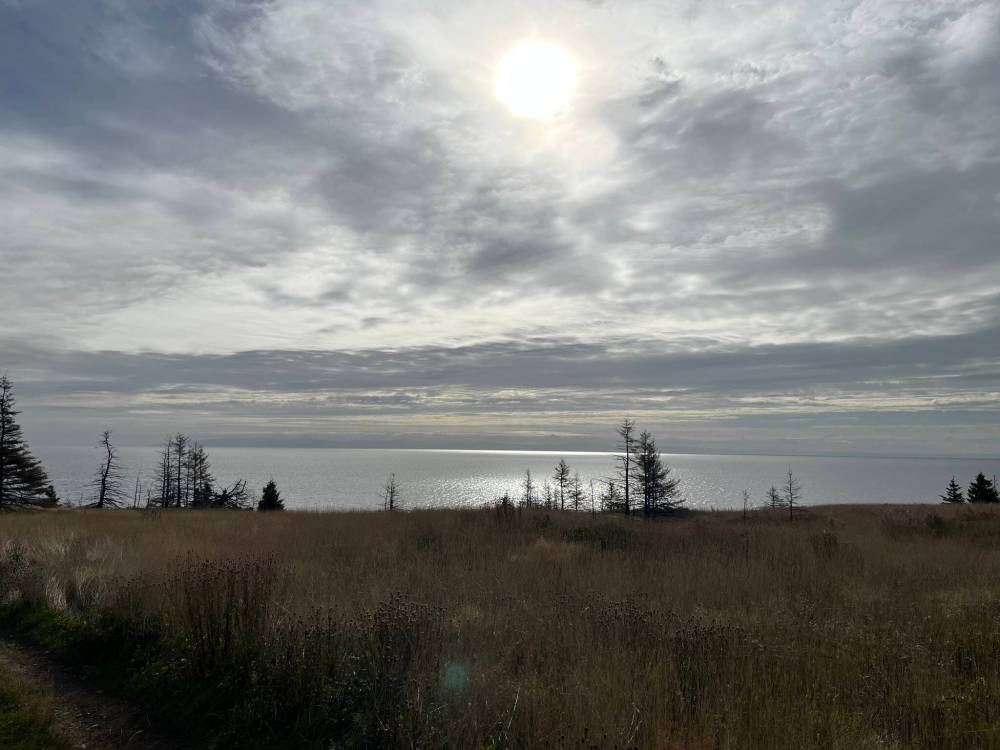
The sun breaks through the clouds in Gusset’s Cove.
From other areas, maybe we will eventually sample sorrel: it depends on how close they were to the house or shed or anything else that burned. And so very much burned. The province has said gardens are safe from contamination by fire-retardant chemicals as nothing has shown up in tests. But we know what way the wind was blowing — what burned, and where, is always part of the equation. It’s a strange calculation to make: I’m just glad our house wasn’t heated with fuel oil, was too old to contain asbestos, and didn’t have indoor plumbing for decades.
It’s not just the sorrel that has come rampaging back. This year’s blueberries, even in the burnover, were amazing and areas that were burned in the first major fire, in May 2025, are recovering, at least at ground level. The August 2025 fire burned much longer and much hotter: it will be years for the areas it burned thoroughly to recover. For comparison, the May fire burned 12 homes; August, 200.
But areas from the May fire — a flash fire of wind-blown brush and conifers (most deciduous trees hadn’t leafed out yet and survived without burning) — are recovering, at least at your knees or below.
Our red currant bush burned flat to the ground, but came back strong this year. Nature being nature, though, a late-summer infestation, gooseberry sawfly caterpillars the most likely culprit, removed much of the leaves, only skeletal stalks remaining.
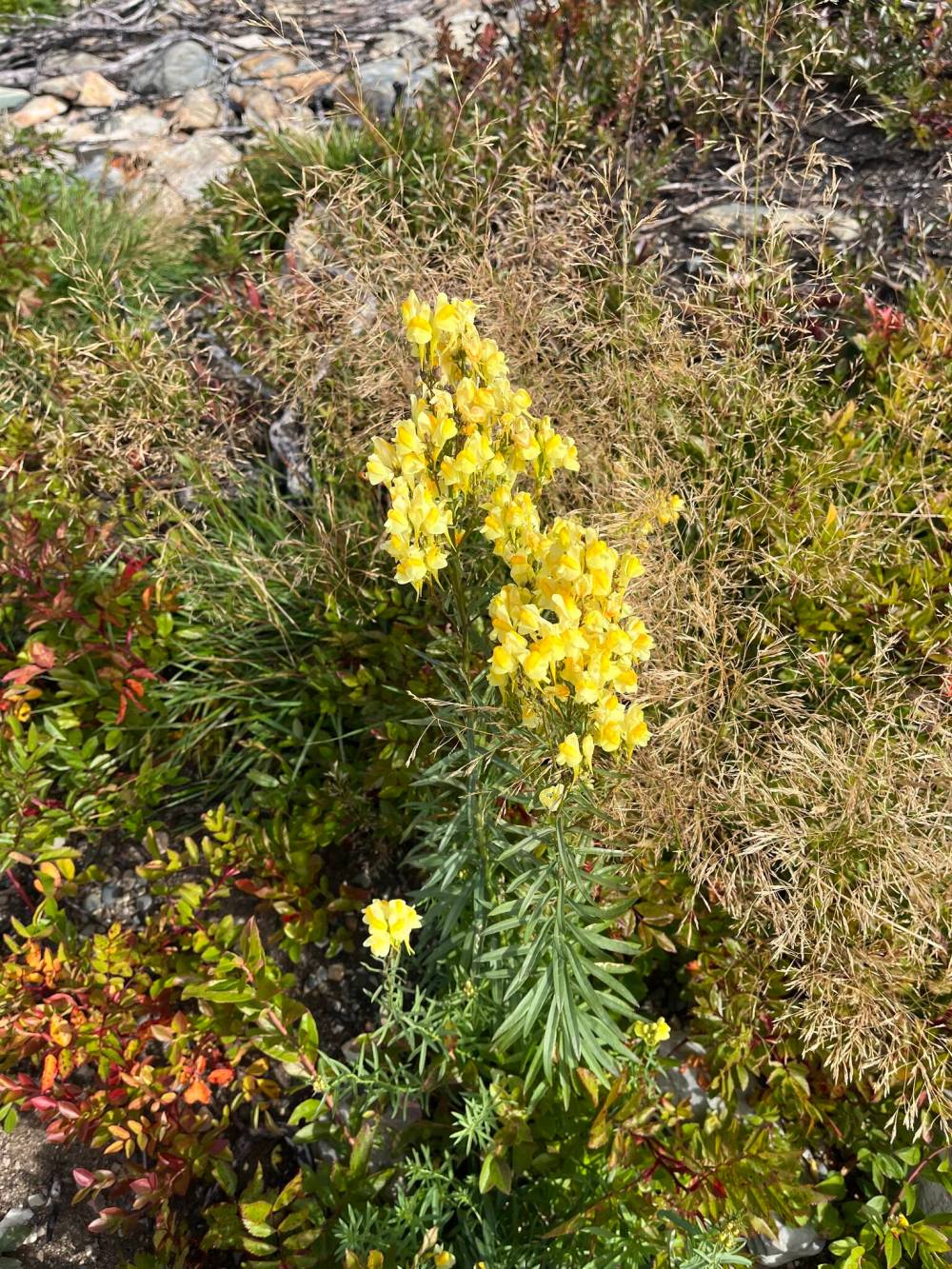
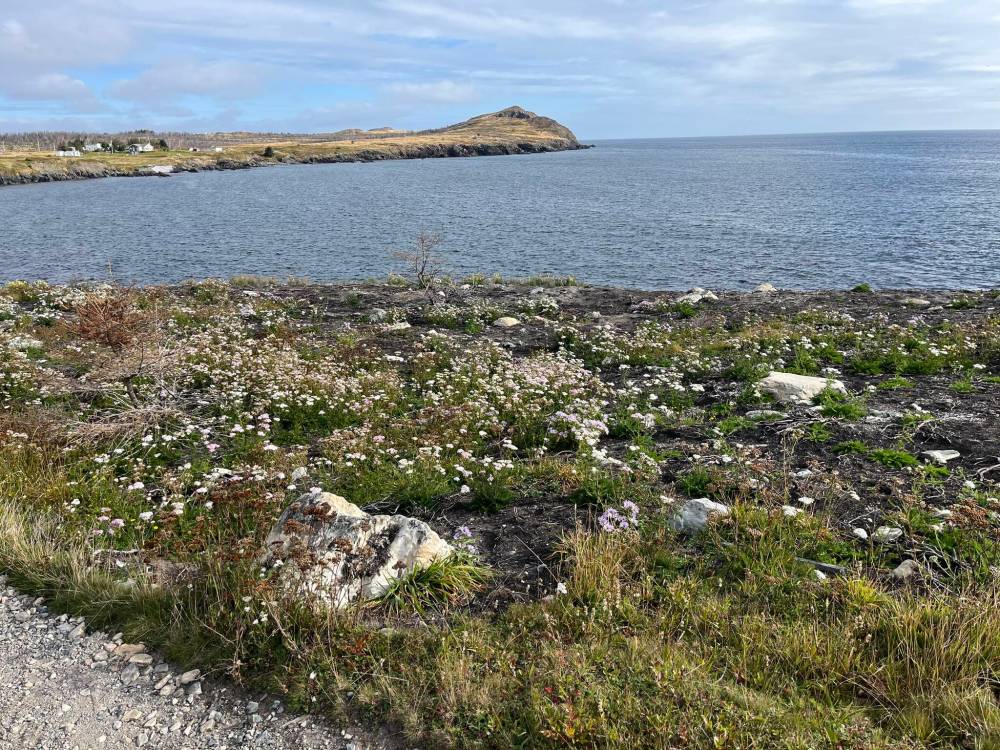
There are bushy weeds throwing up bouquets of what look like small snapdragons — I think “small snapdragon” suits them much better than their formal name, Yellow Toadflax, which sounds like a fantasy novel villain. Riots of wild yarrow and asters have taken advantage of having the competing long grass and ground roses burned away and nod together in the wind on shore headlands.
Almost everywhere, ranks of goldenrod and fireweed compete to block each other out, but while the goldenrod seems to be winning the hand-to-hand combat, the fireweed is clearly winning the aerial battle.
On windy sunny days, the air is full of the cast-out parachutists of fireweed seed fluff — even in the bad burn scars, you sometimes catch sight of the low-transiting fireweed seeds, light enough to carry for miles, ready with as little as a slight wind shift or a windrow of burned branches to settle and colonize. A riot of pink and fuchsia awaits, as early as next year.
I don’t know whether to be pleased or discouraged. In some ways, the ground is recovering faster than I would have expected. In other ways, it is perhaps not paralyzingly slow, but frustratingly methodical and lock-stepped.
There are saplings fighting their way up through the wreckage already — small eager firs still in their perfect Christmas-tree cone shapes, not yet individualized by a snapped-off branch or broken candle tip, along with the single gawky stalks of first-year poplars. But they will not be adult trees in my lifetime. I could plant new apple trees and nurture them carefully, but I might never see them bear fruit.
Russell Wangersky photo
Yellow Toadflax near Adam’s Cove, Nfld.
You will know this, too, if you don’t already. A point comes when you realize that all around you, friends and acquaintances are running into the cruelty of statistics.
A certain number find that the great bingo caller has stamped their card with prostate issues or cardiac problems. Others hear the message, “under the C, cancer.”
Other are dealt much-less common things — how unfair it must be to be dealt a diagnosis for something so out of the ordinary that you’ve never even heard its name before.
And then, having that sinking feeling of finding your future in fear-quickened internet research. Dr. Google is completely without bedside manner.
It’s no longer a surprise when an acquaintance is diagnosed — it’s a tick of the clock.
A dear friend explained it to me simply: “It feels like you’re always running to escape a sharpshooter.”
I get it. The never knowing who is next. The knowing that you can just as easily be right there, fixed in the sights for the next shot.
You wonder often if it’s not more important to be greedier about whatever time you have. Not because you’ve been hit, but because you don’t know if someone or something has taken aim.
This is a long and perhaps too florid way of saying I’ve stepped away from being the Comment Editor at the Free Press. It was time to stop marking time.
Russell Wangersky photo
Yarrow and asters growing on a headland overlooking Adam’s Cove.

Do you really need fireweed seeds and sorrel to explain leaving your job? Well, I do.
I’ll still be writing for the Free Press in this space and others, as required. I’ll still be doing other writing as well, whether it’s a more-frequent appearance on Substack — rwangersky@substack.com, where I write a series called Found in Place — or my other work as a fiction and non-fiction writer. (My latest collection of short stories, We Had Years, published by Biblioasis, is scheduled to come out in November.)
And I’ll still be musing in print on everything from Manitoba politics to the perspective of lying on my stomach in the yard, watching the way the fireweed fluff tumbles panjandrum through the stalks of grass.
Keeping my head down.
Russell Wangersky is a writer and columnist — and a journalist for 42 years — who splits his time between Winnipeg and Adam’s Cove, Nfld.