Pandemic fatigue, divisive politics pose likely hurdles to return to masking: experts

Advertisement

Advertise with us

TORONTO - A plea by health officials to resume masking in Ontario and Quebec is a tall order that is unlikely to take hold without a significant culture shift, say observers who point to pandemic fatigue, mixed messages and divisive politics as likely hurdles.

Read this article for free:


or

Already have an account? Log in here »

To continue reading, please subscribe:

Subscribe and receive a limited-edition Free Press branded hat or tote.

Digital Subscription

One year of digital access for only $205*

  • Enjoy unlimited reading on winnipegfreepress.com
  • Read the E-Edition, our digital replica newspaper
  • Access News Break, our award-winning app
  • Play interactive puzzles

*First annual payment billed as $205.00 + GST for one year. This annual subscription will automatically renew at $233.00 + GST every 52 weeks (10% off the regular annual price of $259.35). Offer available to new and qualified returning subscribers only. Cancel any time.

To continue reading, please subscribe:

Add Free Press access to your Brandon Sun subscription for only an additional

$1 for the first 4 weeks*

  • Enjoy unlimited reading on winnipegfreepress.com
  • Read the E-Edition, our digital replica newspaper
  • Access News Break, our award-winning app
  • Play interactive puzzles
Start now

*Your next Brandon Sun subscription payment will increase by $1.00 and you will be charged $17.95 plus GST for four weeks. After four weeks, your payment will increase to $24.95 plus GST every four weeks.

Hey there, time traveller!
This article was published 15/11/2022 (1419 days ago), so information in it may no longer be current.

TORONTO – A plea by health officials to resume masking in Ontario and Quebec is a tall order that is unlikely to take hold without a significant culture shift, say observers who point to pandemic fatigue, mixed messages and divisive politics as likely hurdles.

The fact that a renewed push for personal protective measures remains voluntary means many people will consider it optional, and possibly even unnecessary, says behaviour expert and York University associate professor Rebecca Bassett-Gunter.

She notes that many people abandoned masks altogether after most pandemic precautions were lifted earlier this year.
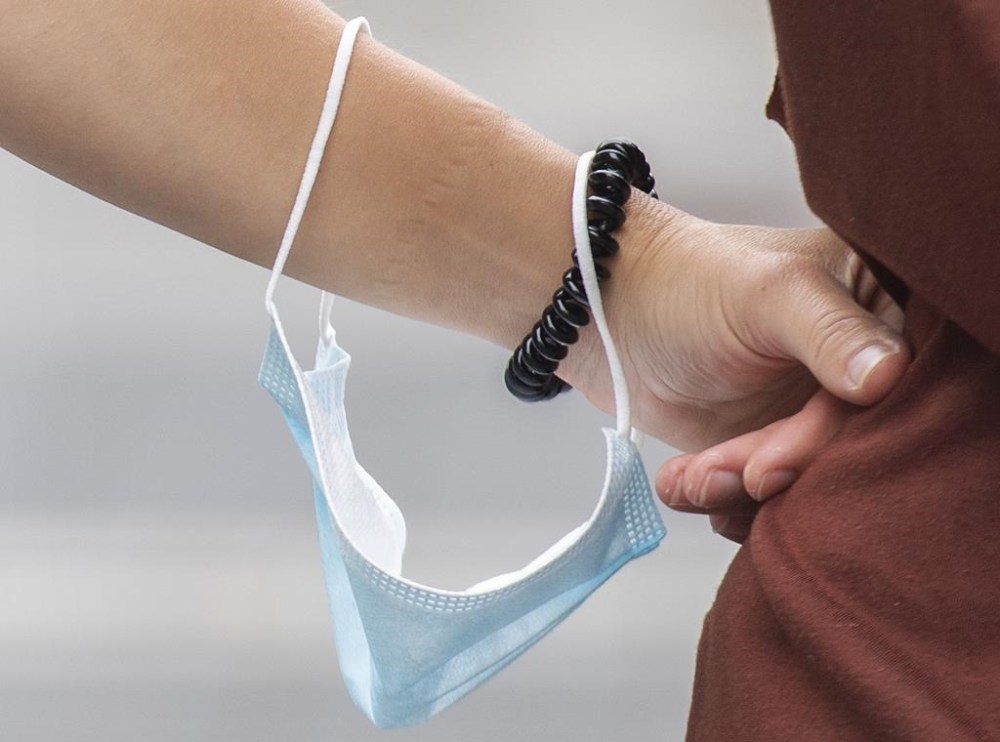
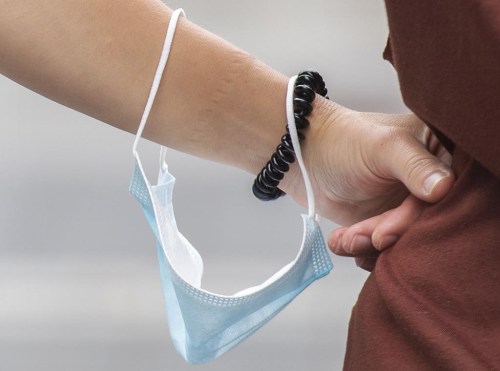
A disposable face mask is shown attached to a woman's arm in Old Montreal on July 18 2021. A plea by health officials to resume masking in Ontario and Quebec is a tall order that is unlikely to take hold without a significant culture shift, say observers who point to pandemic fatigue, mixed messages and divisive politics as likely hurdles. THE CANADIAN PRESS/Graham Hughes

It’s not clear that weeks of warnings from overwhelmed hospital staff over the “triple threat” of viral infections is enough to get those same people to put their masks back on.

“Without mandating it, I think people are hearing a message that it must not be as bad as it was,” says Bassett-Gunter, whose research at the school of kinesiology and health science has included a look at how to get people to comply with COVID-19 precautions.

“That’s a really hard implicit message to override, unfortunately.”

Add in pandemic fatigue and a yearning for festive holiday gatherings to return after two seasons of restraint, and public health officials face a tough psychological wall to break through, adds Dr. Eddy Lang, professor and department head for emergency medicine at the Cumming School of Medicine at the University of Calgary.

While his province isn’t seeing a surge in respiratory syncytial virus and influenza cases to the same degree as Ontario and Quebec, he noted cases are expected to increase as cold and flu season progresses.

“When we look at the wastewater analysis, RSV is still on the rise, which suggests that the worst of it may still be yet to come,” Lang said.

Already, a wave of viral illnesses among young students has pushed hospital capacity to dangerous levels. But given Alberta Premier Danielle Smith’s stated opposition to a school mask mandate, Lang doubts a masking plea is imminent or that there is much public support for more precautions.

“People are just so tired of public health directives,” says Lang.

“Until we really see a cultural shift … I don’t think this is going to work particularly well or give us much of an impact against hospitalizations.”

Health authorities in Canada’s two most populous provinces issued strong recommendations on Monday for people to mask up indoors to mitigate the spread of respiratory viruses that have overwhelmed hospitals and pediatric centres.

Ontario’s chief medical officer of health, Dr. Kieran Moore, stressed the vulnerability of babies and children younger than five to unseasonably high rates of RSV and rising rates of influenza. At the same time, he warned of emerging COVID-19 variants.

Quebec’s college of physicians made a similar appeal that the public don masks on a “voluntary and preventive basis” in public places, crowded private spaces and on public transit.

Last week, Canada’s top doctor stressed the need for “stepped-up precautions” while warning that COVID-19, RSV and the flu were challenging the health system in several parts of the country.

Turney McKee of the Montreal-based consultancy group Decision Lab was skeptical that “a mere recommendation” would be enough to drive the adoption needed to mitigate public health risks.

“Sure, our attitudes or values may align with one course of action, but then when actually put in the situation to either comply or not to comply, I think it’s very likely that we see a disconnect,” says McKee.

He sees politics as less a driver than fatigue, convenience and social pressure.

“When the mandate is no longer there, if it is no longer convenient, we’re probably going to stop,” says McKee, whose firm uses applied behavioural science to guide advice for organizations and government clients.

“And when we see everyone else around us starting to stop, the social influence can be very potent.”

However, that’s not to say this public health plea is completely powerless.

It sends a clear signal that stronger measures could follow and that the public should brace for a potential mandate, says McKee.

“It primes people to expect that maybe some more heavy-handed measures are around the corner,” he says.

Moore said a mask mandate could be possible if Ontario’s health-care system continues to see an increase in pressure due to respiratory illnesses, though he said that would be “the furthest we’d have to go.”

This report by The Canadian Press was first published Nov. 15, 2022.
Report Error Submit a Tip

More Stories

What’s luck got to do with it?

Tim Kist 5 minute read Yesterday at 2:01 AM CDT

We all seek certainty in our daily lives. We expect if we make a decision, the outcome will be just as we planned: a direct correlation between the decision and result.

You, as a business leader, seek the same certainty from the decisions you make. And sometimes, the result is what was expected. Sometimes, it isn’t.

The big question is: why is it so difficult to achieve the business results you expect when you carefully craft your plans and seemingly make good decisions?

The truth is we cannot predict the future. This means we almost never know precisely how customers will respond to a sales quote, what competitors are planning, and a myriad of other external variables at play.

Khan should’ve taken high road: Goertzen

Carol Sanders 5 minute read Preview

Khan should’ve taken high road: Goertzen

Carol Sanders 5 minute read Friday, Oct. 2, 2026

The veteran Progressive Conservative who championed Obby Khan’s leadership bid says the former Blue Bomber dropped the ball by dissing his Tory teammates before he stepped down.

“I wouldn’t recommend it, and I didn’t recommend it,” Kelvin Goertzen (Steinbach) said in an interview Friday.

Khan resigned as PC leader and quit the caucus Monday saying some members were secretly plotting his ouster, even after he won a confidence vote on Sept. 25.

On Tuesday, Khan lashed out in a CJOB interview, naming the alleged plotters, saying constituents deserved to know which of their elected representatives “lacked moral integrity.” Khan told the Free Press he was “deeply emotionally hurt,” and felt stabbed in the back.

Read
Friday, Oct. 2, 2026

Giant Tiger decision creates giant void for desperate population

Niigaan Sinclair 5 minute read Preview

Giant Tiger decision creates giant void for desperate population

Niigaan Sinclair 5 minute read Friday, Jul. 31, 2026

A lot of Winnipeggers may shrug, but the end of Giant Tiger’s downtown store is a giant problem for many of the people living in the centre of the city.

It would have been difficult for anyone going into or passing by the Canadian discount chain’s Donald Street and Ellice Avenue location Thursday to miss the red notices posted on the store’s windows advising it will close on Nov. 7.

According to a 2024 Downtown Winnipeg BIZ report, about 18,000 people live in Winnipeg’s downtown.

More than 60,000 people work there, and some days — when there’s a big concert or the Jets play at Canada Life Centre, for example — the number of people spending time in the area increases significantly.

Read
Friday, Jul. 31, 2026

The idea of Alberta separation viewed through a faith lens shows further fracture lines

Josiah Neufeld 10 minute read Preview

The idea of Alberta separation viewed through a faith lens shows further fracture lines

Josiah Neufeld 10 minute read Yesterday at 2:01 AM CDT

CALGARY — One morning in May, John Pentland, a minister at Hillhurst United Church in Calgary, opened his newspaper and read about a group of Albertans who were trying to divide his country.

Something inside of him felt like it cracked open. He started to weep.

“I couldn’t stop, I couldn’t breathe,” he said. He called a friend and told him: “I think I’m losing my mind.”

Pentland has always believed in Canada — flawed as it might be — as a nation gifted with diversity and welcoming of asylum seekers, refugees and immigrants. But recently that belief has been shaken as he’s witnessed right-wing ideologies charged with anti-immigrant sentiment take root in his province. It makes him angry and embarrassed for the country he loves.

Read
Yesterday at 2:01 AM CDT

Pandemic fatigue, divisive politics pose likely hurdles to return to masking: experts

Cassandra Szklarski, The Canadian Press 5 minute read Preview

Pandemic fatigue, divisive politics pose likely hurdles to return to masking: experts

Cassandra Szklarski, The Canadian Press 5 minute read Tuesday, Nov. 15, 2022

TORONTO - A plea by health officials to resume masking in Ontario and Quebec is a tall order that is unlikely to take hold without a significant culture shift, say observers who point to pandemic fatigue, mixed messages and divisive politics as likely hurdles.

The fact that a renewed push for personal protective measures remains voluntary means many people will consider it optional, and possibly even unnecessary, says behaviour expert and York University associate professor Rebecca Bassett-Gunter.

She notes that many people abandoned masks altogether after most pandemic precautions were lifted earlier this year.

It’s not clear that weeks of warnings from overwhelmed hospital staff over the “triple threat” of viral infections is enough to get those same people to put their masks back on.

Read
Tuesday, Nov. 15, 2022

Teachers work with Microsoft and Minecraft to create Anishinaabe society

Maggie Macintosh 8 minute read Preview

Teachers work with Microsoft and Minecraft to create Anishinaabe society

Maggie Macintosh 8 minute read Wednesday, Feb. 10, 2021

In a forest abundant with birch trees, knowledge keeper Chickadee Richard greets students with a teaching about tobacco, known as semaa in Anishinaabemowin.

“Semaa is a gift of reciprocity. We give semaa to receive knowledge and healing,” Richard says about a practice that is traditional for Anishinaabe people, via a medium that is anything but.

The birch trees, much like the teepees, campfire flames and murky brown rivers that surround her, are pixelated.

And the elder from Sandy Bay First Nation? A video game version of Richard.

Read
Wednesday, Feb. 10, 2021