Religion and Alberta’s referendum
The idea of separation viewed through a faith lens shows further fracture lines
Advertisement
Read this article for free:
or
Already have an account? Log in here »
To continue reading, please subscribe:

Digital Subscription
One year of digital access for only $205*
- Enjoy unlimited reading on winnipegfreepress.com
- Read the E-Edition, our digital replica newspaper
- Access News Break, our award-winning app
- Play interactive puzzles
*First annual payment billed as $205.00 + GST for one year. This annual subscription will automatically renew at $233.00 + GST every 52 weeks (10% off the regular annual price of $259.35). Offer available to new and qualified returning subscribers only. Cancel any time.
To continue reading, please subscribe:
Add Free Press access to your Brandon Sun subscription for only an additional
$1 for the first 4 weeks*
- Enjoy unlimited reading on winnipegfreepress.com
- Read the E-Edition, our digital replica newspaper
- Access News Break, our award-winning app
- Play interactive puzzles
*Your next Brandon Sun subscription payment will increase by $1.00 and you will be charged $17.95 plus GST for four weeks. After four weeks, your payment will increase to $24.95 plus GST every four weeks.
Read unlimited articles for free today:
or
Already have an account? Log in here »
CALGARY — One morning in May, John Pentland, a minister at Hillhurst United Church in Calgary, opened his newspaper and read about a group of Albertans who were trying to divide his country.
Something inside of him felt like it cracked open. He started to weep.
“I couldn’t stop, I couldn’t breathe,” he said. He called a friend and told him: “I think I’m losing my mind.”
JOSIAH NEUFELD / FREE PRESS Calgary
Pentland has always believed in Canada — flawed as it might be — as a nation gifted with diversity and welcoming of asylum seekers, refugees and immigrants. But recently that belief has been shaken as he’s witnessed right-wing ideologies charged with anti-immigrant sentiment take root in his province. It makes him angry and embarrassed for the country he loves.
“I’ve never felt our worship and our sermons matter more than they do right now,” Pentland said in early September, sitting in a crowded coffee shop in Calgary’s Kensington neighbourhood, a few blocks from his church. “Right now, it feels very important that we’re speaking what I call good religion. Jesus has been usurped by the right wing. It’s not biblical. It’s not following Matthew 25: ‘I was hungry and you fed me, thirsty and you gave me drink. I was a stranger and you welcomed me.’”
● ● ●
On Oct. 19, Albertans will go to the polls in a referendum that has largely been framed as a vote on the province’s independence.
But voters will receive a total of 10 ballot questions, five of which are about immigration. These questions ask whether the Alberta government should take more control of immigration “for the purposes of decreasing immigration to more sustainable levels”; whether health care, education and other social services should be withheld from people who aren’t Alberta citizens or permanent residents; whether newcomers should have to live in the province for a year before receiving provincially funded social support programs; whether non-permanent residents should be charged a fee for health care and education; and whether people should be required to show proof of citizenship to vote.
“Are these questions proposing solutions or are they presenting scapegoats?” asks Chris Mah Poy, who works for the United Church of Canada’s Alberta region.
Since June, Mah Poy has been holding workshops at churches to help people understand the referendum questions and prepare to vote.
When Mah Poy’s great-grandparents came to Canada in the early 1900s, they had to pay the Chinese head tax, a race-based levy designed to restrict Chinese immigration after the completion of the Canadian Pacific Railway. Mah Poy’s grandfather was born in Alberta but wasn’t recognized as a citizen until 1947. He paid taxes but couldn’t vote.
“When I read the referendum questions on immigration I see that once again a group of people, valued for their labour, who pay taxes and are our neighbours, risk being second-class citizens,” Mah Poy says. “Once again the forces of division, xenophobia and racism are being weaponized to distract and deflect from failures of government policy.”
Immigration is often blamed for the housing shortage and strained health-care system, but these crises existed before Canada increased its immigration numbers to bring in more foreign students and refugees from Syria, Ukraine and Gaza. In 2024, Alberta Premier Danielle Smith wrote to Ottawa asking for Alberta’s federal immigration allotment to be doubled so the province could bring in more evacuees from Ukraine.
In the past two years, the federal government has cut immigration levels sharply; this year Canada recorded the lowest rate of population growth since the Second World War.
“The division has already started,” says Adanech Sahilie, executive director of the Immigrant Outreach Society in Calgary, a non-profit organization that supports Ethiopian and Eritrean families. “We can feel it, we can see it.”
Sahilie says she’s experienced more personal racism in the past 10 months than in all the previous 15 years she’s lived in Calgary. People yell at her while she’s driving. They call her racial slurs and tell her to go back where she came from.
“It’s really unbelievable. Canada is supposed to be a great country. It’s widely known Canada is very welcoming,” she says.
Families whom Sahilie works with fear they’ll lose access to health care and see their children expelled from school if the proposals in the referendum are acted on.
“Some of them are crying,” she says. “Already life is really uncertain for them. When you flee your home country, you leave everything behind and you know you aren’t going back. This is just another layer of stress. Honestly, it’s even hard for me to sit with them.”
● ● ●
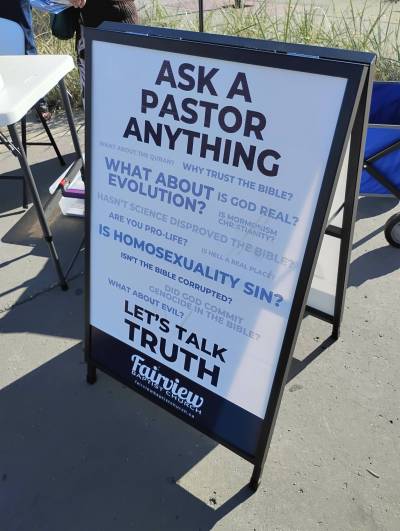
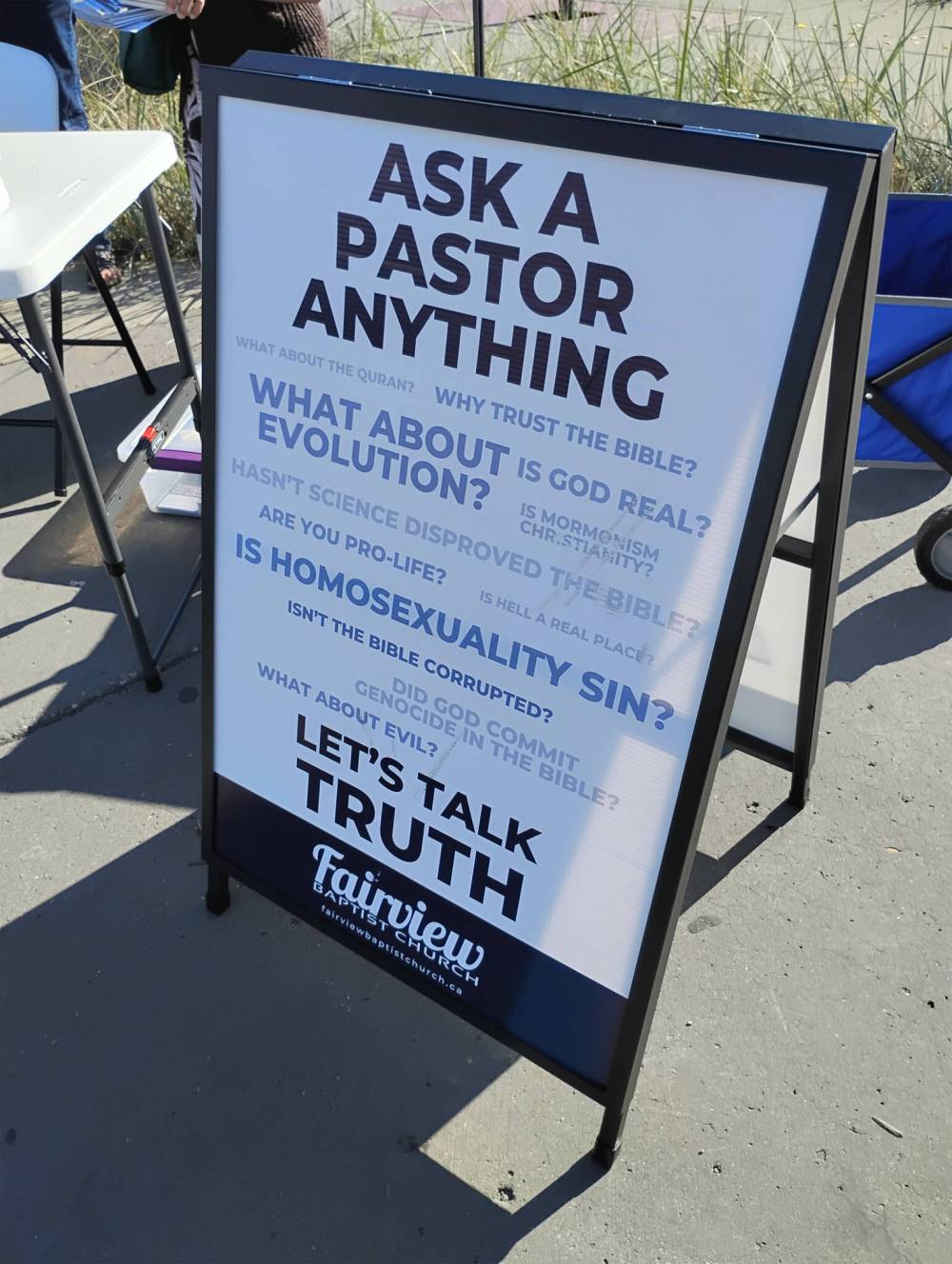
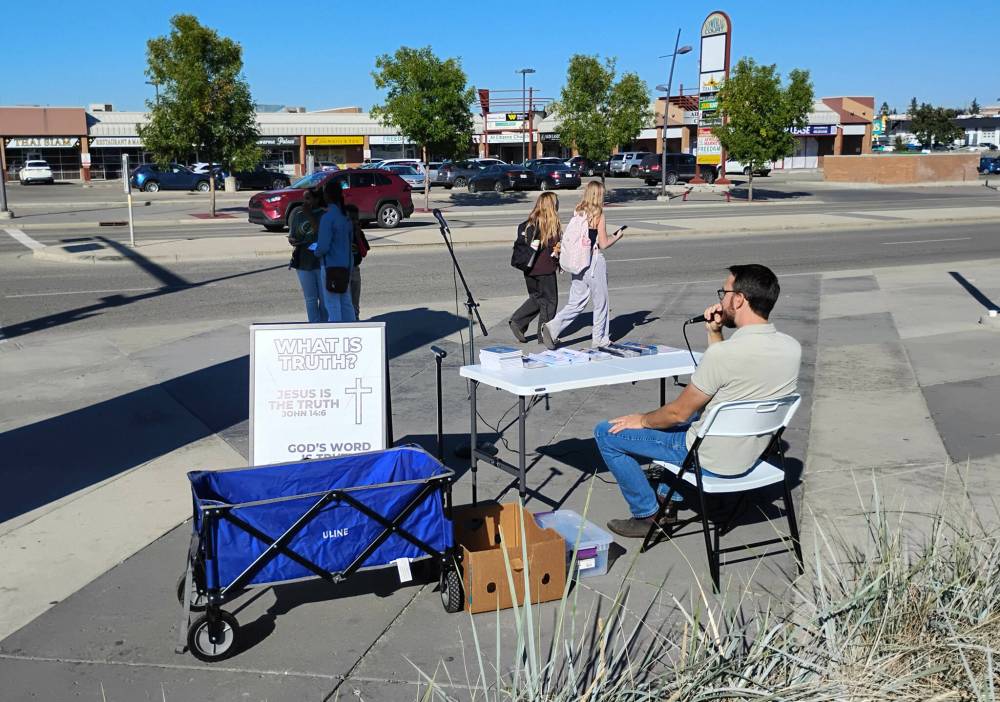
Two days after having coffee with Pentland, I met Rory St. John on a street corner not far from the Chinook light rail station. He was handing out Ziploc bags of granola bars and Gatorade. Next to him was a folding table stacked with tracts that warned of the civilizational threats posed by medical assistance in dying, Islam and “transgenderism.”
A young man with a trim beard and a warm handshake, St. John is a pastoral assistant at Fairview Baptist Church. Earlier this year, his church hosted a public lecture titled “A Christian Perspective on Alberta Independence” at which pastor Tim Stephens likened Canada to a cow being fed by Alberta farmers and milked by bureaucrats in Ottawa.
Stephens said the call for independence represented the “groaning of a people to live in a Christian society with Christian principles.” He outlined four “bedrock biblical values” that pertained to Alberta separatism: liberty, justice, vocation and belonging.
The liberty found in the Bible, Stephens said, is based on personal responsibility, personal rights, property rights, a limited government and a local government. And biblical justice isn’t “socialist or Marxist justice in which you take from those who have and give to those who have not,” but the kind of justice where everyone gets to keep what they earn.
I phoned Stephens and asked him how he reckoned with Jesus’s frequent commands to rich people to sell what they have and give the money to the poor, or the story Jesus told about labourers who start work at different times of day but all receive the same wage. Stephens said those teachings were about voluntary acts of charity, which he supported.
St. John wasn’t on the street corner to talk to people about separatism; his main priority was getting “the good news about Jesus to people so that they might be saved.” But he did have a few minutes to share his thoughts on the referendum.
He believed his resource-rich province would be better off if Albertans didn’t contribute to federal equalization payments and were free from “federal restrictions on oil and gas.”
Even more pressing was his belief Alberta has historically been more Christian and more conservative than the rest of Canada.
“Having Alberta as a separate nation would give us more freedom to talk about things like MAID and abortion and transgenderism and build a more Christian-influenced society,” he said.
LEAH HENNEL PHOTO
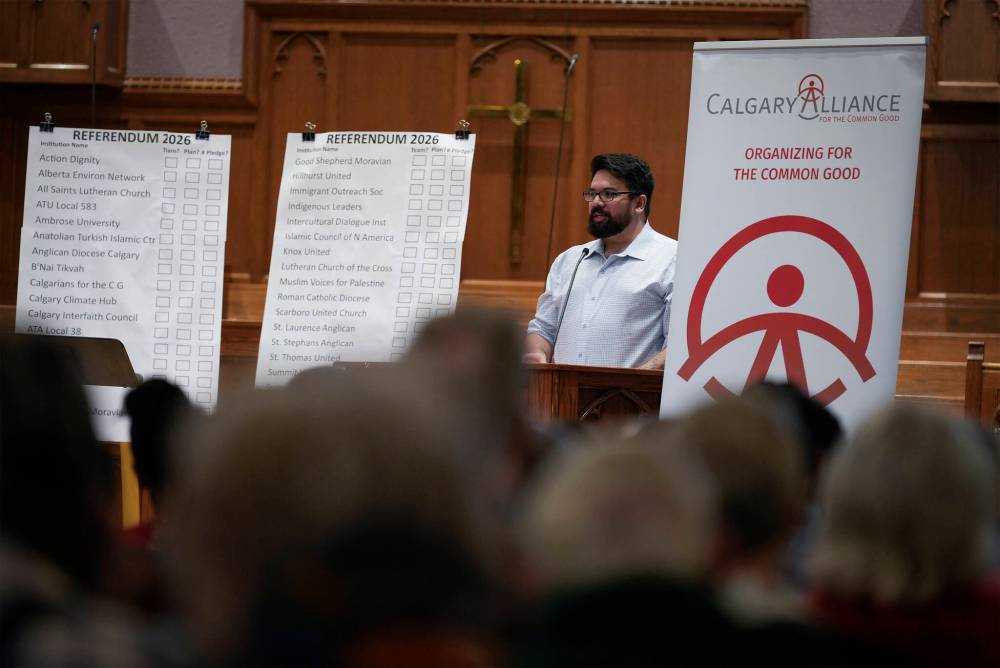
Chris Mah Poy says the referendum questions treat many Albertans as second-class citizens.
According to a 2022 Ipsos poll, Albertans, on average, support a woman’s right to access abortion services at a rate slightly higher than the rest of Canada.
St. John acknowledged the Bible urges people to welcome the stranger and the foreigner, but he felt former prime minister Justin Trudeau’s immigration policy had given “too much incentive for people piling into the country.”
“(The Apostle) Paul says if you’re not going to work, you shouldn’t eat,” he said. “I don’t think Christianity necessitates free handouts to everybody.”
“You’re giving away granola bars and Gatorade to people who aren’t working,” I pointed out.
St. John chuckled. “Well, we want to be kind to them and get them on the right track, and most of all share the gospel with them. There’s a gospel tract in there. That’s our main mission.”
● ● ●
On a warm Wednesday evening in September, about 200 people crowded into the wooden pews of Scarboro United Church. They were from Unitarian, Lutheran, Anglican and United churches as well as synagogues, non-profit organizations, unions and immigration support groups. All of them were there to figure out how they could defeat the separatist agenda.
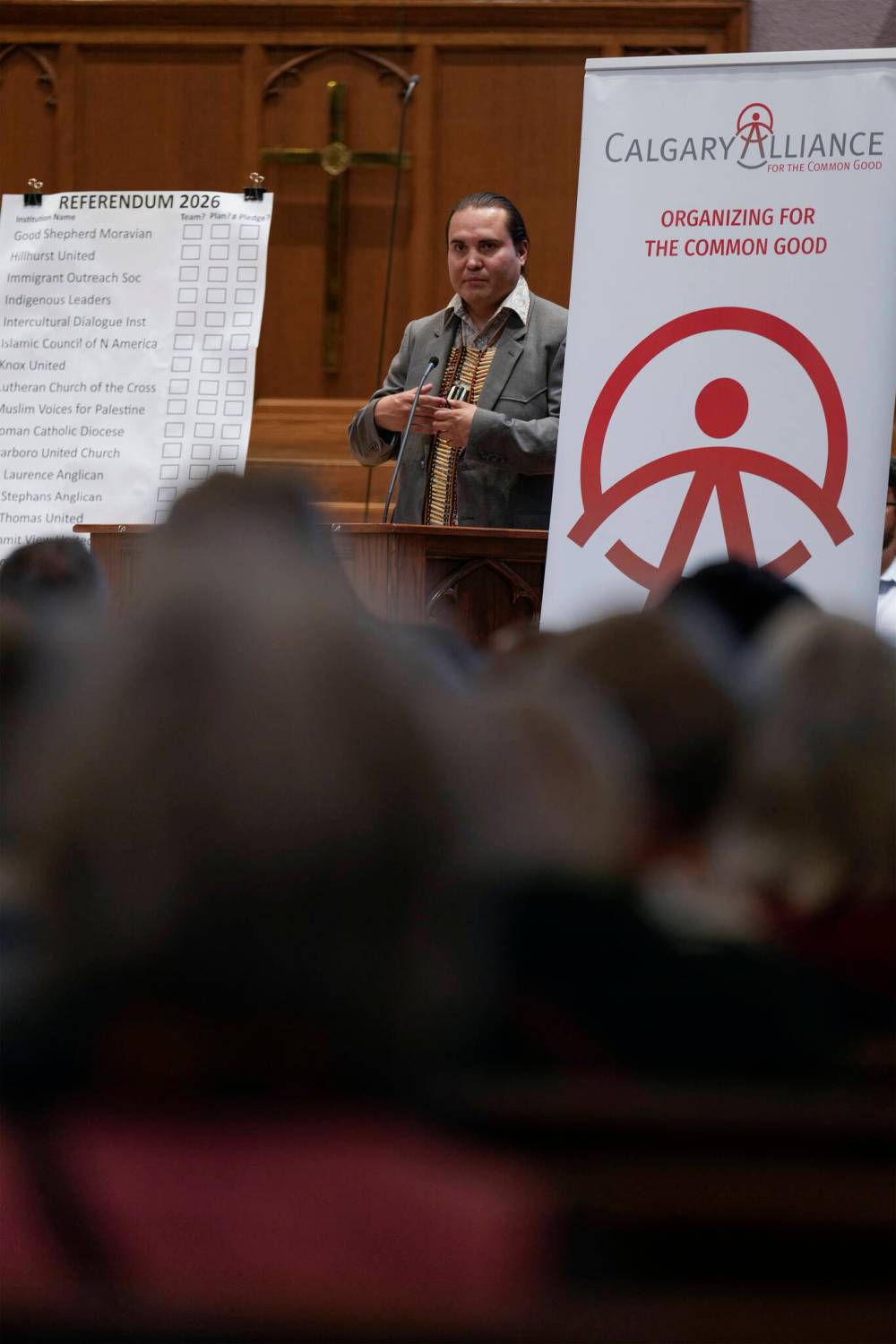
Darren Weaselchild, a member of Siksika Nation Blackfoot Confederacy, reminded the room that First Nations Treaty relationships are with the Crown, not the Alberta government.
“Treaty 7 represents a promise to work together, a promise to live together, a promise to build a future together,” he said.
An Alberta court has ruled that separation would violate Treaty rights.
Then a man in a trim blazer, his hair ruffled as though he’d been anxiously running his fingers through it all evening, stepped up to the pulpit and set the stakes.
Ryan Andersen is lead organizer with Calgary Alliance for the Common Good, a coalition of progressive faith groups, unions and non-profits. The alliance has enough clout that former Calgary mayor Naheed Nenshi once flew back from a meeting with the prime minister to respond to a group of them who were protesting an austere budget at city hall.
“So far we’ve been focusing on educating about the issues. It’s time to switch to educating people about voting,” Andersen said.
LEAH HENNEL PHOTO
Darren Weaslechild told gathering Treaty 7 represents a promise to live together.
“It’s expected that about 80 per cent of separatists will vote. In a typical referendum about 30 per cent of people vote. So, if 80 per cent of separatists vote and 30 per cent of the rest of us vote, guess who wins? The separatists.”
Everyone in the room needed to claim their turf, form a team and make a plan for getting people to polls, Andersen said.
“This is hard work. You don’t want to do it on your own.”
A warm hubbub filled the room as clusters of people put their heads together among the pews. Eventually a representative from each group stepped up to the microphone to announce how many people they calculated they could get to the voting booth.

Two ministers tallied the numbers on flip charts. “We’ve done the math!” Erin Klassen, a minister at Scarboro United Church, finally announced. People in the room had pledged to bring between 16,000 and 20,000 people to the polls. The audience was jubilant.
Half an hour later, Chris Mah Poy exited the church into the autumn night. He was getting ready to take a couple of weeks of much needed vacation before the final push to referendum day.
“Often we say we hope for an outcome,” he said. “Hope is not a strategy. We’re moving people from passive hope to: ‘We have a plan.’”
This story was produced in conjunction with Broadview, as part of a joint Religion in the News partnership covering issues of faith in Manitoba and nationally.
josiah.neufeld@winnipegfreepress.com
The Free Press is committed to covering faith in Manitoba through our Religion in the News project. This reporting continues because readers like you step forward to fund it.
Donate now to support our reporting on religion.
Your donation is eligible for a charitable tax receipt.
BECOME A FAITH JOURNALISM SUPPORTER
The Free Press acknowledges the financial support it receives from members of the city’s faith community, which makes our coverage of religion possible.