Lemieux’s sportsmanship story from 1988 Seoul Games featured in new Olympic book

Advertisement

Advertise with us

Somewhat lost in the shuffle of the 1988 Seoul Olympics — a Games forever remembered for the Ben Johnson saga — was a competition that featured sportsmanship of the highest order.

Read this article for free:


By clicking the button above, an account will be created and you will begin to receive some of our recommended newsletters. You may opt out of any newsletter by visiting your Email and Communication Preferences page or by clicking "unsubscribe" at the bottom of any email.

or

Already have an account? Log in here »

To continue reading, please subscribe:

Digital Subscription

One year of digital access for only $1.44 a week*

  • Enjoy unlimited reading on winnipegfreepress.com
  • Read the E-Edition, our digital replica newspaper
  • Access News Break, our award-winning app
  • Play interactive puzzles

*Billed as $5.77 plus GST every four weeks. After 52 weeks, price increases to the regular rate of $19.95 plus GST every four weeks. Offer available to new and qualified returning subscribers only. Cancel any time.

To continue reading, please subscribe:

Add Free Press access to your Brandon Sun subscription for only an additional

$1 for the first 4 weeks*

  • Enjoy unlimited reading on winnipegfreepress.com
  • Read the E-Edition, our digital replica newspaper
  • Access News Break, our award-winning app
  • Play interactive puzzles
Start now

*Your next Brandon Sun subscription payment will increase by $1.00 and you will be charged $17.95 plus GST for four weeks. After four weeks, your payment will increase to $24.95 plus GST every four weeks.

Hey there, time traveller!
This article was published 21/07/2021 (1928 days ago), so information in it may no longer be current.

Somewhat lost in the shuffle of the 1988 Seoul Olympics — a Games forever remembered for the Ben Johnson saga — was a competition that featured sportsmanship of the highest order.

Canadian sailor Lawrence Lemieux stopped racing to save a sailor who was struggling in the water after his boat capsized. While he missed the podium, Lemieux was awarded the prestigious Pierre de Coubertin medal for exhibiting true sportsmanship in an Olympic event.

The saga of “The Gentlemanly Olympian” is one of many interesting anecdotes featured in the book “Total Olympics: Every Obscure, Hilarious, Dramatic and Inspiring Tale Worth Knowing,” by sports writer Jeremy Fuchs.
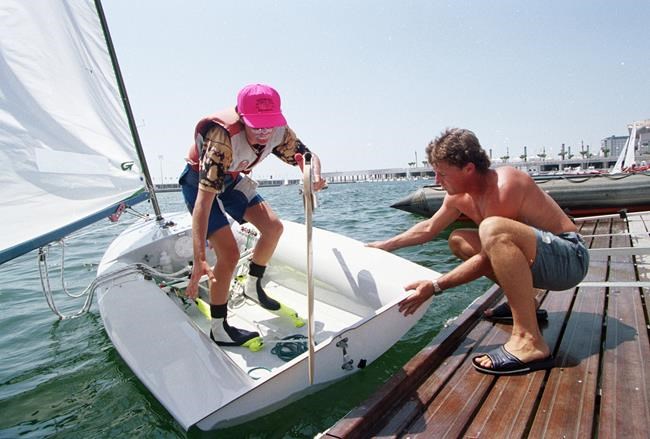
Lawrence Lemieux, from Edmonton, helps launch Paula Lewin in her 470 class sailboat at the 1992 Barcelona Summer Olympics on Sunday, July 19, 1992. Lemieux gave up his chance at an Olympic medal in Seoul when he dived out of his boat to help a capsized competitor. THE CANADIAN PRESS/Dave Buston

Johnson generated worldwide headlines by edging archrival Carl Lewis in the men’s 100-metre final but later failing a drug test. The sordid doping tale was contrasted by Lemieux’s actions on a windy September day near the port city of Busan.

Lemieux competed in the one-man Finn class event on a course that was shared with two other races. Halfway through his heat, he spotted two Singapore sailors who were struggling in rough waters.

One sailor made it back to the dinghy’s hull, but the other athlete was bobbing in waves while fighting the current. Lemieux manoeuvered his boat to the sailor and pulled him in before waiting for a patrol boat to arrive.

Lemieux was in second place in his heat at the time. He rejoined the race but would settle for 22nd place, eventually finishing 11th in the overall standings.

“He didn’t win a medal — gold, silver or bronze — but he got something else that I think was just as valuable,” Fuchs said. “And he arguably saved this guy’s life.”

Lemieux’s story is one of many intriguing anecdotes packed into the 322-page volume. Fuchs delved back into the late 1800s with his research, digging into old newspapers, files and scholarly reports on the Games.

The craziest story on his list dates back to 1912, he said: Japan’s Shizo Kanakuri was in a field of 68 marathoners, half of whom were suffering from extreme overheating (hyperthermia) during the race.

Kanakuri decided to stop racing after noticing some people enjoying some juice by a garden in a village outside Stockholm. The parched runner ended up mingling with them for about an hour, Fuchs writes, before leaving Sweden the next day on the first boat back to Japan.

Officials in his home country were embarrassed by his failure to finish the race. Communication, much like athletic event organization in those early Olympic days, was lacking.

The Swedes didn’t know where Kanakuri was and placed him on the missing persons list. He remained there for 50 years, despite competing at the next two Summer Games.

The Swedish Olympic Committee eventually tracked him down in 1967. Kanakuri accepted an invite to return to Sweden for an anniversary celebration of the Stockholm Games and even finished the race as part of a fundraising effort.

That gave him a time of 54 years, eight months, six days, five hours, 32 minutes and 20.3 seconds.

“Everything from the biggest stars to people who finished in last place in the most embarrassing ways, it’s all there,” Fuchs said of the book. “Obviously you can’t do the entire Olympics, there’s just too much.

“So I just tried to focus on some of the coolest and most interesting (stories) and the sort of things that make you go, ‘Huh? I didn’t know that happened.'”

The did-you-know factor is prominent throughout.

For example, winners at the ancient Olympics were awarded money instead of medals. The famous Olympic rings made their debut at the 1920 Games in Antwerp.

A traditional podium was used for the first time at the 1932 Lake Placid Games after then-IOC president Henri de Baillet-Latour liked its use at the 1930 British Empire Games in Hamilton, Ont.

Discontinued sports — a trivia lover’s delight — also get some love, with details on club swinging (1904, ’32), tandem bicycle (1908, ’20-72), pigeon shooting (1900) and tug of war (1900-20).

Remember the Canadian Bruce-Li badminton team from the 2012 London Olympics?

Michelle Li and Alex Bruce made an unlikely run to the medal round after eight players from China, South Korea and Indonesia were expelled for dropping their matches on purpose to get a more favourable opponent in the knockout round.

“The Olympics are supposed to be about fair play, sportsmanship and these higher ideals,” Fuchs said. “This was pretty much the complete opposite of that. A black mark on a sport that is not the most popular and it’s just a weird way for it to get more attention.”

The financial overruns that plagued the Montreal Games in 1976 also made the cut in the “Wild and Strange” chapter. Fuchs notes the city set an Olympic record at the time by going a whopping 720 per cent over budget.

“Olympics cost a lot, they go over-budget, things go wrong,” Fuchs said in a recent interview. “But this one was just so in a different stratosphere.”

Olympic icons like Michael Phelps, Ian Thorpe, Usain Bolt and Jesse Owens are featured along with memorable games like the infamous “Blood in the Water” Soviet Union-Hungary water polo match in 1956.

“This is about as complete as you can get without making it into an encyclopedia,” Fuchs said.

“Total Olympics: Every Obscure, Hilarious, Dramatic, and Inspiring Tale Worth Knowing,” by Workman Publishing is available now at a retail price of US$22.95.

This report by The Canadian Press was first published July 21, 2021.

Follow @GregoryStrongCP on Twitter.

Report Error Submit a Tip

More Stories

Actor-director Cooper takes new approach to familiar tale

Randall King 4 minute read Preview

Actor-director Cooper takes new approach to familiar tale

Randall King 4 minute read Thursday, Oct. 4, 2018

TORONTO — In his self-directed version of A Star Is Born, Bradley Cooper plays a rock star named Jackson Maine.

Note the name: it marks the character as a member of a cinematic lineage that descends all the way to 1937.

That year, the first A Star Is Born was made, with Frederick March in the role of alcoholic actor Norman Maine. The name stayed in 1954, when James Mason took over the role of an actor who first nurtures the career of Judy Garland’s up-and-coming star Vicki Lester before his drunken shenanigans threaten to derail it. By 1976, Kris Kristofferson played the role of musician John Norman Howard, a rock singer with a musical stake in the ascent of Barbra Streisand’s Esther Hoffman.

Cooper, 43, remembered the Maine name, but also brought his own vision as a first-time feature filmmaker to the new version, which opens Thursday, Oct. 4, opposite Lady Gaga after the originally designated director, Clint Eastwood, dropped out. While actors might not want to see different interpretations of a role, Cooper embraced the opportunity to see all the past iterations.

Read
Thursday, Oct. 4, 2018

Ottawa announces $500 million for North End sewage plant upgrade

Joyanne Pursaga 4 minute read Preview

Ottawa announces $500 million for North End sewage plant upgrade

Joyanne Pursaga 4 minute read 5:03 PM CDT

The federal government will provide $500 million to help complete the major upgrade to Winnipeg’s North End sewage treatment plant.

Winnipeg South MP Terry Duguid confirmed the total funding at a news conference at the plant Friday, calling the work critical to Winnipeg’s future.

“The stakes could not be higher. Without expanded wastewater treatment, Winnipeg would run out of capacity to build new homes and accommodate new industries within six years,” said Duguid.

The commitment offers the final funding needed to cover the $1.57-billion third and final phase of the upgrade. The city and province will also pay $500 million each for the work.

Read
5:03 PM CDT

Opera singer David Daniels no longer in singers’ union following sexual assault guilty plea

The Associated Press 2 minute read Preview

Opera singer David Daniels no longer in singers’ union following sexual assault guilty plea

The Associated Press 2 minute read Thursday, Dec. 21, 2023

NEW YORK (AP) — Countertenor David Daniels is no longer a member of the union for singers following his guilty plea to a charge of sexual assault.

The 57-year-old and his husband, Scott Walters, pleaded guilty to sexual assault of an adult, a second-degree felony, in Houston's Harris County District Court on Aug. 4. Their accuser was aspiring opera singer Sam Schultz.

They both were sentenced to eight years’ probation and required to register as sex offenders.

American Guild of Musical Artists spokesperson Alicia Cook said Wednesday that Daniels is no longer a member of the union.

Read
Thursday, Dec. 21, 2023

Trump touts USMCA win in state of the union

James McCarten, The Canadian Press 6 minute read Preview

Trump touts USMCA win in state of the union

James McCarten, The Canadian Press 6 minute read Tuesday, Feb. 4, 2020

WASHINGTON - President Donald Trump declared his scorched-earth political style an unmitigated success Tuesday in a fiercely partisan, made-for-TV state of the union speech that made it clear he expects to be back in the White House next year on the strength of the U.S. economy and his trade deals with Canada, Mexico and China.

Trump, addressing a joint session of Congress in the very chamber where House Democrats voted to impeach him less than two months ago, became only the second president in American history — Bill Clinton was the first — to deliver a state of the union while standing trial in the Senate.

Unrepentant, he pointedly refused to shake the offered hand of House Speaker Nancy Pelosi on the dais before singing the praises of what he billed as "the great American comeback," pointing to strong job growth, a soaring stock market and low unemployment as evidence of his leadership. And when he was done, Pelosi ripped up the speech in full view of the television cameras.

"America's enemies are on the run, America's fortunes are on the rise, and America's future is blazing bright. The years of economic decay are over," Trump declared, taking full credit for the country's "roaring economy," including what he billed as seven million new jobs and the lowest jobless rate in half a century — a "blue-collar boom" that he's counting on to help his re-election chances in November.

Read
Tuesday, Feb. 4, 2020

City rec facilities crumbling

Ryan Thorpe 6 minute read Preview

City rec facilities crumbling

Ryan Thorpe 6 minute read Monday, Oct. 22, 2018

Throughout Winnipeg, decades-old community assets — pools, arenas and recreation and leisure centres — are deteriorating so quickly that service disruptions are inevitable.

Meanwhile, the city’s community services department, which is responsible for managing those assets, operates with an annual deficit of roughly $80 million, meaning there are scant resources to do little more than bail water on a sinking ship.

Soon, Winnipeggers will have a choice: fewer community services or higher costs.

“It poses a huge challenge because we have very limited dollars that we have to invest in our existing facilities. We also have growing demands for new amenities in new areas. We have to be very strategic,” said Ken McKim, manager of asset management for the department.

Read
Monday, Oct. 22, 2018

A timeline of the WE Charity controversy

The Canadian Press 9 minute read Wednesday, Aug. 19, 2020

OTTAWA - A timeline of events regarding the Canada Student Service Grant program, based on public documents, events and statements from cabinet ministers, government officials, and WE Charity:

March 6, 2020: WE Charity staff prepare a concept paper on service learning for public servants at Employment and Social Development Canada.

April 5: Finance Minister Bill Morneau and Prime Minister Justin Trudeau talk over the phone about how to help students whose summer job and volunteer opportunities were vanishing due to the COVID-19 pandemic. Finance Department officials are tasked with considering options the next morning.

April 7: Small Business Minister Mary Ng and WE co-founder Craig Kielburger have an introductory phone call in which Ng asks WE to send what it calls a ``pre-established proposal'' to help young people launch businesses.