Split over AstraZeneca vaccine sparks questions on who will get it as variants spread
Advertisement
Read this article for free:
or
Already have an account? Log in here »
To continue reading, please subscribe:

Digital Subscription
One year of digital access for only $205*
- Enjoy unlimited reading on winnipegfreepress.com
- Read the E-Edition, our digital replica newspaper
- Access News Break, our award-winning app
- Play interactive puzzles
*First annual payment billed as $205.00 + GST for one year. This annual subscription will automatically renew at $233.00 + GST every 52 weeks (10% off the regular annual price of $259.35). Offer available to new and qualified returning subscribers only. Cancel any time.
To continue reading, please subscribe:
Add Free Press access to your Brandon Sun subscription for only an additional
$1 for the first 4 weeks*
- Enjoy unlimited reading on winnipegfreepress.com
- Read the E-Edition, our digital replica newspaper
- Access News Break, our award-winning app
- Play interactive puzzles
*Your next Brandon Sun subscription payment will increase by $1.00 and you will be charged $17.95 plus GST for four weeks. After four weeks, your payment will increase to $24.95 plus GST every four weeks.
Read unlimited articles for free today:
or
Already have an account? Log in here »
Hey there, time traveller!
This article was published 02/03/2021 (2038 days ago), so information in it may no longer be current.
OTTAWA – Canada’s chief public health officer says new COVID-19 cases are starting to tick back up after a month-longdecline, giving urgency to the question of who should receive doses of the newly approved Oxford-AstraZeneca vaccine due to arrive in Canada Wednesday.
The “moderate increase” at the national level noted by Dr. Theresa Tam is in keeping with models forecasting a spike in cases over the next two months unless stricter public health measures are imposed to combat more contagious strains of the virus.
“The concern is that we will soon see an impact on hospitalization, critical care and mortality trends,” Tam said Tuesday.

Canada saw 2,933 new cases on average over the past week, a figure similar to last Friday’s numbers that revealed week-over-week increases of between eight and 14 per cent in Ontario, Alberta and British Columbia.
The uptickcomes as provinces figure out how to allocate their various vaccines, especially as Canada receives 500,000 doses of the Oxford-AstraZeneca vaccine produced at the Serum Institute of India. About 445,000 doses of the Pfizer-BioNTech vaccine are also arriving this week, said Procurement Minister Anita Anand.
Guidance on the Oxford-AstraZeneca vaccine has caused some confusion. Health Canada authorized its use last week for all adults but the National Advisory Committee on Immunization recommends it not be administered to people 65 and over.
The advisory committee cites concern over limited data from clinical trials for older patients. Health Canada also acknowledges that issue. But the advisory panel, which recommends how vaccines should be used, says the limitation means seniors should take priority for the two greenlighted mRNA vaccines — Pfizer-BioNTech and Moderna — where dearth of data is not an issue.
Alberta’s health minister said Monday the province will not give Oxford-AstraZeneca’s vaccine to anyone over 65. British Columbia, Saskatchewan, Ontario and Prince Edward Island are on similar courses,though details on who will get those jabs is not always clear.
“With clinical testing of AstraZeneca limited to those under 65, we will need to adjust our plan to look at a parallel track for some of these more flexible vaccines in order to cast the widest net possible,” the B.C. health ministry said in an email.
Provincial health officer Dr. Bonnie Henry said B.C. will use the Oxford-AstraZeneca vaccine to target younger people who have more social interactions and who would have to wait much longer for the other vaccines.
Ontario Health Minister Christine Elliott characterized Oxford-AstraZeneca as “very versatile ” because it lacks the same cold-storage requirements as the two other vaccines in use in Canada. It won’t go to seniors, but she said shots might be administered in correctional facilities for that reason.
P.E.I. will target AstraZeneca at “healthy younger individuals who are working in certain front-line, essential services,” said Dr. Heather Morrison, the province’s chief medical officer of health.
Health officials in Quebec and New Brunswick say they await further advice from health authorities and are taking time to examine how to deploy the latest vaccine.
Nova Scotia’s chief medical health officer Dr. Robert Strang said the province has yet to give an answer to Ottawa “about whether we actually want to take the vaccine.” All provinces must provide a response by midday Thursday, he said.
Two experts say essential workers who are more likely to contract and transmit COVID-19 should be prioritized for immunization with the Oxford-AstraZeneca doses.
Caroline Colijn, a COVID-19 modeller and mathematician at Simon Fraser University, and Horacio Bach, an adjunct professor in the division of infectious diseases at the University of British Columbia, also say the Oxford-AstraZeneca vaccine could be better promoted by provincial health officials as a strong alternative to the Pfizer-BioNTech and Moderna vaccines.
Oxford-AstraZeneca reported their vaccine is about 62 per cent effective at preventing COVID-19 while Pifzer-BioNTech and Moderna have said the efficacy of their vaccines is about 95 per cent.
But Colijn and Bach say the fact there have been no hospitalizations from severe illness and no deaths among those receiving the Oxford-AstraZeneca vaccine needs to be underscored because people awaiting immunization seem to be fixated on the higher efficacy data for the first two vaccines approved in Canada.
“If the AstraZeneca vaccine will prevent you from getting really sick that’s still a win for you,” Colijn said.
“If the AstraZeneca vaccine will prevent you from getting really sick that’s still a win for you.”–Caroline Colijn
“I see this huge, huge benefit of vaccinating young people, particularly people with high contact, essential workers, sooner.”
No province has been spared from the increase in new variants circulating across the country, though several continue to ease anti-pandemic restrictions.
Modelling from the Public Health Agency of Canada projecteda steep surge in new cases starting late last month — and reaching 20,000 new cases a day before May — if public health measures weren’t tightened. Since that Feb. 19 forecast, restrictions in many regions have loosened as Canadians return to restaurants, cinemas and hair salons.
But Tam said Canada is gaining ground on “the vaccine-versus-variants leg of this marathon” every day.
“Canada is prepared, and Canada remains on track,” she said.
Provinces have now reported 1,257 cases of the B.1.1.7 mutation that was first identified in the United Kingdom, 99 cases of the B. 1.3.5.1 strain first identified in South Africa, and three of the P. 1 variant first identified in Brazil.
There have been 870,033 cases of COVID-19 in Canada and 22,017 deaths as of Monday night.
There were 30,430 active cases across Canada, with an average of 42 deaths reported daily over the past week.

Provinces are also figuring out whether to stick to the original injection schedules or extend the interval between doses beyond three or four weeks. The national advisory committee is expected to update its recommendations this week.
Ontario is waiting for that guidance, while B.C. is pushing ahead with its plan to prolong the interval to four months.
Dr. Bonnie Henry, B.C.’s provincial health officer, said Monday the decision was based on local and international evidence that shows the first dose of the Pfizer-BioNTech and Moderna vaccines provides “miraculous” 90 per cent protection from the virus.
This report by The Canadian Press was first published March 2, 2021.
— With files from Camille Bains, Kevin Bissett, Laura Dhillon Kane and Holly McKenzie-Sutter.
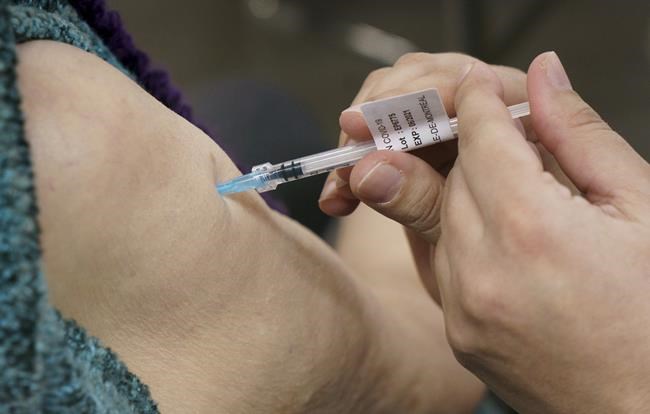
A look at the Oxford-AstraZeneca vaccine confusion
Posted:
Here’s a closer look at some of the questions raised by Canada's newest COVID-19 vaccine.
Related Articles
Province to delay second doses in bid to immunize more eligible Manitobans sooner









Advertisement Advertise With Us
Advertisement Advertise With Us
History
Updated on Wednesday, March 3, 2021 7:48 AM CST: re-attaches image