Nova Scotia re-examining conservative approach to vaccinations as supply increases

Advertisement

Advertise with us

HALIFAX - Nova Scotia will re-examine its methodical approach to COVID-19 vaccinations as supply increases and medical advice changes, chief medical officer of health Dr. Robert Strang said Tuesday.

Read this article for free:


By clicking the button above, an account will be created and you will begin to receive some of our recommended newsletters. You may opt out of any newsletter by visiting your Email and Communication Preferences page or by clicking "unsubscribe" at the bottom of any email.

or

Already have an account? Log in here »

To continue reading, please subscribe:

Digital Subscription

One year of digital access for only $1.44 a week*

  • Enjoy unlimited reading on winnipegfreepress.com
  • Read the E-Edition, our digital replica newspaper
  • Access News Break, our award-winning app
  • Play interactive puzzles

*Billed as $5.77 plus GST every four weeks. After 52 weeks, price increases to the regular rate of $19.95 plus GST every four weeks. Offer available to new and qualified returning subscribers only. Cancel any time.

To continue reading, please subscribe:

Add Free Press access to your Brandon Sun subscription for only an additional

$1 for the first 4 weeks*

  • Enjoy unlimited reading on winnipegfreepress.com
  • Read the E-Edition, our digital replica newspaper
  • Access News Break, our award-winning app
  • Play interactive puzzles
Start now

*Your next Brandon Sun subscription payment will increase by $1.00 and you will be charged $17.95 plus GST for four weeks. After four weeks, your payment will increase to $24.95 plus GST every four weeks.

Hey there, time traveller!
This article was published 02/03/2021 (2070 days ago), so information in it may no longer be current.

HALIFAX – Nova Scotia will re-examine its methodical approach to COVID-19 vaccinations as supply increases and medical advice changes, chief medical officer of health Dr. Robert Strang said Tuesday.

The province has so far received 61,980 doses of vaccine and as of Monday, had administered 33,471 doses — 20,580 first doses and 12,891 booster shots.

Health officials have been holding back roughly half the shipments to be used as booster shots — a policy that follows recommendations by vaccine makers but also in large part made possible by Nova Scotia’s low case numbers. Quebec, by contrast, has decided to vaccinate as many people as possible with one shot because it reports hundreds of new infections every day.
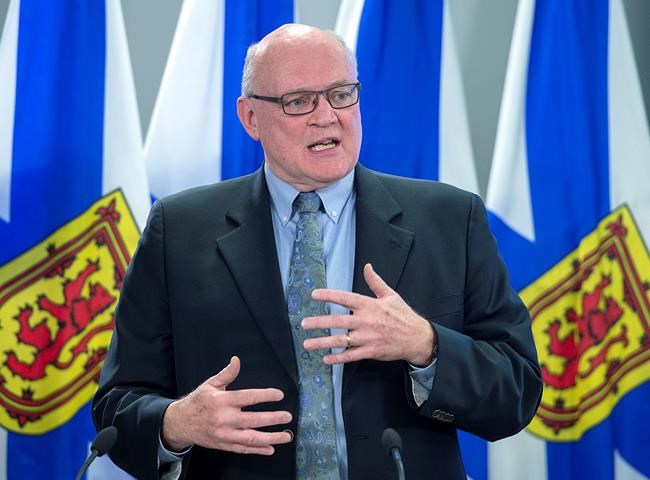
Dr. Robert Strang, chief medical officer of health, provides an update on health system preparations in Nova Scotia for the coronavirus that causes COVID-19, in Halifax on March 6, 2020. THE CANADIAN PRESS/Andrew Vaughan

But Strang told reporters the province’s approach could change pending new national recommendations on the interval between shots, which is expected Wednesday. Pfizer has said the second dose of its vaccine should be given within 21 days, while Moderna has set the date for the second shot at 28 days. Ottawa’s National Advisory Committee on Immunization, however, has said the second dose of both vaccines can wait up to 42 days.

“What we are expecting is a significant increase in the time frame between first dose and second dose,” Strang said. “What that means is that we can move away from our current process … and we will be able to focus all our vaccine on first doses.”

Doing so, he said, would double the number of people the province could vaccinate, something he described as “quite a game changer for us” as the government works toward its goal of vaccinating 70 per cent of the population by September.

British Columbia said Monday it would extend to four months the time between first and second doses of vaccine. Ontario has also said it was considering following suit.

Strang said his province has been offered an initial shipment of 13,000 doses of the newly approved Oxford-AstraZeneca vaccine, which has been recommended for use on people between 18 and 64 years old. “These will expire in a month’s time and therefore we would need to have a plan to use them immediately,” he said. “We are actively looking at what is the best use of this AstraZeneca vaccine for Nova Scotia.”

The province said it expected 56,160 doses of the Pfizer-BioNTech vaccine and 30,500 doses of the Moderna vaccine this month, for a total of 86,660 doses. A total of about one million doses of vaccine is expected to arrive from April through June.

Health officials also said that vaccination rollout plans for this month include the province’s first pharmacy clinics and an expansion of shots to community health-care workers.

Four prototype pharmacy clinics will launch in Halifax and Shelburne on March 9, Port Hawkesbury on March 16 and Springhill on March 23. People aged 80 years and over who were eligible to receive the vaccine through one of the first clinics will receive an invitation to get their shot from their pharmacy.

The vaccination program is also expanding to include anyone who works in a hospital and may come into contact with patients, as well as health-care providers in the community, such as doctors, nurses and continuing-care assistants.

Meanwhile, Nova Scotia reported one new case of COVID-19 on Tuesday and seven cases of virus mutations resulting from previously reported cases. The variant cases included two that are the B.1.1.7 variant, first detected in the United Kingdom, and five that are the 501.V2 mutation, originally identified in South Africa.

Nova Scotia has reported a total of eight cases of the B.1.1.7 variant and six cases of the South African mutation. “At this point, there is no indication that we have community spread from either of these clusters of variant cases,” Strang said.

Nova Scotia has a total of 29 active reported infections.

This report by The Canadian Press was first published March 2, 2021.

Report Error Submit a Tip

More Stories

Has the political wind changed?

Gwynne Dyer 5 minute read Yesterday at 2:01 AM CDT

It has been quite a week. First we had “Lula” – Luiz Inácio da Silva (as nobody but his mother ever called him) – defying everybody’s expectations. After winding up two million votes behind his challenger, Flávio Bolsonaro, in the first round of the Brazilian presidential election, he made a “miraculous” comeback in the second.

It was like a man going into a revolving door behind you and coming out in front. At the end of the first round, Lula was two million votes behind; at the end of the second round on Oct. 25 he was four million votes ahead. So how did he win a fourth term without cheating?

That’s what Bolsonaro claims he did, having fled to the United States; Trump, Flávio’s mentor, hints at the same. But Lula’s victory was not miraculous. He only learned to read when he was 10, and at 80 he still refused to have a mobile phone. His team finally made him get one and use it.

He wouldn’t do social media videos, so they created a WhatsApp channel called Lula’s Army, and made him appear on it at least daily. The channel went from zero to 10.8 million viewers in two weeks, and Lula won.

Letters, Oct. 31

6 minute read Yesterday at 2:01 AM CDT

Civic election a missed opportunity

The outcome of the latest municipal election in Winnipeg is nothing short of baffling. The decline of what was once a proud, beautiful prairie hub is impossible to ignore.

Winnipeg is rapidly sliding into a state of structural and social dilapidation, yet voters have inexplicably chosen to hand incumbent Mayor Scott Gillingham a second term. The decision smells of complacency, and sadly, it represents a massive missed opportunity for real urban renewal.

Walking through downtown Winnipeg today is an exercise in heartbreak. A city centre that should be a bustling economic and cultural core has instead transformed into an absolute eyesore. Encampments and tents are permitted to dot the heart of the city. Streets that used to thrive are now dominated by the tragic, visible reality of severe addiction, with individuals wandering and staggering through public spaces without adequate intervention or care.

Ottawa announces $500 million for North End sewage plant upgrade

Joyanne Pursaga 4 minute read Preview

Ottawa announces $500 million for North End sewage plant upgrade

Joyanne Pursaga 4 minute read Friday, Oct. 30, 2026

The federal government will provide $500 million to help complete the major upgrade to Winnipeg’s North End sewage treatment plant.

Winnipeg South MP Terry Duguid confirmed the total funding at a news conference at the plant Friday, calling the work critical to Winnipeg’s future.

“The stakes could not be higher. Without expanded wastewater treatment, Winnipeg would run out of capacity to build new homes and accommodate new industries within six years,” said Duguid.

The commitment offers the final funding needed to cover the $1.57-billion third and final phase of the upgrade. The city and province will also pay $500 million each for the work.

Read
Friday, Oct. 30, 2026

Truckers convoy: How a TikToker, oil advocates and a Wexit organizer helped fire up the ‘Freedom Rally’ that’s heading to Ottawa

Kieran Leavitt - Edmonton Bureau,Alex McKeen - Vancouver Bureau, Toronto Star 7 minute read Preview

Truckers convoy: How a TikToker, oil advocates and a Wexit organizer helped fire up the ‘Freedom Rally’ that’s heading to Ottawa

Kieran Leavitt - Edmonton Bureau,Alex McKeen - Vancouver Bureau, Toronto Star 7 minute read Monday, Jan. 24, 2022

A GoFundMe raised more than $3 million to help the truckers with fuel, food and lodging.

Read
Monday, Jan. 24, 2022

The long and winding road

Editorial 4 minute read Preview

The long and winding road

Editorial 4 minute read Yesterday at 2:01 AM CDT

As theatre goes, it sent a strong message.

Manitoba Premier Wab Kinew, standing in front of microphones and television cameras, holding up his Indigenous status card and saying that he didn’t feel Canada should have “a race-based form of identification in this country, but that is a reality,” adding that it was time to abolish the Indian Act.

“I think it’s time to abolish the Indian Act, get rid of the Indian Act, move past the Indian Act, and it needs to be done with First Nations people and First Nations governments, of course. I think it’s long overdue that we have a relationship with Indigenous Peoples in Canada that reflects who we are as Canadians today,” he said.

The Indian Act — the name alone suggests how out-dated and out of place the law has become. Originally dating from 1876, the law was put in place to “amend and consolidate the laws respecting Indians” and gave the Minister of the Interior the responsibility to “control and management of the reserves, lands, moneys and property of Indians in Canada.”

Read
Yesterday at 2:01 AM CDT

Fact Check

1 minute read Thursday, Nov. 30, 2023

Fact Check

Having problems with the form?Contact Us Directly |