P.E.I. health officials expect to give first vaccine dose to all adults by July 1

Advertisement

Advertise with us

CHARLOTTETOWN - Health officials in Prince Edward Island say they will shift their focus to getting a first dose of COVID-19 vaccine to all adults by July 1, even if it means delaying the second shot for some.

Read this article for free:


By clicking the button above, an account will be created and you will begin to receive some of our recommended newsletters. You may opt out of any newsletter by visiting your Email and Communication Preferences page or by clicking "unsubscribe" at the bottom of any email.

or

Already have an account? Log in here »

To continue reading, please subscribe:

Digital Subscription

One year of digital access for only $1.44 a week*

  • Enjoy unlimited reading on winnipegfreepress.com
  • Read the E-Edition, our digital replica newspaper
  • Access News Break, our award-winning app
  • Play interactive puzzles

*Billed as $5.77 plus GST every four weeks. After 52 weeks, price increases to the regular rate of $19.95 plus GST every four weeks. Offer available to new and qualified returning subscribers only. Cancel any time.

To continue reading, please subscribe:

Add Free Press access to your Brandon Sun subscription for only an additional

$1 for the first 4 weeks*

  • Enjoy unlimited reading on winnipegfreepress.com
  • Read the E-Edition, our digital replica newspaper
  • Access News Break, our award-winning app
  • Play interactive puzzles
Start now

*Your next Brandon Sun subscription payment will increase by $1.00 and you will be charged $17.95 plus GST for four weeks. After four weeks, your payment will increase to $24.95 plus GST every four weeks.

Hey there, time traveller!
This article was published 02/03/2021 (2069 days ago), so information in it may no longer be current.

CHARLOTTETOWN – Health officials in Prince Edward Island say they will shift their focus to getting a first dose of COVID-19 vaccine to all adults by July 1, even if it means delaying the second shot for some.

Chief medical officer of health Dr. Heather Morrison says she’s expecting some guidance on that delay from the National Advisory Committee on Immunization.

“Given that we expect to receive 100,000 doses of vaccination in P.E.I. between the first of April and end of June, and based on this anticipated guidance, we plan to offer every Islander over the age of 16 a single dose of vaccine by the end of June,” Morrison told a news conference Tuesday.
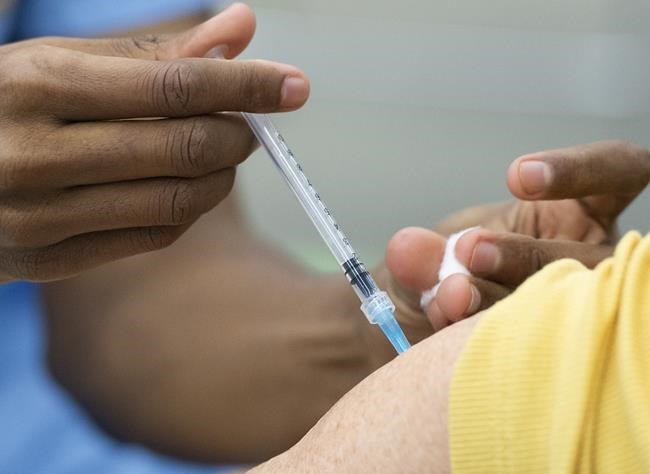
A senior receives their COVID-19 vaccination, Monday, March 1, 2021 in Montreal.  Health officials in Prince Edward Island say they expect to be able to give a first dose of the COVID-19 vaccine to all adults in the province by July 1. THE CANADIAN PRESS/Ryan Remiorz

People over the age of 80 will get a second dose based on their existing appointments. “However, going forward,” she said, “others will receive a longer time interval between their first and second doses.” She did not specify how long she expects the interval to be.

Morrison said having everyone over 16 partially vaccinated by July would bring “the finish line” into much sharper focus. She said it would result in a much better summer than last year but added that some health and border restrictions may remain in place.

As of Saturday, 12,596 doses of vaccine had been injected on the Island, and 7,377 people had received at least one dose.

Morrison reported four new cases of COVID-19 in the province Tuesday involving three men and one woman, all in their 20s.

One man is a close contact of someone who was among a recently identified cluster of cases in Charlottetown. The investigation and contact tracing is just beginning on a second man whose case is believed to be linked to travel.

The other man and woman are connected to each other, and health officials are investigating if their infections are related to cases recently reported in Summerside and Charlottetown.

There are 22 active cases on the Island, and there have been a total of 136 cases since the onset of the pandemic.

Morrison said test results from the National Microbiology Laboratory have confirmed that earlier COVID-19 cases involving two women in Charlottetown are linked to the more transmissible variant first identified in the United Kingdom.

Morrison also gave an update on enforcement by the Department of Justice and Public Safety.

She said authorities have received 587 complaints and have visited 709 homes and completed six business inspections. She said 200 warnings have been issued and 111 charges have been laid, including a $5,000 fine to a business this week.

This report by The Canadian Press was first published Mar. 2, 2021.

— By Kevin Bissett in Fredericton.

Report Error Submit a Tip

More Stories

Three in-custody fatalities trigger inquests

Free Press staff 2 minute read Preview

Three in-custody fatalities trigger inquests

Free Press staff 2 minute read Thursday, Oct. 29, 2026

The province’s chief medical examiner has called inquests into the deaths of three men, including two who died by suicide in correctional facilities earlier this year.

Craig Flett, 32, was found hanging in his cell in the Stony Mountain Institution prison on Feb. 10 this year.

Corrections officers were able to cut him down and tried to resuscitate him, but he later died of a brain injury. Flett was serving a life sentence at the time.

Sebastian Atkinson, a 25-year-old inmate at the Winnipeg Remand Centre, was found hanging in his cell by a linen sheet tied to a metal bar about five feet from the floor.

Read
Thursday, Oct. 29, 2026

Newspaper websites display fewer stories, more curation

5 minute read Tuesday, Feb. 10, 2026

A city subcommittee was provided with a routine update on the status of an ongoing administrative process Thursday, in accordance with standard reporting procedures.

The trick to attracting wee, treat-seeking ghosts and goblins on Halloween is to go all-in

Jen Zoratti 5 minute read Preview

The trick to attracting wee, treat-seeking ghosts and goblins on Halloween is to go all-in

Jen Zoratti 5 minute read Wednesday, Oct. 31, 2018

When I was a kid in the 1990s, I lived for Halloween.

My mom, a gifted seamstress, made all of my costumes. Deciding what I’d dress up as involved imagination and a trip to the fabric or craft store.

I loved flipping through the McCall’s patterns, and running my hands along the bolts of fabric that my mom would transform into Little Bo Peep, or Dorothy from the Wizard of Oz, or, one year, a Christmas tree — complete with the star on top. Old things were repurposed into new things.

Trick-or-treating was my... I don’t know, some sort of sports reference. The goal? Amass as much candy as possible. We’d troll the neighbourhood for hours, dragging snow-sodden pillow cases full of it. We’d target specific streets, lured mostly by the promise of full-sized chocolate bars.

Read
Wednesday, Oct. 31, 2018

Court ruling concludes Canadian Wheat Board saga

Laura Rance-Unger 4 minute read Preview

Court ruling concludes Canadian Wheat Board saga

Laura Rance-Unger 4 minute read 2:01 AM CDT

It remains to be seen whether the recent court ruling in a lawsuit filed after Canadian Wheat Board’s dissolution in 2012 puts the whole debate to rest, as some no doubt hope.

But either way, the dust has settled on the post-CWB world. The sun still rises and a new generation of farmers on the land only knows by name an institution that for generations influenced every aspect of Prairie grain farming.

The first Rural Revival column I wrote for this newspaper more than 30 years ago was about a thousand farmers from Western Canada demonstrating in support of the Wheat Board. It was in the aftermath of the Western Grain Marketing Panel report, one of several efforts that eventually included a plebiscite to help the federal government decide what to do about a vocal minority of farmers who wanted marketing “freedom.”

The polls at the time suggested about two-thirds of farmers were comfortable enough with the single-desk system for food wheat and barley to keep it around. It served as a counterbalance to canola, which they sold on the open market. They essentially had a dual market.

Read
2:01 AM CDT

Affordable southwest Winnipeg attached two-storey home designed with families in mind

Todd Lewys 5 minute read Preview

Affordable southwest Winnipeg attached two-storey home designed with families in mind

Todd Lewys 5 minute read 2:01 AM CDT

Those in the market for a new entry-level home tend to have one main thought in mind. That thought, in most cases, centres on how much value a dwelling delivers — in both price and livability.

Spencer Curtis, owner of Hilton Homes, says he and his design team are acutely aware of how meticulously prospective buyers scrutinize entry-level new house options, which in most cases are attached two-storey models.

“That’s why we keep tweaking plans to make those homes better,” Curtis says. “This model, the Wilkens, is by far our most popular plan. We put a lot of thought into its design, and are always working at making it as functional and family-friendly as possible.”

Right from the get-go, the Wilkens distinguishes itself from other attached two-storey homes with its square footage.

Read
2:01 AM CDT

Human rights museum responds to reopening backlash

Julia-Simone Rutgers 4 minute read Preview

Human rights museum responds to reopening backlash

Julia-Simone Rutgers 4 minute read Thursday, Jul. 29, 2021

The Canadian Museum for Human Rights reopened to fully vaccinated members of the public this week, drawing cries of discrimination from those who have chosen not to get vaccinated against COVID-19.

While the some of the backlash has been “disturbing,” museum CEO Isha Khan said the conflict has opened room for a conversation about human rights during the pandemic.

“We made the decision to open in compliance with that law, really because we’re a public institution and we saw it as our responsibility to open as soon as we could to the public — within the restrictions as they currently are,” Khan said Thursday.

“But it’s really important to us, as the Canadian Museum for Human Rights we have a mandate for human rights education, that we’re trying to ground the conversation in human rights principles.”

Read
Thursday, Jul. 29, 2021