Holiday season vacations coincide with rise in COVID-19 travel-related cases

Advertisement

Advertise with us

OTTAWA - As the federal government prepares to slap new restrictions on international travel, Health Canada data suggest a worrying uptick of infections directly connected to foreign arrivals.

Read this article for free:


By clicking the button above, an account will be created and you will begin to receive some of our recommended newsletters. You may opt out of any newsletter by visiting your Email and Communication Preferences page or by clicking "unsubscribe" at the bottom of any email.

or

Already have an account? Log in here »

To continue reading, please subscribe:

Digital Subscription

One year of digital access for only $1.44 a week*

  • Enjoy unlimited reading on winnipegfreepress.com
  • Read the E-Edition, our digital replica newspaper
  • Access News Break, our award-winning app
  • Play interactive puzzles

*Billed as $5.77 plus GST every four weeks. After 52 weeks, price increases to the regular rate of $19.95 plus GST every four weeks. Offer available to new and qualified returning subscribers only. Cancel any time.

To continue reading, please subscribe:

Add Free Press access to your Brandon Sun subscription for only an additional

$1 for the first 4 weeks*

  • Enjoy unlimited reading on winnipegfreepress.com
  • Read the E-Edition, our digital replica newspaper
  • Access News Break, our award-winning app
  • Play interactive puzzles
Start now

*Your next Brandon Sun subscription payment will increase by $1.00 and you will be charged $17.95 plus GST for four weeks. After four weeks, your payment will increase to $24.95 plus GST every four weeks.

Hey there, time traveller!
This article was published 28/01/2021 (2103 days ago), so information in it may no longer be current.

OTTAWA – As the federal government prepares to slap new restrictions on international travel, Health Canada data suggest a worrying uptick of infections directly connected to foreign arrivals.

While travel exposures account for less than two per cent of all Canada’s COVID-19 cases, the number of cases in recent travellers, and people they came into close contact with after arriving, shows continual growth in recent months.

In December, 486 cases of COVID-19 were diagnosed in recent travellers, the most since March and up from 312 in November and 204 in October. Despite mandatory two-week quarantines for international travellers, there were 1,258 COVID-19 cases confirmed in people who had close contact with a recent traveller in December, up from 744 in November and 704 in October.
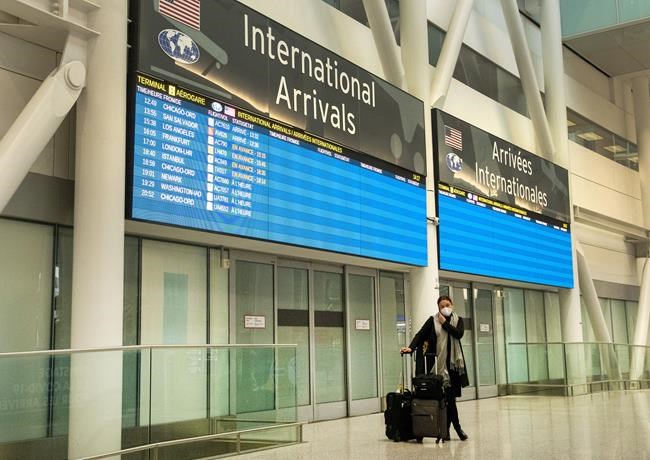
A lone passenger stands outside the International Arrivals area at Pearson Airport in Toronto on Tuesday, Jan. 26, 2021. As the federal government prepares to slap new restrictions on foreign arrivals, Health Canada data suggest a growing number of infections directly connected to international travel. THE CANADIAN PRESS/Frank Gunn

In the first three weeks of January, 384 travel cases and 607 traveller-contact cases were confirmed.

The figures also correspond with a recent rise in the number of people travelling, at least by air. Land-border arrivals are typically fewer in the winter because of the weather in much of the country, but more people arrived from the U.S. by air in December than any month since March. Arrivals from other international locations were higher in December than any month except August.

Reports of notable Canadians ignoring pleas not to travel during the pandemic in favour of sun-kissed days on foreign beaches angered much of the country in the weeks after Christmas, and led to several high-profile provincial and federal politicians and health officials being fired, demoted or reprimanded.

Between Nov. 30 and Dec. 27, 86,953 people flew into Canada from the United States, and 184,260 arrived by air from other international locations.

Prime Minister Justin Trudeau has been promising for more than a week that the government will bring in stronger measures for international arrivals, as Canada fears the impact of new variants of COVID-19 that have arisen in other countries.

That is on top of a mandatory two-week quarantine for all arrivals, which has been in place since last spring, restricting international flights to just four airports, and a more recent requirement for foreign travellers to provide proof of recent negative COVID-19 tests within three days of boarding planes to Canada.

A spokesman for Health Minister Patty Hajdu said “Canada has some of the strongest border measures in the world” and all future measures will be guided by both science and evidence. Cole Davidson said 6,500 phone calls are made daily to verify travellers are in quarantine, and that 99 per cent of nearly 50,000 checks on quarantine made by police have found people are where they are supposed to be.

There are more than 50 cases of the new coronavirus variants from the United Kingdom and South Africa now confirmed in Canada, most, but not all of them, in people who recently travelled into Canada from those countries. The variants are believed to spread more easily, and in recent days concerns have arisen about whether they are more likely to cause serious illness or death.

Conservative Health Critic Michelle Rempel Garner said while community spread within Canada still accounts for the vast majority of this country’s cases, Canada has to do more at the borders. She said the most effective option is to impose a mandatory rapid COVID-19 test on all arrivals, and have that test repeated midway through the two-week quarantine period.

Rempel Garner said Canada can’t “hermetically seal” our border as island nations like New Zealand have done, so testing all travellers for the virus, screening them all for the variants, and maintaining the quarantine would be effective and more efficient than requiring travellers to quarantine at a hotel for two weeks at their own expense.

Similar rules have been in place in Iceland for months. Singapore began requiring testing at all airports on Jan. 24, along with using drones and electronic surveillance to monitor people in quarantine.

NDP Leader Jagmeet Singh said a trend in more travel-related cases is “alarming” and that Trudeau can’t wait any longer to act to stop it.

“With the catastrophic situation we are in, we cannot afford a spike because of non-essential travel,” Singh said.

This report by The Canadian Press was first published Jan. 28, 2021.

Report Error Submit a Tip

More Stories

Sharpton decries 'stench of racism' in Daunte Wright's death

Aaron Morrison, Tim Sullivan And Tammy Webber, The Associated Press 5 minute read Friday, Apr. 23, 2021

MINNEAPOLIS - Daunte Wright, the young Black man shot by an officer during a traffic stop in suburban Minneapolis, was not “just some kid with an air freshener,” but a “prince” whose life ended too soon at the hands of police, the Rev. Al Sharpton said Thursday during an emotional funeral.

Hundreds of people wearing COVID-19 masks packed into Shiloh Temple International Ministries to remember Wright, a 20-year-old father of one who was shot by a white police officer on April 11 in the small city of Brooklyn Center. The funeral was held just two days after former Minneapolis police Officer Derek Chauvin was convicted in the death of George Floyd and amid a national reckoning on racism and policing.

“The absence of justice is the absence of peace,” Sharpton said. “You can’t tell us to shut up and suffer. We must speak up when there is an injustice.”

The civil rights leader's thundering eulogy included a stinging rebuke of the possibility that Wright was pulled over for having air fresheners dangling from his mirror. Wright’s mother has said her son called her after he was stopped and told her that was the reason. Police said it was for expired registration.

The new normal in Canadian politics

David McLaughlin 5 minute read Preview

The new normal in Canadian politics

David McLaughlin 5 minute read Yesterday at 2:01 AM CDT

“Nothing happening, all at once.”

Welcome to the new normal of Canadian politics, where normality is the new normal. Routine and stable are in; disruptive and excessive are out. Exhibits A and B are the Alberta referendum and the British Columbia election. Voters opted for stability over volatility.

The opposite of being normal is being different from the norm. In politics that means different from where we’ve been and what we’ve come to expect. Two competing trends have dominated our politics for the past decade and a half — progressivism and populism. Think Justin Trudeau and liberal, progressive identity politics in Canada, and Donald Trump and conservative, populist MAGA politics in America. We are now experiencing a swing away from both those trends.

Representing this “new normal” are Prime Minister Mark Carney, for one, and newly elected British Columbia premier, Lorne Doerksen, for another. Both are considered normal because they talk and act like adults in a childish political world. Their political flair is to not have any political flair. They stand out for not standing out.

Read
Yesterday at 2:01 AM CDT

Taxi and ride-hailing services receive 58 complaints since March

Jessica Botelho-Urbanski 5 minute read Preview

Taxi and ride-hailing services receive 58 complaints since March

Jessica Botelho-Urbanski 5 minute read Friday, Aug. 17, 2018

The City of Winnipeg has fielded 58 formal complaints about vehicle-for-hire operations since taking over industry oversight from the province in March.

According to freedom of information request results, the city mostly received complaints about taxi operations, and the two largest companies – Duffy’s Taxi and Unicity Taxi – were the main culprits.

From March 1, 2018 to July 13, 2018, the Winnipeg Parking Authority received 20 complaints about Duffy’s, mostly to do with driver road habits (five complaints), driver conduct (three), service refusal (three) or poor service (three), among other issues.

During the same period, Unicity had 19 complaints, five of them related to poor service and three about driver conduct, plus other misdeeds.

Read
Friday, Aug. 17, 2018

SNC planned U.S. move if no deal: documents

Jordan Press and Christopher Reynolds, The Canadian Press 5 minute read Preview

SNC planned U.S. move if no deal: documents

Jordan Press and Christopher Reynolds, The Canadian Press 5 minute read Thursday, Mar. 28, 2019

OTTAWA - SNC-Lavalin warned federal prosecutors last fall about a possible plan to split the company in two, move its offices to the United States and eliminate its Canadian workforce if it didn't get a deal to avoid criminal prosecution, newly obtained documents show.

The documents, part of a PowerPoint presentation obtained by The Canadian Press, describe something called "Plan B" — what Montreal-based SNC might have to do if it can't convince the government to grant a so-called remediation agreement to avoid criminal proceedings in a fraud and corruption case related to projects in Libya.

Under that plan, SNC would move its Montreal headquarters and corporate offices in Ontario and Quebec to the U.S. within a year, cutting its workforce to just 3,500 from 8,717, before eventually winding up its Canadian operations.

“The government of Canada needs to weigh the public interest impact of the prosecution of SNC-Lavalin," the presentation reads.

Read
Thursday, Mar. 28, 2019

Court ruling concludes Canadian Wheat Board saga

Laura Rance-Unger 4 minute read Preview

Court ruling concludes Canadian Wheat Board saga

Laura Rance-Unger 4 minute read Yesterday at 2:01 AM CDT

It remains to be seen whether the recent court ruling in a lawsuit filed after Canadian Wheat Board’s dissolution in 2012 puts the whole debate to rest, as some no doubt hope.

But either way, the dust has settled on the post-CWB world. The sun still rises and a new generation of farmers on the land only knows by name an institution that for generations influenced every aspect of Prairie grain farming.

The first Rural Revival column I wrote for this newspaper more than 30 years ago was about a thousand farmers from Western Canada demonstrating in support of the Wheat Board. It was in the aftermath of the Western Grain Marketing Panel report, one of several efforts that eventually included a plebiscite to help the federal government decide what to do about a vocal minority of farmers who wanted marketing “freedom.”

The polls at the time suggested about two-thirds of farmers were comfortable enough with the single-desk system for food wheat and barley to keep it around. It served as a counterbalance to canola, which they sold on the open market. They essentially had a dual market.

Read
Yesterday at 2:01 AM CDT

RRC Polytech program cuts take bite out of hospitality, tourism sector

Maggie Macintosh 4 minute read Preview

RRC Polytech program cuts take bite out of hospitality, tourism sector

Maggie Macintosh 4 minute read Saturday, May. 2, 2026

Manitoba’s tourism industry is bracing for the disappearance of hospitality training programs — once-popular courses among international students.

Citing budgetary challenges related to a shift in federal immigration policy, Red River College Polytechnic is scrapping 11 programs and scaling back three others in 2026-27. Its hospitality business management diploma is one of seven permanent casualties.

The announcement, while unsurprising, is but the latest blow to a sector trying to “build back the workforce” in the wake of the COVID-19 pandemic, said Michael Juce, president of the Manitoba Hotel Association.

“Are people going to go outside of Manitoba for training? And if they leave, are they going to come back?” Juce said, adding that rural hotels in particular are already grappling with staffing shortages.

Read
Saturday, May. 2, 2026