Freeland chairs cabinet committee on ‘whole-of-country’ response to coronavirus

Advertisement

Advertise with us

OTTAWA - The Minister of Everything has one more hot potato on her plate.

Read this article for free:


By clicking the button above, an account will be created and you will begin to receive some of our recommended newsletters. You may opt out of any newsletter by visiting your Email and Communication Preferences page or by clicking "unsubscribe" at the bottom of any email.

or

Already have an account? Log in here »

To continue reading, please subscribe:

Digital Subscription

One year of digital access for only $1.44 a week*

  • Enjoy unlimited reading on winnipegfreepress.com
  • Read the E-Edition, our digital replica newspaper
  • Access News Break, our award-winning app
  • Play interactive puzzles

*Billed as $5.77 plus GST every four weeks. After 52 weeks, price increases to the regular rate of $19.95 plus GST every four weeks. Offer available to new and qualified returning subscribers only. Cancel any time.

To continue reading, please subscribe:

Add Free Press access to your Brandon Sun subscription for only an additional

$1 for the first 4 weeks*

  • Enjoy unlimited reading on winnipegfreepress.com
  • Read the E-Edition, our digital replica newspaper
  • Access News Break, our award-winning app
  • Play interactive puzzles
Start now

*Your next Brandon Sun subscription payment will increase by $1.00 and you will be charged $17.95 plus GST for four weeks. After four weeks, your payment will increase to $24.95 plus GST every four weeks.

Hey there, time traveller!
This article was published 04/03/2020 (2433 days ago), so information in it may no longer be current.

OTTAWA – The Minister of Everything has one more hot potato on her plate.

Prime Minister Justin Trudeau has tapped Chrystia Freeland to chair a cabinet committee aimed at co-ordinating the federal government’s response to the outbreak of the new coronavirus that has now spread to dozens of countries around the world.

That’s on top of her duties as deputy prime minister, working closely with Trudeau to both set and fulfil the government’s agenda, as he put it in her mandate letter.

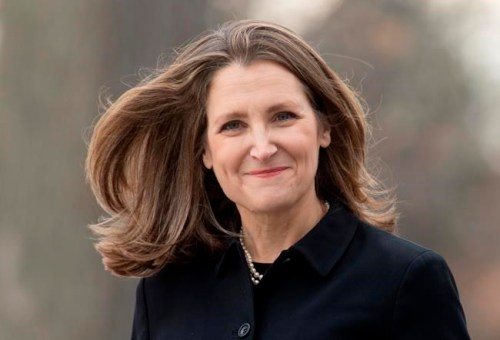
Chrystia Freeland makes her way to a ceremony naming her Deputy Prime Minister and Minister of Intergovernmental Affairs Chrystia Freeland in Ottawa, Wednesday November 20, 2019. The Minister of Everything has one more hot potato on her plate. Justin Trudeau has tapped Deputy Prime Minister Chrystia Freeland to chair a cabinet committee aimed at co-ordinating the federal government's response to the COVID-19 outbreak. THE CANADIAN PRESS/Adrian Wyld

And it’s on top of her job as minister of intergovernmental affairs, which has had her hopscotch around the country to meet with every provincial and territorial premier since she was sworn in last November and will see her effectively co-hosting with Trudeau a first ministers’ meeting next week.

Her mandate includes attempting to douse federal-provincial brush fires and develop common ground on some of the most divisive issues facing the country: climate change, resource development, western alienation, Indigenous reconciliation, health care, child care and gun control.

Oh, and her new task is in addition to her job seeing the new North American free trade deal through to ratification.

And overseeing Canada-U.S. relations in general.

And chairing the cabinet committee on the economy and the environment.

And sitting on the cabinet operations committee and vice-chairing the agenda, results and communications committee.

And participating in meetings of the incident response group, an emergency ad hoc committee of relevant ministers to co-ordinate the federal response to various national crises. And chairing those meetings when Trudeau is out of the country, as he was late last month when blockades in support of Wet’suwet’en hereditary chiefs fighting a pipeline in northern B.C. paralyzed rail traffic across the country.

Until now, the incident response group has been dealing with the novel coronavirus, which can cause a respiratory illness called COVID-19. But Wednesday’s creation of a special, more permanent COVID-19 committee was deemed necessary because the outbreak is clearly going to present challenges — both for the health of Canadians and for the economy — for some time to come.

“This is a whole-of-government, indeed a whole-of-country, effort,” Freeland told a news conference Wednesday to update Canadians on the outbreak, stressing the need for close federal-provincial collaboration.

Freeland’s newest job is to ensure a sort of Team Canada approach to COVID-19, much as she did as foreign affairs minister in navigating tumultuous negotiations with the United States on renewing the North American trade pact, while President Donald Trump threatened to shred the deal entirely.

It was Freeland’s success in getting Canada through those negotiations relatively unscathed that prompted Trudeau to turn to her after the October election to try to bridge the chasm between the federal Liberals and conservative governments in Alberta and Saskatchewan, where the Liberals were shut out. Freeland’s Alberta roots factored into his decision as well.

The role of deputy prime minister, which comes with no specific department to oversee, is not defined in Canada. Some have seemed little more than occasional stand-ins for the prime minister. Others, like Don Mazankowski during Brian Mulroney’s Conservative regime, have essentially been the government’s chief operating officer.

Some prime ministers, including Trudeau himself during his first mandate, have not felt it necessary to have a deputy.

John Manley, who served as deputy prime minister during the tail-end of Jean Chretien’s Liberal government, says the role “is very much subject to what the prime minister wants the job to be.”

Manley twice turned down the role, having no desire to give up his job as foreign affairs minister for what he saw as just “a title.” When he did finally acquiesce, Manley insisted on having some very specific assignments attached to the job: minister for infrastructure and Crown corporations, as well as the Canadian equivalent of the U.S. homeland security secretary, newly created at the time.

Manley was also political minister for Ontario and chaired three cabinet committees.

“All of that added up to more than a job,” he said in an interview.

Freeland also appears to have insisted that the role be more than just a title.

The addition of responsibility for intergovernmental affairs puts her at the centre of any federal file that involves co-operation or collaboration with the provinces — which covers pretty much all the major issues facing the country.

However, Manley notes that unlike his assignments, which put him squarely in charge of specific files, Freeland’s role primarily involves working with other ministers who are in charge of health, environment, natural resources and other departments.

That makes her job “tricky,” Manley says, requiring “dexterity” on Freeland’s part and a willingness to co-operate with her on the part of other ministers, whose instinct may be to protect their turf.

That might explain why, at Wednesday’s news conference, Freeland took pains to recognize “the exceptional leadership of my colleague and friend,” Health Minister Patty Hajdu, who sat smiling beside her.

This report by The Canadian Press was first published March 4, 2020.

Report Error Submit a Tip

More Stories

Behind the scenes at circus spectacle Odysseo, it's the horses who hold the reins

Erin Lebar / Photos by Ruth Bonneville 15 minute read Preview

Behind the scenes at circus spectacle Odysseo, it's the horses who hold the reins

Erin Lebar / Photos by Ruth Bonneville 15 minute read Wednesday, Jun. 13, 2018

It’s almost 4 p.m. on a particularly steamy May afternoon and Cavalia Odysseo rider Chelsea Jordan is putting on her makeup in the back corner of the very humid artistic tent.

She’s already spent some time layering on foundation, and is now into the decorative portion of the 30-minute process, placing a pair of small gems on her forehead and enhancing her naturally sharp cheekbones with some extra contouring.

“This is the messy part of the business,” she jokes as she sticks on fake lashes over an eyelid covered in earth-toned shadow.

It’s odd that makeup is considered the messy part of the day when Jordan spends the majority of her time surrounded by horses, but as with most people involved in Odysseo, the glitzy and glamorous aspects of being a member of the largest touring production in the world aren’t nearly as fun as the time she gets to spend with her four-legged cast-mates.

Read
Wednesday, Jun. 13, 2018

Court ruling concludes Canadian Wheat Board saga

Laura Rance-Unger 4 minute read Preview

Court ruling concludes Canadian Wheat Board saga

Laura Rance-Unger 4 minute read 2:01 AM CDT

It remains to be seen whether the recent court ruling in a lawsuit filed after Canadian Wheat Board’s dissolution in 2012 puts the whole debate to rest, as some no doubt hope.

But either way, the dust has settled on the post-CWB world. The sun still rises and a new generation of farmers on the land only knows by name an institution that for generations influenced every aspect of Prairie grain farming.

The first Rural Revival column I wrote for this newspaper more than 30 years ago was about a thousand farmers from Western Canada demonstrating in support of the Wheat Board. It was in the aftermath of the Western Grain Marketing Panel report, one of several efforts that eventually included a plebiscite to help the federal government decide what to do about a vocal minority of farmers who wanted marketing “freedom.”

The polls at the time suggested about two-thirds of farmers were comfortable enough with the single-desk system for food wheat and barley to keep it around. It served as a counterbalance to canola, which they sold on the open market. They essentially had a dual market.

Read
2:01 AM CDT

The long and winding road

Editorial 4 minute read Preview

The long and winding road

Editorial 4 minute read 2:01 AM CDT

As theatre goes, it sent a strong message.

Manitoba Premier Wab Kinew, standing in front of microphones and television cameras, holding up his Indigenous status card and saying that he didn’t feel Canada should have “a race-based form of identification in this country, but that is a reality,” adding that it was time to abolish the Indian Act.

“I think it’s time to abolish the Indian Act, get rid of the Indian Act, move past the Indian Act, and it needs to be done with First Nations people and First Nations governments, of course. I think it’s long overdue that we have a relationship with Indigenous Peoples in Canada that reflects who we are as Canadians today,” he said.

The Indian Act — the name alone suggests how out-dated and out of place the law has become. Originally dating from 1876, the law was put in place to “amend and consolidate the laws respecting Indians” and gave the Minister of the Interior the responsibility to “control and management of the reserves, lands, moneys and property of Indians in Canada.”

Read
2:01 AM CDT

Walkout creates chaos at St. James Smitty’s

Morgan Modjeski 3 minute read Preview

Walkout creates chaos at St. James Smitty’s

Morgan Modjeski 3 minute read 2:01 AM CDT

Gordon Sharpe wanted to eat a meal at the St. James Smitty’s Wednesday, but he got a helping of bad news instead.

He saw several workers walk out of the restaurant, at 1017 St. James St.

“(The waiter) came back about 10 minutes later and stood over the table, looking a little distraught and said, ‘I’m quitting right now and so is everybody else,’” Sharpe said. “He said, ‘This is my last time serving you,’ and he was quite choked up.”

“I’ve never seen anything like it,” he said, adding that the managers scrambled to serve patrons.

Read
2:01 AM CDT

Freeland handed another hot potato: COVID-19

Joan Bryden, The Canadian Press 5 minute read Preview

Freeland handed another hot potato: COVID-19

Joan Bryden, The Canadian Press 5 minute read Wednesday, Mar. 4, 2020

OTTAWA - The Minister of Everything has one more hot potato on her plate.

Prime Minister Justin Trudeau has tapped Chrystia Freeland to chair a cabinet committee aimed at co-ordinating the federal government's response to the outbreak of the new coronavirus that has now spread to dozens of countries around the world.

That's on top of her duties as deputy prime minister, working closely with Trudeau to both set and fulfil the government's agenda, as he put it in her mandate letter.

And it's on top of her job as minister of intergovernmental affairs, which has had her hopscotch around the country to meet with every provincial and territorial premier since she was sworn in last November and will see her effectively co-hosting with Trudeau a first ministers' meeting next week.

Read
Wednesday, Mar. 4, 2020

Newspaper websites display fewer stories, more curation

5 minute read Tuesday, Feb. 10, 2026

A city subcommittee was provided with a routine update on the status of an ongoing administrative process Thursday, in accordance with standard reporting procedures.