Freeland chairs cabinet committee on ‘whole-of-country’ response to coronavirus
Advertisement
Read this article for free:
or
Already have an account? Log in here »
To continue reading, please subscribe:
Digital Subscription
One year of digital access for only $1.44 a week*
- Enjoy unlimited reading on winnipegfreepress.com
- Read the E-Edition, our digital replica newspaper
- Access News Break, our award-winning app
- Play interactive puzzles
*Billed as $5.77 plus GST every four weeks. After 52 weeks, price increases to the regular rate of $19.95 plus GST every four weeks. Offer available to new and qualified returning subscribers only. Cancel any time.
To continue reading, please subscribe:
Add Free Press access to your Brandon Sun subscription for only an additional
$1 for the first 4 weeks*
- Enjoy unlimited reading on winnipegfreepress.com
- Read the E-Edition, our digital replica newspaper
- Access News Break, our award-winning app
- Play interactive puzzles
*Your next Brandon Sun subscription payment will increase by $1.00 and you will be charged $17.95 plus GST for four weeks. After four weeks, your payment will increase to $24.95 plus GST every four weeks.
Read unlimited articles for free today:
or
Already have an account? Log in here »
Hey there, time traveller!
This article was published 04/03/2020 (2432 days ago), so information in it may no longer be current.
OTTAWA – The Minister of Everything has one more hot potato on her plate.
Prime Minister Justin Trudeau has tapped Chrystia Freeland to chair a cabinet committee aimed at co-ordinating the federal government’s response to the outbreak of the new coronavirus that has now spread to dozens of countries around the world.
That’s on top of her duties as deputy prime minister, working closely with Trudeau to both set and fulfil the government’s agenda, as he put it in her mandate letter.
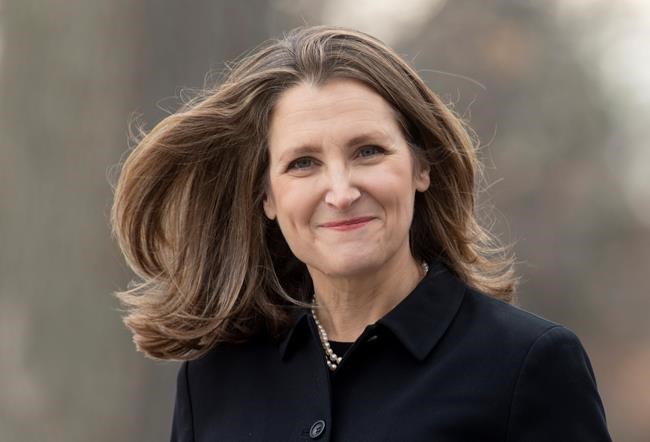
And it’s on top of her job as minister of intergovernmental affairs, which has had her hopscotch around the country to meet with every provincial and territorial premier since she was sworn in last November and will see her effectively co-hosting with Trudeau a first ministers’ meeting next week.
Her mandate includes attempting to douse federal-provincial brush fires and develop common ground on some of the most divisive issues facing the country: climate change, resource development, western alienation, Indigenous reconciliation, health care, child care and gun control.
Oh, and her new task is in addition to her job seeing the new North American free trade deal through to ratification.
And overseeing Canada-U.S. relations in general.
And chairing the cabinet committee on the economy and the environment.
And sitting on the cabinet operations committee and vice-chairing the agenda, results and communications committee.
And participating in meetings of the incident response group, an emergency ad hoc committee of relevant ministers to co-ordinate the federal response to various national crises. And chairing those meetings when Trudeau is out of the country, as he was late last month when blockades in support of Wet’suwet’en hereditary chiefs fighting a pipeline in northern B.C. paralyzed rail traffic across the country.
Until now, the incident response group has been dealing with the novel coronavirus, which can cause a respiratory illness called COVID-19. But Wednesday’s creation of a special, more permanent COVID-19 committee was deemed necessary because the outbreak is clearly going to present challenges — both for the health of Canadians and for the economy — for some time to come.
“This is a whole-of-government, indeed a whole-of-country, effort,” Freeland told a news conference Wednesday to update Canadians on the outbreak, stressing the need for close federal-provincial collaboration.
Freeland’s newest job is to ensure a sort of Team Canada approach to COVID-19, much as she did as foreign affairs minister in navigating tumultuous negotiations with the United States on renewing the North American trade pact, while President Donald Trump threatened to shred the deal entirely.
It was Freeland’s success in getting Canada through those negotiations relatively unscathed that prompted Trudeau to turn to her after the October election to try to bridge the chasm between the federal Liberals and conservative governments in Alberta and Saskatchewan, where the Liberals were shut out. Freeland’s Alberta roots factored into his decision as well.
The role of deputy prime minister, which comes with no specific department to oversee, is not defined in Canada. Some have seemed little more than occasional stand-ins for the prime minister. Others, like Don Mazankowski during Brian Mulroney’s Conservative regime, have essentially been the government’s chief operating officer.
Some prime ministers, including Trudeau himself during his first mandate, have not felt it necessary to have a deputy.
John Manley, who served as deputy prime minister during the tail-end of Jean Chretien’s Liberal government, says the role “is very much subject to what the prime minister wants the job to be.”
Manley twice turned down the role, having no desire to give up his job as foreign affairs minister for what he saw as just “a title.” When he did finally acquiesce, Manley insisted on having some very specific assignments attached to the job: minister for infrastructure and Crown corporations, as well as the Canadian equivalent of the U.S. homeland security secretary, newly created at the time.
Manley was also political minister for Ontario and chaired three cabinet committees.
“All of that added up to more than a job,” he said in an interview.
Freeland also appears to have insisted that the role be more than just a title.

The addition of responsibility for intergovernmental affairs puts her at the centre of any federal file that involves co-operation or collaboration with the provinces — which covers pretty much all the major issues facing the country.
However, Manley notes that unlike his assignments, which put him squarely in charge of specific files, Freeland’s role primarily involves working with other ministers who are in charge of health, environment, natural resources and other departments.
That makes her job “tricky,” Manley says, requiring “dexterity” on Freeland’s part and a willingness to co-operate with her on the part of other ministers, whose instinct may be to protect their turf.
That might explain why, at Wednesday’s news conference, Freeland took pains to recognize “the exceptional leadership of my colleague and friend,” Health Minister Patty Hajdu, who sat smiling beside her.
This report by The Canadian Press was first published March 4, 2020.
Related Articles
Manitoba manufacturers face coronavirus uncertainty
Advertisement Advertise With Us
Advertisement Advertise With Us