


Get out and exercise your franchise
Advertisement
Read this article for free:
or
Already have an account? Log in here »
To continue reading, please subscribe:
Digital Subscription
One year of digital access for only $1.44 a week*
- Enjoy unlimited reading on winnipegfreepress.com
- Read the E-Edition, our digital replica newspaper
- Access News Break, our award-winning app
- Play interactive puzzles
*Billed as $5.77 plus GST every four weeks. After 52 weeks, price increases to the regular rate of $19.95 plus GST every four weeks. Offer available to new and qualified returning subscribers only. Cancel any time.
To continue reading, please subscribe:
Add Free Press access to your Brandon Sun subscription for only an additional
$1 for the first 4 weeks*
- Enjoy unlimited reading on winnipegfreepress.com
- Read the E-Edition, our digital replica newspaper
- Access News Break, our award-winning app
- Play interactive puzzles
*Your next Brandon Sun subscription payment will increase by $1.00 and you will be charged $17.95 plus GST for four weeks. After four weeks, your payment will increase to $24.95 plus GST every four weeks.
Read unlimited articles for free today:
or
Already have an account? Log in here »
Are there any compelling arguments left that will convince Manitobans to vote in this province’s municipal elections on Wednesday, Oct. 28?
For years — nay, decades — this newspaper has urged people to exercise their right to vote. Our arguments have grown increasingly adamant, yet voter turnout has continued to decline.
This has created a meaningful threat to democracy itself.
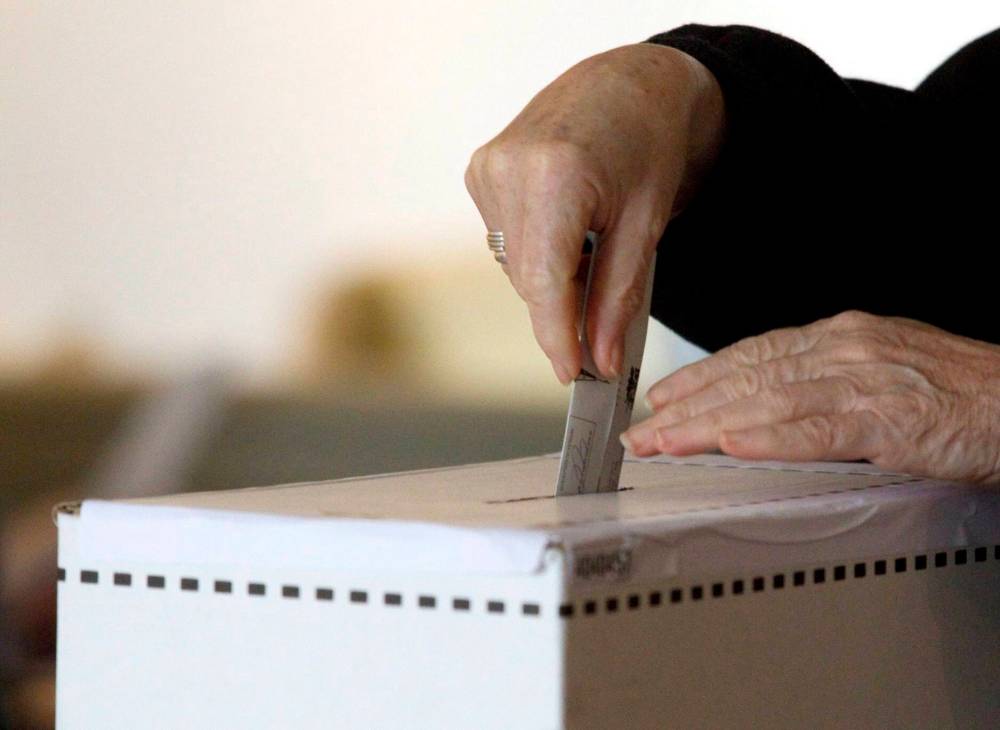
The Canadian Press files
It’s your city and your money, so you should vote in the Oct. 28 civic election.
Without engagement from voters, we leave ourselves open to being led by those who are, at best, ill-suited, or at worse, are emboldened to grab the levers of government power and then abuse democratic institutions.
The final report of the commission of inquiry into the Winnipeg Police Service headquarters scandal, by inquiry commissioner Garth Smorang is, at its essence, a good example of how government officials who know voters are ignoring them could engage in malfeasance with perceived impunity.
Former Winnipeg mayor Sam Katz, whose administration approved and oversaw construction of the new police headquarters, was first elected in a 2004 byelection. He was re-elected twice, in 2006 and 2010. In all the elections he won, voter turnout ranged from unimpressive to dismal. The highest turnout was in the 2004 byelection, when 58 per cent of eligible Winnipeggers voted. When Katz was re-elected in 2006 and 2010, voter turnout was 38 per cent and 47 per cent, respectively.
Would higher voter turnout have prevented Katz and his chosen former chief administrative officer, Phil Sheegl, from engaging in “conflicts of interest (that) were so blatant that there will always be questions,” as Smorang concluded? Probably not.
But competitive mayoral elections and stronger voter turnout would have been a statement from voters that they were watching the mayor closely. That might have given Katz and Sheegl pause to reconsider.
It should be noted that, while turnout for municipal votes is typically the lowest of all elections, anemic voter participation is a problem at all levels of government.
Turnout in federal elections has not breached the 70-per-cent level since 1992; the most recent election, held against a backdrop of existential threats from the United States, saw 69 per cent of Canadians cast a ballot. In Manitoba’s 2023 general election, only 55 per cent of voters turned out after one of the province’s ugliest and most contentious campaigns.
While scheduled elections are particularly vulnerable to voter apathy, referendums that involve one-off ballot propositions also have trouble generating interest.
The recent vote in Alberta is an interesting study in voter turnout for referendums. Asked to weigh in on a truly seismic question — whether Canada’s wealthiest province should remain in Canada — only 1.9 million, or less than two-thirds of the 3.1 million eligible voters, showed up to have a say.
Turnout was higher than in the 2023 Alberta general election, which was 60.5 per cent. However, with the future of the province and, indeed, the entire country hanging in the balance, that seems like a rather lukewarm response.
Are there any fixes for voter apathy?

Many jurisdictions have expanded voting options — longer advance voting opportunities; mail-in voting; and online or telephone voting. Lamentably, while there were slight upticks in turnout early on, apathy slowly crept back into the electorates in these areas.
Some advocates argue that proportional representation — as opposed to the current first-past-the-post elections — would boost turnout. Jurisdictions which have reformed electoral systems have seen meaningful increases in turnout, although the calculus on applying this system to municipal elections, where formal party slates rarely exist, is a bit more complicated.
Overall, though, there appear to be no compelling arguments or new voting tools that can combat voter apathy. What’s left to say?
How about: It’s your city, it’s your money, and if you want to continue enjoying the pleasure of criticizing municipal officials, you have to vote.
It doesn’t have to be more complicated than that.