States trashing troves of masks and pandemic gear as huge, costly stockpiles linger and expire

Advertisement

Advertise with us

When the coronavirus pandemic took hold in an unprepared U.S., states scrambled for masks and other protective gear.

Read this article for free:


By clicking the button above, an account will be created and you will begin to receive some of our recommended newsletters. You may opt out of any newsletter by visiting your Email and Communication Preferences page or by clicking "unsubscribe" at the bottom of any email.

or

Already have an account? Log in here »

To continue reading, please subscribe:

Digital Subscription

One year of digital access for only $1.44 a week*

  • Enjoy unlimited reading on winnipegfreepress.com
  • Read the E-Edition, our digital replica newspaper
  • Access News Break, our award-winning app
  • Play interactive puzzles

*Billed as $5.77 plus GST every four weeks. After 52 weeks, price increases to the regular rate of $19.95 plus GST every four weeks. Offer available to new and qualified returning subscribers only. Cancel any time.

To continue reading, please subscribe:

Add Free Press access to your Brandon Sun subscription for only an additional

$1 for the first 4 weeks*

  • Enjoy unlimited reading on winnipegfreepress.com
  • Read the E-Edition, our digital replica newspaper
  • Access News Break, our award-winning app
  • Play interactive puzzles
Start now

*Your next Brandon Sun subscription payment will increase by $1.00 and you will be charged $17.95 plus GST for four weeks. After four weeks, your payment will increase to $24.95 plus GST every four weeks.

Hey there, time traveller!
This article was published 20/12/2023 (1048 days ago), so information in it may no longer be current.

When the coronavirus pandemic took hold in an unprepared U.S., states scrambled for masks and other protective gear.

Three years later, as the grips of the pandemic have loosened, many states are now trying to deal with an excess of protective gear, ditching their supplies in droves.

With expiration dates passing and few requests to tap into its stockpile, Ohio auctioned off 393,000 gowns for just $2,451 and ended up throwing away another 7.2 million, along with expired masks, gloves and other materials. The now expiring supplies had cost about $29 million in federal money.

Boxes of personal protection equipment maintained by the Missouri Department of Health and Senior Services are shown stacked in a warehouse in Jefferson City, Mo., on Dec. 1, 2023. (Brad Bashore/Missouri Department of Health and Senior Services via AP)

A similar reckoning is happening around the country. Items are aging, and as a deadline to allocate federal COVID-19 cash approaches next year, states must decide how much to invest in maintaining warehouses and supply stockpiles.

An Associated Press investigation found that at least 15 states, from Alaska to Vermont, have tossed some of their trove of PPE because of expiration, surpluses and a lack of willing takers.

Into the trash went more than 18 million masks, 22 million gowns, 500,000 gloves, and more. That’s not counting states that didn’t give the AP exact figures or responded in cases or other measures. Rhode Island said it got rid of 829 tons of PPE; Maryland disposed of over $93 million in supplies.

“What a real waste. That’s what happens when you don’t prepare, when you have a bust-and-boom public health system,” where a lack of planning leads to panicked over-purchasing in emergencies, said Dr. Georges Benjamin, executive director of the American Public Health Association. “It shows that we really have to do a better job of managing our stockpiles.”

The AP sent inquiries about PPE stockpiles to all 50 states over the past several months. About half responded.
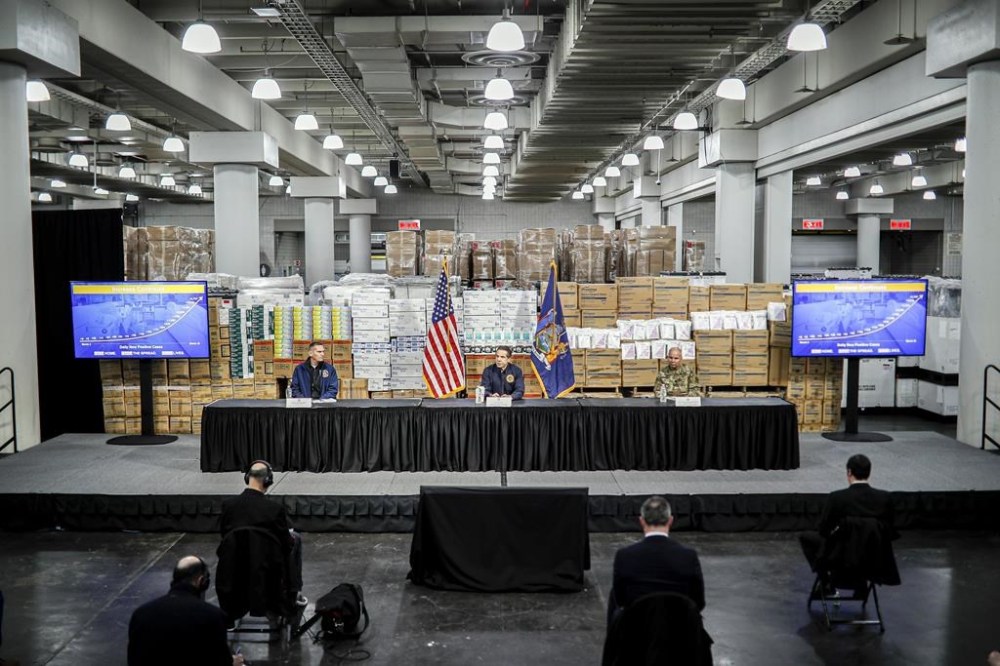
FILE - New York Gov. Andrew Cuomo, center, speaks while practicing social distancing against a backdrop of medical supplies during a news conference at the Jacob Javits Center that will house a temporary hospital in response to the COVID-19 outbreak, Tuesday, March 24, 2020, in New York. Some states that stockpiled millions of masks and other personal protective equipment during the coronavirus pandemic are now throwing the items away. (AP Photo/John Minchillo, File)

States emphasize that they distributed far more gear than they discarded and have gone to great lengths to donate the leftovers. Washington state sent hundreds of thousands of supplies to the Marshall Islands last year, yet ended up throwing out millions more items after they expired.

Many states are keeping at least a portion, and sometimes all, of their remaining protective gear. Some even plan to update their stockpiles.

But others say the vagaries of the pandemic and the PPE supply left no choice but to acquire the items, and now to throw them out, however reluctantly. Expiration dates are set to ensure the protection works as intended, and the Federal Emergency Management Agency has set the fair market value of expired supplies at zero dollars.

“Anytime you’re involved in a situation where you’re recalling how difficult it was to get something in the first place, and then having to watch that go or not be used in the way it was intended to be used, certainly, there’s some frustration in that,” said Louis Eubank, who runs the South Carolina health department’s COVID-19 coordination office. The state has discarded over 650,000 expired masks.

When the virus struck, demand skyrocketed for N95 masks, gloves and gowns. The U.S government’s Strategic National Stockpile was underequipped, and states plunged into global bidding wars.

Boxes of personal protection equipment maintained by the Missouri Department of Health and Senior Services are shown stacked in a warehouse in Jefferson City, Mo., on Dec. 1, 2023. (Brad Bashore/Missouri Department of Health and Senior Services via AP)

The AP found in 2020 that states spent over $7 billion in a few months on PPE, ventilators and some other high-demand medical devices in a seller’s market. Ultimately, the federal government paid for many of the supplies.

“There was no way to know, at the time of purchase, how long the supply deficit would last or what quantities would be needed,” Ohio Department of Health spokesperson Ken Gordon said.

Ohio distributed more than 227 million pieces of protective equipment during the pandemic. But as the supply crunch and the health crisis eased, demand faded, especially for gowns.

Now, “states, hospitals, manufacturers – everybody in the whole system — has extra product,” said Linda Rouse O’Neill of the Health Industry Distributors Association.

Given the glut, stockpiled items are selling for bargain prices, if at all. Vermont got $82.50 for 105,000 boot covers and 29 cents apiece for thousands of safety goggles.
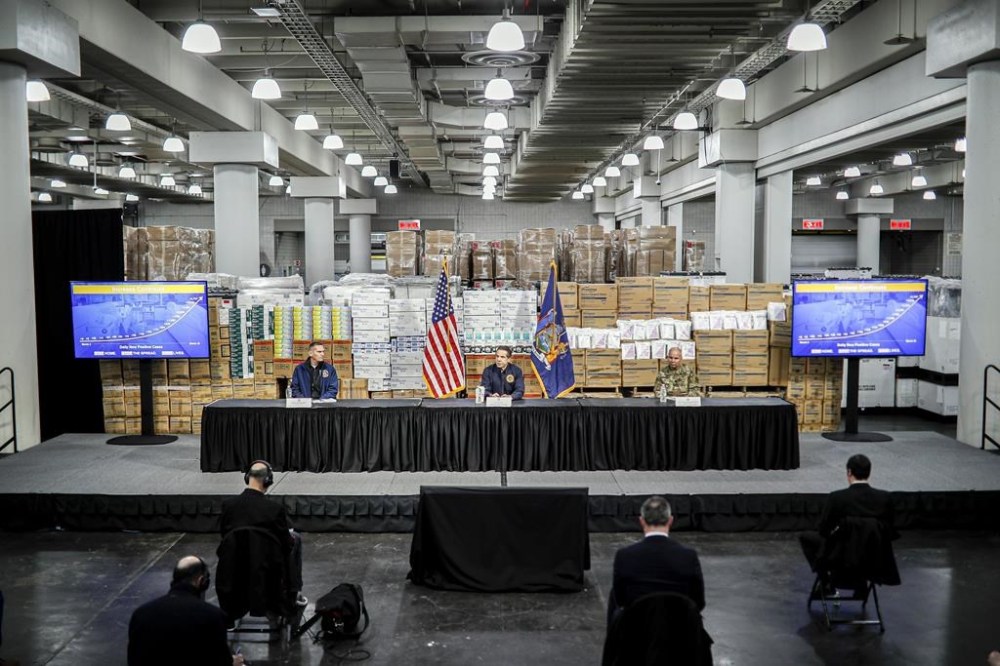
FILE - New York Gov. Andrew Cuomo, center, speaks while practicing social distancing against a backdrop of medical supplies during a news conference at the Jacob Javits Center that will house a temporary hospital in response to the COVID-19 outbreak, Tuesday, March 24, 2020, in New York. Some states that stockpiled millions of masks and other personal protective equipment during the coronavirus pandemic are now throwing the items away. (AP Photo/John Minchillo, File)

Striking a balance between preparedness and surpluses is “a major dilemma” for governments, said Scott Amey of the Project on Government Oversight, a Washington, D.C.-based watchdog group. And while politicians vowed in 2020 never to be caught off guard again, “memories are short, budgets are tight,” Amey noted.

In Wisconsin, a legislative committee axed from the budget $17.2 million that would have funded a warehouse with an ongoing 60-day supply of PPE for two years.

The state Department of Health Services said it is now “demobilizing the warehouse” and trying to donate the supplies. Already, Wisconsin has tossed nearly 1.7 million masks and almost 1 million gowns.

Minnesota’s Department of Health was allocated some money this year for retaining and restocking PPE and is strategizing. For now, emergency response official Deb Radi says the agency expects to dispose of a few expiring gowns.

The Health Industry Distributors Association recommends that product distributors maintain a 60-to-90-day supply to guard against demand spikes. But the group says it’s probably unnecessary for everyone in the system — from manufacturers to doctors’ offices — to have such a large cushion.

Boxes of personal protection equipment maintained by the Missouri Department of Health and Senior Services are shown stacked in a warehouse in Jefferson City, Mo., on Dec. 1, 2023. (Brad Bashore/Missouri Department of Health and Senior Services via AP)

Missouri’s health department has maintained a 90-day supply, keeping even expired materials on the presumption that the federal government will OK their use in an emergency. That happened during COVID-19.

“If you don’t make the investment – and perhaps the investment that is never used – then you may not be prepared to assist the public when it’s needed,” Missouri health director Paula Nickelson said.

Pennsylvania officials, by contrast, are aiming for a 15-day stockpile after frank conversations about what they can afford not only to keep, but to keep replacing as items expire, said Andy Pickett, the Health Department’s emergency preparedness and response director.

And Nevada can’t give its aging PPE away fast enough.

Department of Administration Director Jack Robb said the state is endeavoring to shed the supplies safely and without wasting money but already has discarded some.
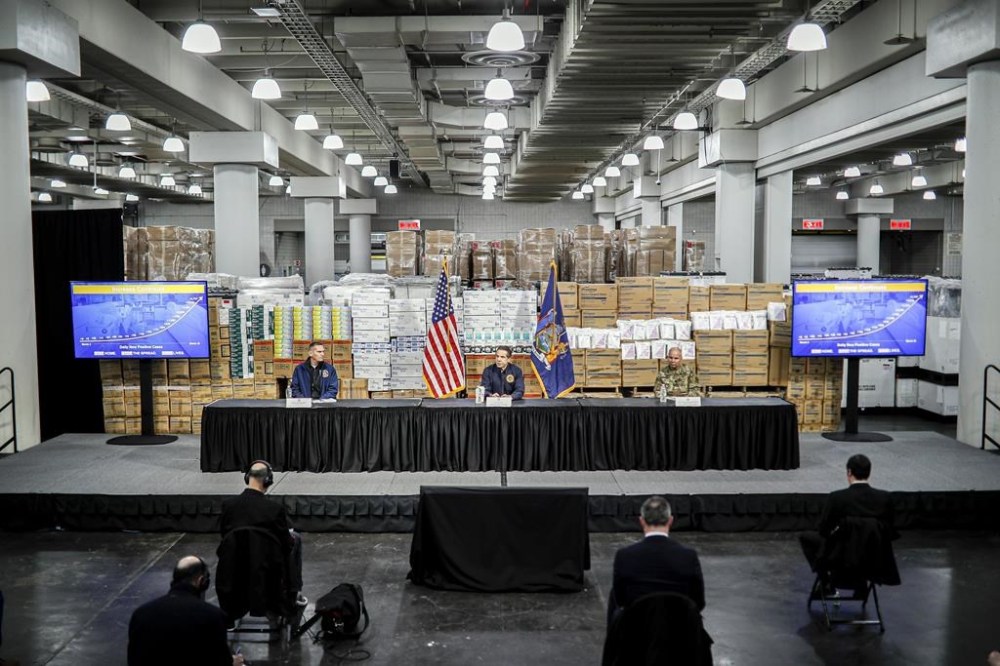
FILE - New York Gov. Andrew Cuomo, center, speaks while practicing social distancing against a backdrop of medical supplies during a news conference at the Jacob Javits Center that will house a temporary hospital in response to the COVID-19 outbreak, Tuesday, March 24, 2020, in New York. Some states that stockpiled millions of masks and other personal protective equipment during the coronavirus pandemic are now throwing the items away. (AP Photo/John Minchillo, File)

But Robb said officials “made the best decisions that they could” when confronted with a disease that has killed nearly 7 million people worldwide, including some of his close friends.

“And I hope we never see anything like that again in our lifetime,” he said.

Boxes of personal protection equipment maintained by the Missouri Department of Health and Senior Services are shown stacked in a warehouse in Jefferson City, Mo., on Dec. 1, 2023. (Brad Bashore/Missouri Department of Health and Senior Services via AP)
FILE - New York Gov. Andrew Cuomo, center, speaks while practicing social distancing against a backdrop of medical supplies during a news conference at the Jacob Javits Center that will house a temporary hospital in response to the COVID-19 outbreak, Tuesday, March 24, 2020, in New York. Some states that stockpiled millions of masks and other personal protective equipment during the coronavirus pandemic are now throwing the items away. (AP Photo/John Minchillo, File)
Report Error Submit a Tip

More Stories

Manitoba’s First Nations and the Indian Act

Hersh Seth 6 minute read 2:00 AM EST

On Monday in Ottawa, Manitoba Premier Wab Kinew called for the Indian Act to be abolished. Prime Minister Mark Carney said he was open to working with First Nations to reform or repeal this law, calling it racist.

The act was created in 1876 and still controls Indian status, reserve lands and band governance. It’s understandable why many people want a better relationship.

But repealing a law and building a new relationship are not the same. What would replace the act’s protections? Who decides? How do governments ensure removing federal authority gives First Nations power while the Crown keeps its promises?

Manitoba has faced these questions before. In 1971, First Nations created a document called Wahbung: Our Tomorrows, in response to then-prime minister Pierre Trudeau’s white paper on assimilation. More than 45 years later, elders and knowledge keepers met at Turtle Lodge, north of Winnipeg, to continue the conversation. Manitobans Dave Courchene Sr. and his son, Dave Courchene Jr., are generational links to the broader movement, and their story should be part of this discussion.

Second plant-based protein plant planned in Manitoba to meet vegan meat demand

Martin Cash 5 minute read Preview

Second plant-based protein plant planned in Manitoba to meet vegan meat demand

Martin Cash 5 minute read Tuesday, Jul. 16, 2019

Manitoba is about to become a key production centre for plant-based protein with a second pea-protein production plant about to break ground.

Merit Functional Foods Corporation is building a $65-million, 65,000-square-foot facility that will produce both pea and canola protein.

The French company, Roquette, is building a $400-million pea protein plant in Portage la Prairie.

Merit is a 60-40 partnership between an investor group made up of Shaun Crew, Barry Tomiski and Ryan Bracken -- all veteran senior management and founders of Hemp Oil Canada Inc./Manitoba Harvest -- and Burcon NutraScience Corp., a publicly traded Vancouver company with strong links to Winnipeg where it has had a research lab for 20 years.

Read
Tuesday, Jul. 16, 2019

Fact Check

1 minute read Thursday, Nov. 30, 2023

Fact Check

Having problems with the form?Contact Us Directly |

Why are Manitoba's school immunization programs so far from achieving herd immunity?

Maggie Macintosh  26 minute read Preview

Why are Manitoba's school immunization programs so far from achieving herd immunity?

Maggie Macintosh  26 minute read Saturday, May. 1, 2021

Sometimes, neither a lollipop nor a dinosaur sticker is enough to convince someone to get a needle.

Dr. Michele Feierstein, a pediatrician for more than 35 years, knows that all too well.

Feierstein has given thousands of immunizations to young patients throughout her career, but she has also had her fair share of difficult conversations with parents who are vaccine-hesitant or outright anti-vaxxers.

She does not bar families who have lukewarm feelings about or adamant views against immunization, whether they be rooted in misinformation, distrust, religious belief, or any other reason, from her practice at the Manitoba Clinic.

Read
Saturday, May. 1, 2021

Bob Saget, beloved TV dad of 'Full House,' dead at 65

Lynn Elber, The Associated Press 7 minute read Preview

Bob Saget, beloved TV dad of 'Full House,' dead at 65

Lynn Elber, The Associated Press 7 minute read Monday, Jan. 10, 2022

LOS ANGELES (AP) — Bob Saget, the actor-comedian known for his role as beloved single dad Danny Tanner on the sitcom “Full House” and as the wisecracking host of “America’s Funniest Home Videos,” died while on a stand-up tour. He was 65.

Deputies in Orange County, Florida, were called Sunday about an “unresponsive man” in a hotel room at the Ritz-Carlton in Orlando and found Saget dead, according to a sheriff’s statement on Twitter. Detectives found “no signs of foul play or drug use in this case.”

Saget was in Florida as part of his “I Don't Do Negative Comedy Tour.” After warm audience receptions to his gigs Friday in Orlando and Saturday in the Ponte Vedra Beach resort area, he celebrated online.

“I’m back in comedy like I was when I was 26. I guess I’m finding my new voice and loving every moment of it,” he posted Saturday on Instagram.

Read
Monday, Jan. 10, 2022

iPhone started fire, Winnipegger says

Kevin Rollason 3 minute read Preview

iPhone started fire, Winnipegger says

Kevin Rollason 3 minute read Tuesday, Nov. 26, 2019

The iPhone has long been a hot item, but for one Winnipeg family, it got too hot.

Wally Hill says earlier this month, he, along with his wife and daughter, were watching television, with his daughter's iPhone 6 sitting unplugged on the cushion between them, when the smartphone set the couch on fire.

"It was frightening," Hill said. "It didn't explode... it fizzled and popped open at the back, and then smoke and flames came out the back. It then ignited the cushion."

Hill said he quickly picked up the entire couch cushion, with the burning phone still on it, to move the device to a tile floor in his residence.

Read
Tuesday, Nov. 26, 2019