Trudeau says he’s not willing to kick health-care reform down the road any longer

Advertisement

Advertise with us

OTTAWA - The federal and provincial governments appear deadlocked in their negotiations on the future of health care in Canada, and Prime Minister Justin Trudeau's latest comments suggest he will not be the one to blink first.

Read this article for free:


By clicking the button above, an account will be created and you will begin to receive some of our recommended newsletters. You may opt out of any newsletter by visiting your Email and Communication Preferences page or by clicking "unsubscribe" at the bottom of any email.

or

Already have an account? Log in here »

To continue reading, please subscribe:

Digital Subscription

One year of digital access for only $1.44 a week*

  • Enjoy unlimited reading on winnipegfreepress.com
  • Read the E-Edition, our digital replica newspaper
  • Access News Break, our award-winning app
  • Play interactive puzzles

*Billed as $5.77 plus GST every four weeks. After 52 weeks, price increases to the regular rate of $19.95 plus GST every four weeks. Offer available to new and qualified returning subscribers only. Cancel any time.

To continue reading, please subscribe:

Add Free Press access to your Brandon Sun subscription for only an additional

$1 for the first 4 weeks*

  • Enjoy unlimited reading on winnipegfreepress.com
  • Read the E-Edition, our digital replica newspaper
  • Access News Break, our award-winning app
  • Play interactive puzzles
Start now

*Your next Brandon Sun subscription payment will increase by $1.00 and you will be charged $17.95 plus GST for four weeks. After four weeks, your payment will increase to $24.95 plus GST every four weeks.

Hey there, time traveller!
This article was published 13/12/2022 (1419 days ago), so information in it may no longer be current.

OTTAWA – The federal and provincial governments appear deadlocked in their negotiations on the future of health care in Canada, and Prime Minister Justin Trudeau’s latest comments suggest he will not be the one to blink first.

In a year-end interview with The Canadian Press on Monday, Trudeau said he’s not willing to kick health-care reform down the road any further, even as provincial premiers clamour for more federal funds to bolster their ailing health systems.

“It wouldn’t be the right thing to do to just throw more money at the problem and sit back and watch the problem not get fixed because we didn’t use this moment to say, ‘No, no, no, it’s time to improve the system,'” Trudeau said.
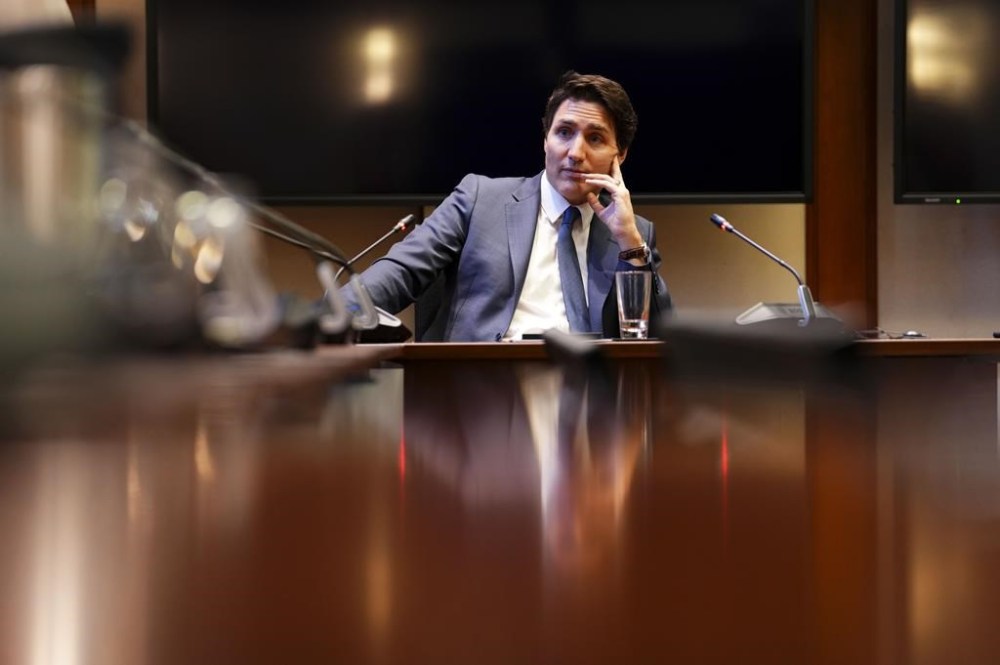
Prime Minister Justin Trudeau takes part in a year-end interview with The Canadian Press in Ottawa on Monday, Dec. 12, 2022. Trudeau says he's not willing to kick health-care reform down the road any farther, with governments appearing to have reached a stalemate in health-care funding negotiations. THE CANADIAN PRESS/Sean Kilpatrick

The stalemate is happening while children’s hospitals across the country are inundated with kids suffering from respiratory diseases. In some cases, hospitals have been overwhelmed by the calamitous combination of record numbers of sick patients and critically low numbers of staff to treat them.

The problem goes back to more than a year ago, when provinces first demanded a sit-down with the prime minister to talk about long-term and sustainable funding increases after pandemic strain left them with large backlogs and a burnt-out workforce.

They want to see Ottawa cover 35 per cent of health-care costs across the country, up from the current 22 per cent, by increasing the Canada Health Transfer.

Trudeau told them those discussions should wait until after the pandemic but dedicated $2 billion in one-time funding to tide them over during the Omicron wave.

Now the prime minister says the system needs reform, and he’s not going to give up the money unless the provinces commit to change.

“Canadians are right to look at all orders of government and say, ‘This is terrible. You guys really need to solve this,'” Trudeau said.

Reform is already underway in most provinces, but the federal government does not seem willing to join them at the table yet, British Columbia Health Minister Adrian Dix said in an interview Tuesday.

His province has embarked on primary-care reform, made spaces for more nurses and signed new collective agreements with health workers, all while coping with an extraordinary increase in demand for services, he said. And Trudeau praised many of the recent changes B.C. has undertaken.

“I would think that the federal government would want to be part of that and to contribute its share, and that’s what we’re asking,” Dix said.

Health Minister Jean-Yves Duclos made an overture to the provinces last month, offering an increase to the federal health transfer in exchange for improved data sharing across the country.

But the meeting ended without progress. Dix said Duclos came to the table with no specifics, and conversations about the health transfer have continued to be elusive with the Liberals.

“It’s always a new moving excuse, a new line in the sand that drifts away after the tide comes in,” he said.

Imposing performance measures on the provinces that affect their access to the Canada Health Transfer is more or less unheard of, said Haizhen Mou, a professor at the University of Saskatchewan who studies health policy.

It’s understandable that provincial leaders don’t want to change that precedent, she said in an interview Tuesday.

“I don’t think the federal government has the right to impose such performance indicators on the broad kind of health transfer,” she said, but added that she understands why the Liberals don’t want to continue to put money toward a system that’s not working.

A more politically palatable situation might be to offer targeted funds for specific priorities and sign individual agreements with each province, she said, rather than treating them all the same way.

That’s what the Paul Martin government did in 2005 to address wait times, and what Trudeau did in 2016 to fund mental-health and home-care services in the face of similar circumstances.

In 2016, the provinces were united as they pushed for an unconditional increase to the health transfer, “but in the end they broke apart, the alliance broke,” Mou said.

That year, the government first signed a bilateral agreement with New Brunswick and other provinces then followed suit individually. Mou said she thinks it’s only a matter of time before that happens again.

“I’m not sure how long they can hold out, because the revenue, the power of the fiscal capacity, is still in the federal government’s hands,” she said.

Health-care advocates, including nurses and doctors’ associations, have echoed Trudeau’s call for a plan to transform Canada’s broken system and to do it quickly.

“Patient care is suffering while health-care working conditions for nurses and other health workers deteriorate,” said Canadian Federation of Nurses Unions president Linda Silas, after talks between health ministers ended last month.

“It is absolutely critical that we put aside politicking and get down to productive discussions around concrete solutions to the health-care staffing crisis.”

Dix said that can’t happen until the prime minister is willing to come to the table for an open discussion. He said Trudeau has not committed to that.

Trudeau tends to speak to premiers often about health care on a one-on-one basis, and his ministers are working bilaterally with their provincial and territorial counterparts, too.

Asked Monday how he plans to kick-start the negotiations if he won’t sit down with premiers as a group, Trudeau seemed to suggest that it’s up to provincial and territorial leaders to take the next step.

“We’re absolutely willing to invest much more in health care, but there has to be clear commitments and results that are going to change things for Canadians,” he said.

For now, each side appears to believe that the ball is in the other’s court.

This report by The Canadian Press was first published Dec. 13, 2022.

Report Error Submit a Tip

More Stories

Has the political wind changed?

Gwynne Dyer 5 minute read Yesterday at 2:01 AM CDT

It has been quite a week. First we had “Lula” – Luiz Inácio da Silva (as nobody but his mother ever called him) – defying everybody’s expectations. After winding up two million votes behind his challenger, Flávio Bolsonaro, in the first round of the Brazilian presidential election, he made a “miraculous” comeback in the second.

It was like a man going into a revolving door behind you and coming out in front. At the end of the first round, Lula was two million votes behind; at the end of the second round on Oct. 25 he was four million votes ahead. So how did he win a fourth term without cheating?

That’s what Bolsonaro claims he did, having fled to the United States; Trump, Flávio’s mentor, hints at the same. But Lula’s victory was not miraculous. He only learned to read when he was 10, and at 80 he still refused to have a mobile phone. His team finally made him get one and use it.

He wouldn’t do social media videos, so they created a WhatsApp channel called Lula’s Army, and made him appear on it at least daily. The channel went from zero to 10.8 million viewers in two weeks, and Lula won.

Canada tops Dominican Republic in pre-qualifier

Jason Hills, The Canadian Press 4 minute read Preview

Canada tops Dominican Republic in pre-qualifier

Jason Hills, The Canadian Press 4 minute read Sunday, Nov. 17, 2019

EDMONTON - Canada's women's basketball team put its depth on display Sunday in a dominant 110-60 victory over the Dominican Republic in the final game of the FIBA Olympic pre-qualifying tournament.

All 12 players hit the scoresheet, including six in double digits, to help the Canadians finish 3-0 at the tournament and advance to the next Olympic qualifier in February.

Sami Hill led the way with 16 points, three rebounds, two assists and three steals, while 20-year-old Shaina Pellington recorded 14 points. Bridget Carleton and Jamie Scott had 13 points each and Ruth Hamblin had 11 points and five rebounds.

"We got to roll our whole lineups through, and it was fun when we got going," said Canada's coach Lisa Thomaidis. "It was nice to see different lineup contributing and building chemistry.

Read
Sunday, Nov. 17, 2019

Trudeau says he’s not willing to kick health-care reform down the road any longer

Laura Osman, The Canadian Press 6 minute read Preview

Trudeau says he’s not willing to kick health-care reform down the road any longer

Laura Osman, The Canadian Press 6 minute read Tuesday, Dec. 13, 2022

OTTAWA - The federal and provincial governments appear deadlocked in their negotiations on the future of health care in Canada, and Prime Minister Justin Trudeau's latest comments suggest he will not be the one to blink first.

In a year-end interview with The Canadian Press on Monday, Trudeau said he's not willing to kick health-care reform down the road any further, even as provincial premiers clamour for more federal funds to bolster their ailing health systems.

"It wouldn't be the right thing to do to just throw more money at the problem and sit back and watch the problem not get fixed because we didn't use this moment to say, 'No, no, no, it's time to improve the system,'" Trudeau said.

The stalemate is happening while children's hospitals across the country are inundated with kids suffering from respiratory diseases. In some cases, hospitals have been overwhelmed by the calamitous combination of record numbers of sick patients and critically low numbers of staff to treat them.

Read
Tuesday, Dec. 13, 2022

Letters, Oct. 31

6 minute read Yesterday at 2:01 AM CDT

Civic election a missed opportunity

The outcome of the latest municipal election in Winnipeg is nothing short of baffling. The decline of what was once a proud, beautiful prairie hub is impossible to ignore.

Winnipeg is rapidly sliding into a state of structural and social dilapidation, yet voters have inexplicably chosen to hand incumbent Mayor Scott Gillingham a second term. The decision smells of complacency, and sadly, it represents a massive missed opportunity for real urban renewal.

Walking through downtown Winnipeg today is an exercise in heartbreak. A city centre that should be a bustling economic and cultural core has instead transformed into an absolute eyesore. Encampments and tents are permitted to dot the heart of the city. Streets that used to thrive are now dominated by the tragic, visible reality of severe addiction, with individuals wandering and staggering through public spaces without adequate intervention or care.

The long and winding road

Editorial 4 minute read Preview

The long and winding road

Editorial 4 minute read Yesterday at 2:01 AM CDT

As theatre goes, it sent a strong message.

Manitoba Premier Wab Kinew, standing in front of microphones and television cameras, holding up his Indigenous status card and saying that he didn’t feel Canada should have “a race-based form of identification in this country, but that is a reality,” adding that it was time to abolish the Indian Act.

“I think it’s time to abolish the Indian Act, get rid of the Indian Act, move past the Indian Act, and it needs to be done with First Nations people and First Nations governments, of course. I think it’s long overdue that we have a relationship with Indigenous Peoples in Canada that reflects who we are as Canadians today,” he said.

The Indian Act — the name alone suggests how out-dated and out of place the law has become. Originally dating from 1876, the law was put in place to “amend and consolidate the laws respecting Indians” and gave the Minister of the Interior the responsibility to “control and management of the reserves, lands, moneys and property of Indians in Canada.”

Read
Yesterday at 2:01 AM CDT

Brandon manufacturer says Canadian steel in demand, but high costs, long delivery times hit hard

Gabrielle Piché 6 minute read Preview

Brandon manufacturer says Canadian steel in demand, but high costs, long delivery times hit hard

Gabrielle Piché 6 minute read Yesterday at 2:01 AM CDT

Something’s different in a Brandon plant.

Building envelope panels — or shells for homes and commercial buildings — keep being produced at Greenstone Building Products.

But the galvanized steel used by workers has been arriving later and the price is constantly increasing, according to company leadership.

“It’s just a little bit nerve-wracking for us to hear the opposite narrative,” said Tilda Fortier, Greenstone Building Products’ business manager.

Read
Yesterday at 2:01 AM CDT