Ottawa announces nearly $24M in funds to transform health-care, community safety on Manitoba First Nations

Advertisement

Advertise with us

The federal government is sending nearly $24 million to Manitoba First Nations groups to transform health-care delivery and community-safety initiatives in northern communities.

Read this article for free:


By clicking the button above, an account will be created and you will begin to receive some of our recommended newsletters. You may opt out of any newsletter by visiting your Email and Communication Preferences page or by clicking "unsubscribe" at the bottom of any email.

or

Already have an account? Log in here »

To continue reading, please subscribe:

Digital Subscription

One year of digital access for only $1.44 a week*

  • Enjoy unlimited reading on winnipegfreepress.com
  • Read the E-Edition, our digital replica newspaper
  • Access News Break, our award-winning app
  • Play interactive puzzles

*Billed as $5.77 plus GST every four weeks. After 52 weeks, price increases to the regular rate of $19.95 plus GST every four weeks. Offer available to new and qualified returning subscribers only. Cancel any time.

To continue reading, please subscribe:

Add Free Press access to your Brandon Sun subscription for only an additional

$1 for the first 4 weeks*

  • Enjoy unlimited reading on winnipegfreepress.com
  • Read the E-Edition, our digital replica newspaper
  • Access News Break, our award-winning app
  • Play interactive puzzles
Start now

*Your next Brandon Sun subscription payment will increase by $1.00 and you will be charged $17.95 plus GST for four weeks. After four weeks, your payment will increase to $24.95 plus GST every four weeks.

Hey there, time traveller!
This article was published 25/11/2022 (1435 days ago), so information in it may no longer be current.

The federal government is sending nearly $24 million to Manitoba First Nations groups to transform health-care delivery and community-safety initiatives in northern communities.

Indigenous Services Minister Patty Hajdu announced Friday that $23 million will be used by Manitoba Keewatinowi Okimakanak Inc., and Keewatinohk Inniniw Minoayawin Inc. — the recently established northern First Nations-led health organization — to make systemic changes to the way First Nations residents access and receive services over the next two years.

As well, more than $715,000 will go to MKO over three years to enhance lawmaking capabilities on First Nations.

Indigenous Services Minister Patty Hajdu announced Friday that $23 million will be used to make systemic changes to the way First Nations residents access and receive services. (Mike Deal / Winnipeg Free Press)
                                MIKE DEAL / WINNIPEG FREE PRESS A teary eyed Patty Hajdu, Minister of Indigenous Services, during the announcement of investments to support First Nations health and community safety initiatives in Northern Manitoba. Grand Chief Garrison Settee of the Manitoba Keewatinowi Okimakanak (MKO), and Dr. Barry Lavallee, CEO of Keewatinohk Inniniw Minoayawin Inc. (KIM) were also in attendance. See Malak Abas story 221125 - Friday, November 25, 2022.

Indigenous Services Minister Patty Hajdu announced Friday that $23 million will be used to make systemic changes to the way First Nations residents access and receive services. (Mike Deal / Winnipeg Free Press)

MIKE DEAL / WINNIPEG FREE PRESS A teary eyed Patty Hajdu, Minister of Indigenous Services, during the announcement of investments to support First Nations health and community safety initiatives in Northern Manitoba. Grand Chief Garrison Settee of the Manitoba Keewatinowi Okimakanak (MKO), and Dr. Barry Lavallee, CEO of Keewatinohk Inniniw Minoayawin Inc. (KIM) were also in attendance. See Malak Abas story 221125 - Friday, November 25, 2022.

Earlier this year, Ottawa began transferring control of federal health programs, services and functions to the two organizations.

“Transformation is about deconstruction of colonial regimes and ideals that were prevalent in the health-care system,” MKO Grand Chief Garrison Settee said at the announcement.

“But we are on the verge of that transformation, and it begins with our people being involved, our leadership being involved… that has been the missing piece.”

MKO is a political advocacy organization representing 26 First Nations in the province. KIM (the full name means “Northern Peoples’ Wellness” in Cree) was established as a non-share corporation by the MKO Chiefs’ health task force in 2020.

KIM chief executive officer Dr. Barry Lavallee said a priority in the transformation is holding health-care providers and systems accountable when serving First Nations people and fulfilling what he said has been a decades-long ask from northern chiefs to adapt medical training to incorporate Indigenous teachings.

“Access to care has been important for First Nations people for decades,” he said. “So although you have nurses and doctors, you have CT scans, MRIs, you have operations occurring, the real analysis that you have to take is, ‘Does it meet the mark for First Nations people?’

“And in all my years of research and studying and practice, in 30 years, it never has.”

Hajdu said her experience running a homeless shelter in Thunder Bay prior to getting into politics exposed her to what she called the “cruelty of the health-care system,” particularly to Indigenous people.

“I think Indigenous people are too kind when they talk about these experiences…. As a federal representative, this kind of collaboration is not just critical, it’s immoral to not to do,” she said.

Like the health-care funding, the $715,000 community-safety money is also focused on advancing self-determination, Settee said, referring to “limitations” to policing that make it difficult for RCMP to enforce First Nations band bylaws.

The project has been in development for three years, he said, but resources had evaporated.

“What we’re wanting to do is to look at not relying on the system, but to create our own system within that community,” he said. “That is what autonomy looks like, and sovereignty looks like, and taking care of our own.”

Rural communities across Manitoba have long called for answers to a lack of mental-health support from the federal government.

While some new services have come through private donors — an initiative announced by the Children’s Hospital Research Institute of Manitoba this week to create eHeath programming for youth living in rural areas raised funds through the Sobeys Family of Support — crisis-intervention services aren’t reaching northern communities when they’re most needed.

After a string of suicides and suicide attempts, Island Lake First Nations called on the provincial and federal governments to work with them. A similar call was made in Red Sucker Lake First Nation, where a 16-year-old boy took his own life on a playground in October.

More autonomous health care in First Nations communities could help leadership address the root causes of mental health issues like suicidal ideation and addiction, Lavallee said.

“The immediacy of need for our communities, indeed, they’re there, but we have to redefine what health looks like in terms of prevention,” he said.

malak.abas@freepress.mb.ca

Malak Abas

Malak Abas
Reporter

Malak Abas is a reporter for the Winnipeg Free Press.

Our newsroom depends on a growing audience of readers to power our journalism. If you are not a paid reader, please consider becoming a subscriber.

Our newsroom depends on its audience of readers to power our journalism. Thank you for your support.

Report Error Submit a Tip

More Stories

Trump touts USMCA win in state of the union

James McCarten, The Canadian Press 6 minute read Preview

Trump touts USMCA win in state of the union

James McCarten, The Canadian Press 6 minute read Tuesday, Feb. 4, 2020

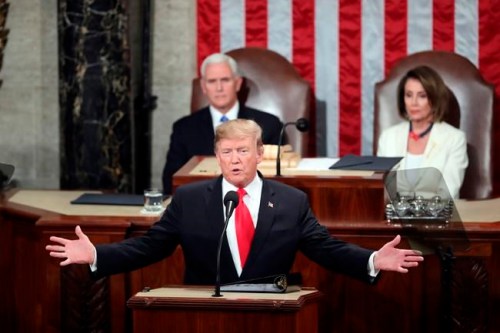
WASHINGTON - President Donald Trump declared his scorched-earth political style an unmitigated success Tuesday in a fiercely partisan, made-for-TV state of the union speech that made it clear he expects to be back in the White House next year on the strength of the U.S. economy and his trade deals with Canada, Mexico and China.

Trump, addressing a joint session of Congress in the very chamber where House Democrats voted to impeach him less than two months ago, became only the second president in American history — Bill Clinton was the first — to deliver a state of the union while standing trial in the Senate.

Unrepentant, he pointedly refused to shake the offered hand of House Speaker Nancy Pelosi on the dais before singing the praises of what he billed as "the great American comeback," pointing to strong job growth, a soaring stock market and low unemployment as evidence of his leadership. And when he was done, Pelosi ripped up the speech in full view of the television cameras.

"America's enemies are on the run, America's fortunes are on the rise, and America's future is blazing bright. The years of economic decay are over," Trump declared, taking full credit for the country's "roaring economy," including what he billed as seven million new jobs and the lowest jobless rate in half a century — a "blue-collar boom" that he's counting on to help his re-election chances in November.

Read
Tuesday, Feb. 4, 2020

Health officials ponder next steps as COVID cases surge in Southern Health region

Katie May 5 minute read Preview

Health officials ponder next steps as COVID cases surge in Southern Health region

Katie May 5 minute read Wednesday, Nov. 3, 2021

Public-health officials say they're trying to avoid ordering another lockdown in southern Manitoba, where COVID-19 infection rates are surging.

Deputy chief provincial public health officer Dr. Jazz Atwal told a news conference Wednesday he doesn't anticipate more lockdowns and suggested he will prioritize keeping schools open when considering future restrictions.

But he couldn't say what the next step will be in an area of the province where hospitalizations among unvaccinated residents are on the rise.

Average daily case counts in the southern part of the province are higher now than they were before lockdown measures went into effect last November, and officials are still figuring out what to do.

Read
Wednesday, Nov. 3, 2021

Is Canada headed for time chaos this weekend?

Michelle Bastian 5 minute read 2:00 AM CDT

When Manitoba Premier Wab Kinew declared Sept. 17 that the province would remain on permanent daylight time, he suggested it was a historical moment people would share with their “great-great-grandkids.” But, while Sunday, Nov. 1 has been heralded as the date many Canadians will stop changing their clocks, there are rumblings behind the scenes suggesting this will actually cause more trouble than ever before.

There are, of course, the warnings from chrono-biologists and sleep scientists about the damage permanent daylight time will do. The lighter evenings will mean many more dark mornings. But there is another set of problems in the offing in the critical infrastructure that underpins our digital lives.

While it used to be common to spend the Sunday morning after a time change going around our homes updating the clocks, we now wake up to devices that have already adjusted to the new time. These automatic updates occur regularly for daylight time, as well as when we travel to new time zones.

Our clocks are able to change by themselves owing to the hard work of a group of volunteers who were recently named in a list of the people who hold up the internet. This group, led by Paul Eggert, a computer scientist at UCLA, maintains a little-known tool called the Time Zone Database. Since the 1980s, it has kept track of regional, national and international debates about clock time and provided an up-to-date table of what time it should be on our walls.

Fact Check

1 minute read Thursday, Nov. 30, 2023

Fact Check

Having problems with the form?Contact Us Directly |

Brian Bowman wins mayoral battle

Aldo Santin and Mary Agnes Welch 6 minute read Preview

Brian Bowman wins mayoral battle

Aldo Santin and Mary Agnes Welch 6 minute read Thursday, Oct. 23, 2014

In the end, it wasn’t even close.

A mayoral race that was supposed to be a head-to-head battle between privacy lawyer Brian Bowman and former NDP MP and MLA Judy Wasylycia-Leis turned into a rout on election night. Wasylycia-Leis, the experienced politician, had held what looked like an unassailable lead for months, but Bowman, the outsider who promised Winnipeggers a better, prosperous future, chipped doggedly away at it.

“I’m excited to tell you that positive change is coming to city hall,” Bowman told roaring supporters at the Inn At The Forks after making his way into the small ballroom accompanied by his wife and two young sons.

He said he hadn’t expecting such a landslide victory, but had believed that the campaign was building momentum.

Read
Thursday, Oct. 23, 2014

Just say no (to deficits during good economic times)

Tom Brodbeck 5 minute read Preview

Just say no (to deficits during good economic times)

Tom Brodbeck 5 minute read Wednesday, Oct. 2, 2019

When a political party pledges to run small, “manageable” deficits if elected, it almost always means it will go deeper into the red if it wins government.

It’s human nature.

After all, as a government, if you get the blessing of the public to spend beyond your means, what’s a few billion more a year in overspending?

The problem is, it doesn’t usually end there. When those same politicians seek re-election, they often want permission to post even larger deficits. In some cases, they’ve abandoned the idea of balancing the books altogether, arguing perpetual deficit financing is acceptable, as long as the debt doesn’t exceed a certain percentage of the economy.

Read
Wednesday, Oct. 2, 2019