Cancelled Keystone XL pipeline expansion won’t lessen oil dependency, experts say
Advertisement
Read this article for free:
or
Already have an account? Log in here »
To continue reading, please subscribe:

Digital Subscription
One year of digital access for only $205*
- Enjoy unlimited reading on winnipegfreepress.com
- Read the E-Edition, our digital replica newspaper
- Access News Break, our award-winning app
- Play interactive puzzles
*First annual payment billed as $205.00 + GST for one year. This annual subscription will automatically renew at $233.00 + GST every 52 weeks (10% off the regular annual price of $259.35). Offer available to new and qualified returning subscribers only. Cancel any time.
To continue reading, please subscribe:
Add Free Press access to your Brandon Sun subscription for only an additional
$1 for the first 4 weeks*
- Enjoy unlimited reading on winnipegfreepress.com
- Read the E-Edition, our digital replica newspaper
- Access News Break, our award-winning app
- Play interactive puzzles
*Your next Brandon Sun subscription payment will increase by $1.00 and you will be charged $17.95 plus GST for four weeks. After four weeks, your payment will increase to $24.95 plus GST every four weeks.
Read unlimited articles for free today:
or
Already have an account? Log in here »
Hey there, time traveller!
This article was published 18/01/2021 (2093 days ago), so information in it may no longer be current.
CALGARY – Cancelling the multi-billion dollar Keystone XL pipeline expansion would not only jeopardize thousands of jobs in Alberta, it would also mean the loss of billions of dollars in corporate income taxes, carbon taxes and royalties, according to energy experts.
TC Energy Corp.’s 1,947-kilometre project would carry crude oil from Hardisty, Alta., to Steele City, Neb. From there it would connect with the company’s existing facilities to reach the U.S. Gulf Coast – one of the world’s biggest oil refining hubs.
Scrapping the pipeline expansion could threaten the security of supply for those refineries, said Richard Masson, an executive fellow and energy expert at the University of Calgary’s School of Public Policy.
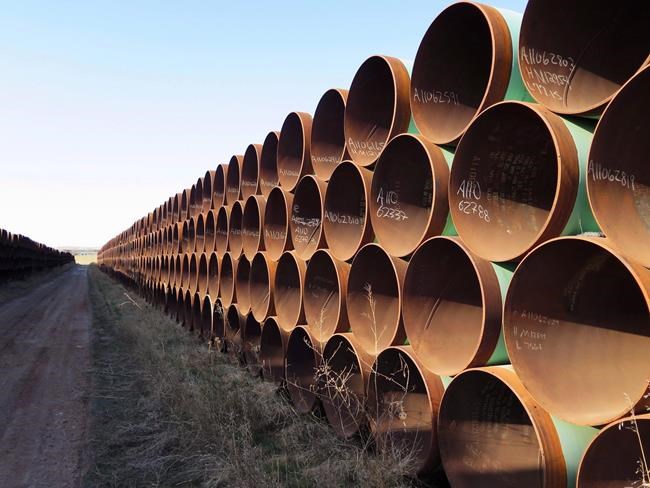
Without a pipeline to move bottlenecked bitumen from Canada to U.S. coastal refineries, they’ll be forced to import from countries like Saudi Arabia, Iraq and Russia, he said.
“Connecting by pipeline within North America is the most secure way to feed those refineries,” Masson said, noting that Canada has higher environmental oversight and labour standards than do many other oil producing countries.
“Those refineries really need our oil … and the U.S. Gulf Coast is the best market for our oil,” he said.
Transition documents suggest Joe Biden will kill the controversial project as soon as Wednesday when he’s sworn in as U.S. president, rescinding a construction permit granted by predecessor Donald Trump.
But the combination of a new environmental plan, Indigenous partnerships and trade union agreements could push the incoming administration to at least reconsider the pipeline project, energy experts say.
The pipeline, in development for more than a decade, would provide a conduit for landlocked Western Canadian crude to reach the U.S. Gulf Coast.
Without it, producers have taken markdowns of as much as $40 per barrel for oil sands bitumen, a type of so-called heavy oil, when compared with U.S. benchmark West Texas intermediate crude, which is a lighter blend. The deep discount has prompted the industry to curtail production.
Moreover, observers believe peak oil demand may not occur until the 2030s as continued population growth and emerging middle classes in India and China push energy demand beyond what can be supplied by renewables alone.
“The demand for heavy oil in the world doesn’t change whether Keystone XL happens or not,” said Dennis McConaghy, a retired TransCanada executive. “It’s just where it’s sourced. Those refineries are still going to run on heavy oil.”
Still, many environmental advocates remain fiercely opposed to oilsands development. The high-profile, cross-border pipeline has long represented a flashpoint in the debate over climate change and fossil fuels.
In an effort to appease environmental concerns, TC Energy announced a plan Sunday for the Keystone XL project to achieve net zero emissions, even as its future appeared in doubt.
“Climate change is a serious issue and we have an important role to play in managing GHG emissions while balancing the need for safe, reliable and economic energy,” TC Energy chief executive Francois Poirier said in a statement.
The Calgary-based company also struck a deal with four labour unions to build the pipeline and has an agreement in place with five Indigenous tribes to take a roughly $785 million ownership stake.
“They’re serious about doing the right thing,” Masson said. “They’re ticking every box.”
He added: “It’s a very important piece of pipe. Unless we get a new pipeline built, nobody is going to be investing in new oil production.”
There’s a lot hinging on the pipeline moving forward.
It’s the most strategically important infrastructure project in Canada in decades, McConaghy said.
“The project has always represented the most efficient, low-cost access for Alberta bitumen produced oil to its most logical, highest value market – the U.S. Gulf Coast – where there are refineries optimized to run on heavy oil,” said McConaghy, author of a book about the pipeline for which initial applications were made in 2008.
As new technologies are developed, Masson added that those greenhouse gas emissions could be further reduced.
Once complete, the Keystone XL expansion is expected to carry up to 830,000 additional barrels a day of diluted bitumen from Alberta’s oilsands to refineries along the U.S. Gulf Coast.
Some 200 kilometres of pipe have already been installed for the expansion, including across the Canada-U.S. border, and construction has begun on pump stations in Alberta and several U.S. states.
Biden was vice-president in 2015 when Barack Obama rejected Keystone XL for fear it would worsen climate change.
Trump approved it again in March 2019. The Alberta government then signed on to help build the pipeline through a $1.5 billion investment, and construction began last summer.
Tim McMillan, President and CEO, of the Canadian Association of Petroleum Producers, urged the incoming Biden administration to reconsider its stance.

“CAPP is concerned by reports that the new Biden administration will soon cancel the Keystone XL pipeline,” he said in a statement. “Cancelling Keystone XL would immediately kill thousands of U.S. and Canadian jobs, harm energy security and integration in North America, and have a negative effective on the economic recovery in both countries.”
Stephanie Stimpson, a partner with Torys LLP in Calgary, said it will be interesting to see what legal recourse TC Energy and the Alberta government will take if the existing permit is rescinded.
“The next part of the story will be the legal implications and ensuing litigation,” she said. “The ability for the U.S. president to revoke this permit, at this stage will be the subject of a lot of legal commentary as well as political debate.”
This report by The Canadian Press was first published Jan. 18, 2021.
Companies in this story: (TSX:TRP)