Audit hits N. Dakota on vaccine handling; agency disputes it

Advertisement

Advertise with us

BISMARCK, N.D. (AP) — The North Dakota Health Department stored thousands of COVID-19 vaccine doses at incorrect temperatures or without temperature data over the past two years, according to a state audit Tuesday that said some of the vaccine was administered to patients.

Read this article for free:


By clicking the button above, an account will be created and you will begin to receive some of our recommended newsletters. You may opt out of any newsletter by visiting your Email and Communication Preferences page or by clicking "unsubscribe" at the bottom of any email.

or

Already have an account? Log in here »

To continue reading, please subscribe:

Digital Subscription

One year of digital access for only $1.44 a week*

  • Enjoy unlimited reading on winnipegfreepress.com
  • Read the E-Edition, our digital replica newspaper
  • Access News Break, our award-winning app
  • Play interactive puzzles

*Billed as $5.77 plus GST every four weeks. After 52 weeks, price increases to the regular rate of $19.95 plus GST every four weeks. Offer available to new and qualified returning subscribers only. Cancel any time.

To continue reading, please subscribe:

Add Free Press access to your Brandon Sun subscription for only an additional

$1 for the first 4 weeks*

  • Enjoy unlimited reading on winnipegfreepress.com
  • Read the E-Edition, our digital replica newspaper
  • Access News Break, our award-winning app
  • Play interactive puzzles
Start now

*Your next Brandon Sun subscription payment will increase by $1.00 and you will be charged $17.95 plus GST for four weeks. After four weeks, your payment will increase to $24.95 plus GST every four weeks.

Hey there, time traveller!
This article was published 18/10/2022 (1473 days ago), so information in it may no longer be current.

BISMARCK, N.D. (AP) — The North Dakota Health Department stored thousands of COVID-19 vaccine doses at incorrect temperatures or without temperature data over the past two years, according to a state audit Tuesday that said some of the vaccine was administered to patients.

The health department disputed the findings. Tim Wiedrich, who heads the agency’s virus response, said “no non-viable vaccine” was given to patients. In responses that accompanied the audit, the department said clerical errors or other errors of documentation erroneously suggested that expired or bad doses were given.

“DoH uses redundant systems to ensure proper monitoring and distribution of vaccines prior to end of shelf life,” the agency said.

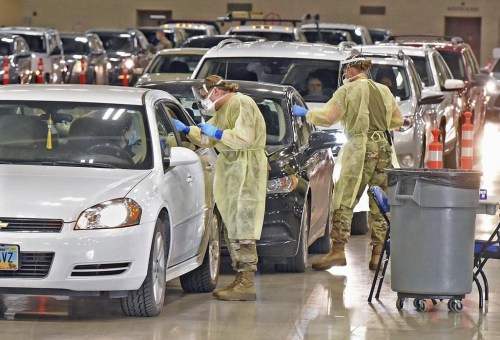
FILE - North Dakota National Guard members administer COVID-19 tests on Nov. 17, 2020, inside the Bismarck Events Center in Bismarck, N.D. The North Dakota Health Department stored thousands of COVID-19 vaccine doses at incorrect temperatures or without temperature data over the past two years, according to a state audit Tuesday, Oct, 18, 2022, that said some of the vaccine was administered to patients. (Tom Stromme/The Bismarck Tribune via AP, File)

A spokeswoman for the auditor’s office said it wasn’t recommending revaccinations.

“We simply report on what we found,” auditor’s office spokeswoman Emily Dalzell said. “It would be up to the individual and their doctor to decide if revaccination is needed.”

The state analysis said nearly 2,000 Moderna doses were stored at incorrect temperatures and were administered to patients. The audit also found that nearly 13,000 doses of the Pfizer vaccines were issued from storage with missing temperature data. The audit covered a two-year span that ended June 30. An inventory of the vaccines was conducted on Aug. 8, 2021, the audit said.

Wiedrich said the problem centered around documentation.

“We did not do the documentation to the satisfaction with the auditor’s office, which we are correcting,” he said. “We actually have changed the forms and everything.”

The audit said if vaccines are not stored correctly, there could be a need for re-vaccination, or they could be ineffective against the COVID-19 virus.

In its written response, the health department said “quality assurance procedures were in place and accurate test results were reported to the public.”

State Auditor Josh Gallion said in a statement the pandemic “brought on immeasurable challenges to all medical staff across the state. But he said “even in stressful situations it’s critical for guidelines to be followed to ensure the efficacy of vaccines.”

Report Error Submit a Tip

More Stories

Meteorologist behind Rob’s Obs is moving weather station to Ontario

Ben Waldman 7 minute read Preview

Meteorologist behind Rob’s Obs is moving weather station to Ontario

Ben Waldman 7 minute read Monday, Jun. 13, 2022

In a Winnipeg winter, there are always at least two certainties: it will be cold, and it will snow. A third certainty: the people will talk endlessly about how frigid the temperature is, and argue about how much snow is cloaking their driveways. Is it colder than it ever has been? Is there more snow today than the same time last year?

Rob Paola likely knows the answers to those questions.

Paola possesses no super powers. He is but a man with a metre stick and 40 years of professional meteorological experience, in the midst of a lifelong love affair with Mother Nature, a most turbulent mistress who rarely, if ever, reciprocates.

Each year when snow begins to fall, Paola heads outside his Charleswood home to figure out how much. He sticks his ruler in the ground, grabs his clipboard, and clicks his pen. In neat script, he records the temperature, what time precipitation began, how deep the powder is stacked. Then, he shares his data and insights online with thousands of followers who want a clear answer to the eternal questions: Why is this happening? When will it stop? How much snow has fallen in the city of Winnipeg?

Read
Monday, Jun. 13, 2022

Letters, Oct. 30

7 minute read 2:00 AM CDT

Embarrassed by turnout

I am ashamed by the poor turnout of voters in the recent municipal election in Winnipeg. Just 38 per cent of eligible voters is a disgrace to the thousands of men and women who gave their lives in past wars, where they were defending democracy and the right to vote.

My grandfather was an infantry soldier in the First World War, and my father-in-law flew in Avro Lancasters in the Second World War. For both I am grateful.

Maybe the 62 per cent that had a flimsy excuse for not voting will keep this mind for the next election. People died for our right to vote.

Just say no (to deficits during good economic times)

Tom Brodbeck 5 minute read Preview

Just say no (to deficits during good economic times)

Tom Brodbeck 5 minute read Wednesday, Oct. 2, 2019

When a political party pledges to run small, “manageable” deficits if elected, it almost always means it will go deeper into the red if it wins government.

It’s human nature.

After all, as a government, if you get the blessing of the public to spend beyond your means, what’s a few billion more a year in overspending?

The problem is, it doesn’t usually end there. When those same politicians seek re-election, they often want permission to post even larger deficits. In some cases, they’ve abandoned the idea of balancing the books altogether, arguing perpetual deficit financing is acceptable, as long as the debt doesn’t exceed a certain percentage of the economy.

Read
Wednesday, Oct. 2, 2019

The volatile U.S. midterms

Allan Levine 5 minute read Preview

The volatile U.S. midterms

Allan Levine 5 minute read 2:00 AM CDT

The last time the Democratic Party had 218 or more seats — the number required to control the U.S. House of Representatives — was from 2021 to 2023, following the election of Democrat Joe Biden as president. During that same period, the Democrats also had the edge in the Senate. Despite a 50-50 split with the Republicans, Democrats were able to control the Senate with the help of Vice-President Kamala Harris, who cast the key vote in a tie. From 2023 to 2025, the Democrats had a slim 51 to 49 Senate majority.

If history repeats itself and the latest polls are fairly accurate, on Tuesday, Nov. 3, the Democratic Party will take back the House and (probably) the Senate from the Republicans, who have controlled both legislative bodies since the 2024 election. In the House, the Democrats have to gain at least three more seats. In the Senate, they have to win four more, which is entirely doable, though they almost certainly have to win a seat in Texas, Ohio, Kansas or Alaska, each of which currently has two Republican senators.

The prospect of a Democratic victory has President Donald Trump in a tizzy. For the past two years, he has abused his executive power to impose illegal tariffs on Canada and other countries; started a war with Iran; cozied up to Russian president Vladimir Putin and turned his back on Ukrainian president Volodymyr Zelenskyy; and increased the national debt through questionable tax cuts — to list only a few of his more egregious actions. He has been able to get away with this mainly because Republicans in the Senate and the House refuse to even question his decisions.

With the Democrats in charge, Trump’s brazen actions won’t be completely halted, but he will face significant legislative challenges and obstacles not easily dismissed. His controversial appointees, such as Attorney General Todd Blanche, who perceives himself as Trump’s private lawyer rather than the legal representative of the people, won’t get a free pass in committee hearings.

Read
2:00 AM CDT

Is Canada headed for time chaos this weekend?

Michelle Bastian 5 minute read 2:00 AM CDT

When Manitoba Premier Wab Kinew declared Sept. 17 that the province would remain on permanent daylight time, he suggested it was a historical moment people would share with their “great-great-grandkids.” But, while Sunday, Nov. 1 has been heralded as the date many Canadians will stop changing their clocks, there are rumblings behind the scenes suggesting this will actually cause more trouble than ever before.

There are, of course, the warnings from chrono-biologists and sleep scientists about the damage permanent daylight time will do. The lighter evenings will mean many more dark mornings. But there is another set of problems in the offing in the critical infrastructure that underpins our digital lives.

While it used to be common to spend the Sunday morning after a time change going around our homes updating the clocks, we now wake up to devices that have already adjusted to the new time. These automatic updates occur regularly for daylight time, as well as when we travel to new time zones.

Our clocks are able to change by themselves owing to the hard work of a group of volunteers who were recently named in a list of the people who hold up the internet. This group, led by Paul Eggert, a computer scientist at UCLA, maintains a little-known tool called the Time Zone Database. Since the 1980s, it has kept track of regional, national and international debates about clock time and provided an up-to-date table of what time it should be on our walls.

Audit hits N. Dakota on vaccine handling; agency disputes it

James Macpherson, The Associated Press 3 minute read Preview

Audit hits N. Dakota on vaccine handling; agency disputes it

James Macpherson, The Associated Press 3 minute read Wednesday, Oct. 19, 2022

BISMARCK, N.D. (AP) — The North Dakota Health Department stored thousands of COVID-19 vaccine doses at incorrect temperatures or without temperature data over the past two years, according to a state audit Tuesday that said some of the vaccine was administered to patients.

The health department disputed the findings. Tim Wiedrich, who heads the agency's virus response, said “no non-viable vaccine” was given to patients. In responses that accompanied the audit, the department said clerical errors or other errors of documentation erroneously suggested that expired or bad doses were given.

“DoH uses redundant systems to ensure proper monitoring and distribution of vaccines prior to end of shelf life,” the agency said.

A spokeswoman for the auditor's office said it wasn't recommending revaccinations.

Read
Wednesday, Oct. 19, 2022