PHAC eyeing COVID-19 variant evolution as fall resurgence looms

Advertisement

Advertise with us

OTTAWA - The national public health agency is preparing for "worst-case scenario" COVID-19 variants that can evade immunity, Canada's top doctor told members of Parliament Tuesday, as early signs point to a fall resurgence of the virus.

Read this article for free:


or

Already have an account? Log in here »

To continue reading, please subscribe:

Subscribe and receive a limited-edition Free Press branded hat or tote.

Digital Subscription

One year of digital access for only $205*

  • Enjoy unlimited reading on winnipegfreepress.com
  • Read the E-Edition, our digital replica newspaper
  • Access News Break, our award-winning app
  • Play interactive puzzles

*First annual payment billed as $205.00 + GST for one year. This annual subscription will automatically renew at $233.00 + GST every 52 weeks (10% off the regular annual price of $259.35). Offer available to new and qualified returning subscribers only. Cancel any time.

To continue reading, please subscribe:

Add Free Press access to your Brandon Sun subscription for only an additional

$1 for the first 4 weeks*

  • Enjoy unlimited reading on winnipegfreepress.com
  • Read the E-Edition, our digital replica newspaper
  • Access News Break, our award-winning app
  • Play interactive puzzles
Start now

*Your next Brandon Sun subscription payment will increase by $1.00 and you will be charged $17.95 plus GST for four weeks. After four weeks, your payment will increase to $24.95 plus GST every four weeks.

Hey there, time traveller!
This article was published 18/10/2022 (1427 days ago), so information in it may no longer be current.

OTTAWA – The national public health agency is preparing for “worst-case scenario” COVID-19 variants that can evade immunity, Canada’s top doctor told members of Parliament Tuesday, as early signs point to a fall resurgence of the virus.

At the House of Commons health committee, Chief Public Health Officer Dr. Theresa Tam said the Public Health Agency of Canada is keeping a particularly careful eye on the evolution of Omicron variants, which are the most common subvariants in the country, along with any new mutations.

“We haven’t detected any very extraordinary appearances as yet, but that is a scenario that we’re planning ahead for,” Tam said during her virtual appearance at the committee.
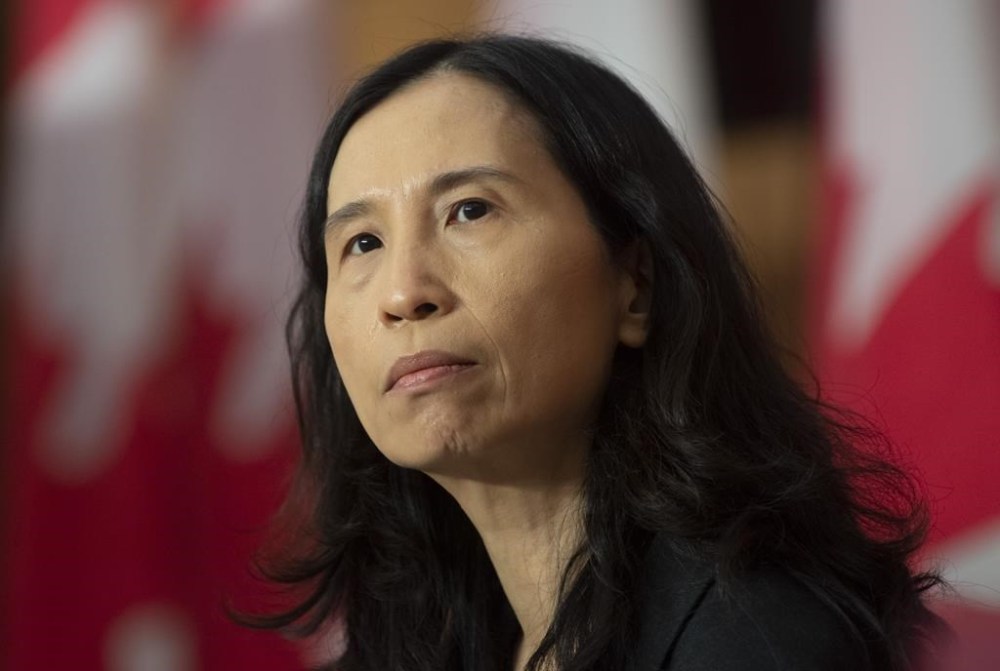
Chief Public Health Officer Theresa Tam listens to a question during a news conference Tuesday January 5, 2021 in Ottawa. Canada's chief public health officer says she is preparing for
Chief Public Health Officer Theresa Tam listens to a question during a news conference Tuesday January 5, 2021 in Ottawa. Canada's chief public health officer says she is preparing for "worst case scenario" COVID-19 variants, as early signs show a fall resurgence of the virus. THE CANADIAN PRESS/Adrian Wyld

In the early days of the pandemic, the virus would mutate in all sorts of ways because people did not have immunity from previous infections or vaccines.

Now, because the virus has been constrained, several subvariants of Omicron have begun to develop identical mutations — a phenomenon known as evolutionary convergence.

“When there’s broad population immunity, it puts pressure on the virus to find advantages, such as escaping our existing immunity,” Tam said.

The worst-case scenario, Tam said, is that eventually a variant will find a way to sidestep the effectiveness of vaccines and treatment with monoclonal antibodies.

“We haven’t detected one of those yet, but we need to be prepared for the potential,” she said.

The COVID-19 situation in Canada has remained relatively steady as of the first week of October, even as the weather has cooled and students have returned to school. Early signs are beginning to show a potential resurgence, Tam said, with the number of hospitalizations increasing in some parts of the country.

In the meantime, only 18 per cent of eligible Canadians are up-to-date on their vaccinations with a two-dose primary series and a booster within the last six months, Tam said.

“The good news is that we do have these bivalent vaccines,” which target both the original strain of COVID-19 and more recent offshoots, Tam said. So far about five per cent of eligible Canadians have received a bivalent shot.

She said the agency is working on building momentum around those new vaccines to try to increase the number of people who get the shot this fall.

But Tam took a barrage of criticism from Conservative members of the committee over her communication throughout the pandemic, as MPs charged that the public has “lost trust” in institutions like the public health agency.

If another really bad virus came along that required lockdowns and other measures, “Canadians wouldn’t listen to you,” Saskatchewan Conservative MP Randy Hoback said to Tam.

“They would say ‘Never. We’re never doing this again. We don’t trust you, we don’t listen to you.’ And we’d see then the massive deaths that would be the result.”

Alberta MP Laila Goodridge told Tam there was a disconnect between the public health agency’s advice and what she hears about daily life in rural Canada, and suggested the chief public health officer visit those places in person.

Several MPs asked Tam whether there would be a post-mortem of Canada’s COVID-19 response. Tam agreed it will be important to review and learn lessons from how the country handled the virus, but wouldn’t comment on any specific plans.

“We’ve just been through the biggest pandemic of the current era and it is very important to take note of lessons learned and be as objective as we can,” Tam said.

“It’s important to set us up well for our response going into the future, given that pandemics will occur again.”

This report by The Canadian Press was first published Oct. 18, 2022.

Report Error Submit a Tip

More Stories

Evaluating the athletic complaint process

Mac Horsburgh 4 minute read Yesterday at 2:00 AM CDT

Be careful what you wish for.

The fervent desire of our Canadian sports communities to attain objectivity in processing complaints has led to the creation of a completely unregulated industry for complaint investigations.

As it stands, professional self-regulation has been criticized for operating in its own self-interest rather than the public interest.

But now we have a new Independent Third Party (ITP) industry which operates without licensing or oversight in carrying out its duties relating to reviewing and conducting investigations into athletic complaints.

What do we elect a school trustee to do?

Laura Reimer 5 minute read Yesterday at 2:00 AM CDT

On Oct. 28, Manitobans will once again elect the people who serve on our local school boards. School trustee races rarely attract the attention given to other elections. Yet school boards are among our most immediate forms of representative democracy.

Before asking who should be a school trustee, perhaps we should ask a more basic question:

What, exactly, are we electing a school trustee to do?

Trustees are elected to govern a school division. They are not elected to run it.

Double climate whammy hits home

Editorial 4 minute read Preview

Double climate whammy hits home

Editorial 4 minute read Wednesday, Sep. 9, 2026

It’s a bit of a one-two punch.

First, the show-and-tell of what global warming could be bringing us.

Then, the fact we’ve already failed our best chance of halting climate change.

On Sept. 3, the World Meteorological Organization released its forecast of the potential effects of the rapidly-developing super El Niño phenomenon.

Read
Wednesday, Sep. 9, 2026

Is Trump about to poke Quebec’s political beehive?

Peter McKenna 5 minute read Preview

Is Trump about to poke Quebec’s political beehive?

Peter McKenna 5 minute read Yesterday at 2:00 AM CDT

When was the last time that a U.S. president seriously stirred the hornet’s nest of Quebec politics?

My best recollection is former U.S. president Bill Clinton. During the 1994 Quebec referendum campaign, Clinton made clear that the U.S. wholly endorsed a united and strong federal Canada — as opposed to a dismembered one. He went on to add that an independent Quebec would have no guarantee of joining the North American Free Trade Agreement as a full-fledged member.

Today, we see U.S. President Donald Trump inserting himself — unwittingly or wittingly — into the electoral and sovereignty politics of Quebec. It’s pretty clear that the resurgent Coalition Avenir Québec government is trying to make the Oct. 5 provincial election about anything other than its own governmental record and more about Trump’s economic coercion against Canada. Of course, the Parti Québécois, the odds-on-favourite, wants to make the electoral contest a referendum on the CAQ and its party leader, Christine Fréchette.

But what if Trump really wanted to make his presence felt in Quebec’s political life? How much influence could he have on shaping political outcomes in Quebec? How much of an “X factor” could he be?

Read
Yesterday at 2:00 AM CDT

Plenty of good money to be made at Manitoba Derby

GEORGE WILLIAMS 5 minute read Preview

Plenty of good money to be made at Manitoba Derby

GEORGE WILLIAMS 5 minute read Friday, Jul. 31, 2026

The 78th running of the $125,000 Manitoba Derby is nearly upon us, and the house will be packed on Monday evening at Assiniboia Downs for the biggest race of the year. And it’s not just the Derby people are coming for.

Monday’s racing card features a mandatory payout on the ASD 20-cent Jackpot Pick 5, which currently has a carryover of $476,656 that could swell to $2 million by post time.

Nine of the best three-year-olds in Canada have been entered for Manitoba’s signature race, and we have to agree with what track announcer Kirt Contois said at the Derby press conference on Friday: “This is one of the strongest fields ever assembled for our local Derby.”

Almost long gone are the days when you could buy or claim a potential Derby horse for $20,000 and win. It can happen, but a number of horses in this year’s Derby are coming out of races where you’d have to pay at least $100,000 to buy the winner. And even that wouldn’t guarantee success.

Read
Friday, Jul. 31, 2026

A father and son arrested last month are accused of travelling across Canada — and using courier services and Canada Post — to supply their Winnipeg drug-trafficking operation, a recent court filing shows.

Devinder Singh, 57, and his 32-year-old son Tarundev Singh, charged by Winnipeg Police Service organized crime investigators last month, are each accused of several counts of conspiracy to commit an indictable offence and related drug-trafficking offences, court records show.

Tarundev is also charged with several firearms offences.

Details of the pair’s alleged trafficking operation and the ongoing police investigation — dubbed Project Pink Panther — are contained in a lawsuit filed in the Court of King’s Bench by the provincial civil forfeiture office this week.